Parametric vs. Patient-Specific Spine FEM: A 2024 Guide for Research & Clinical Translation
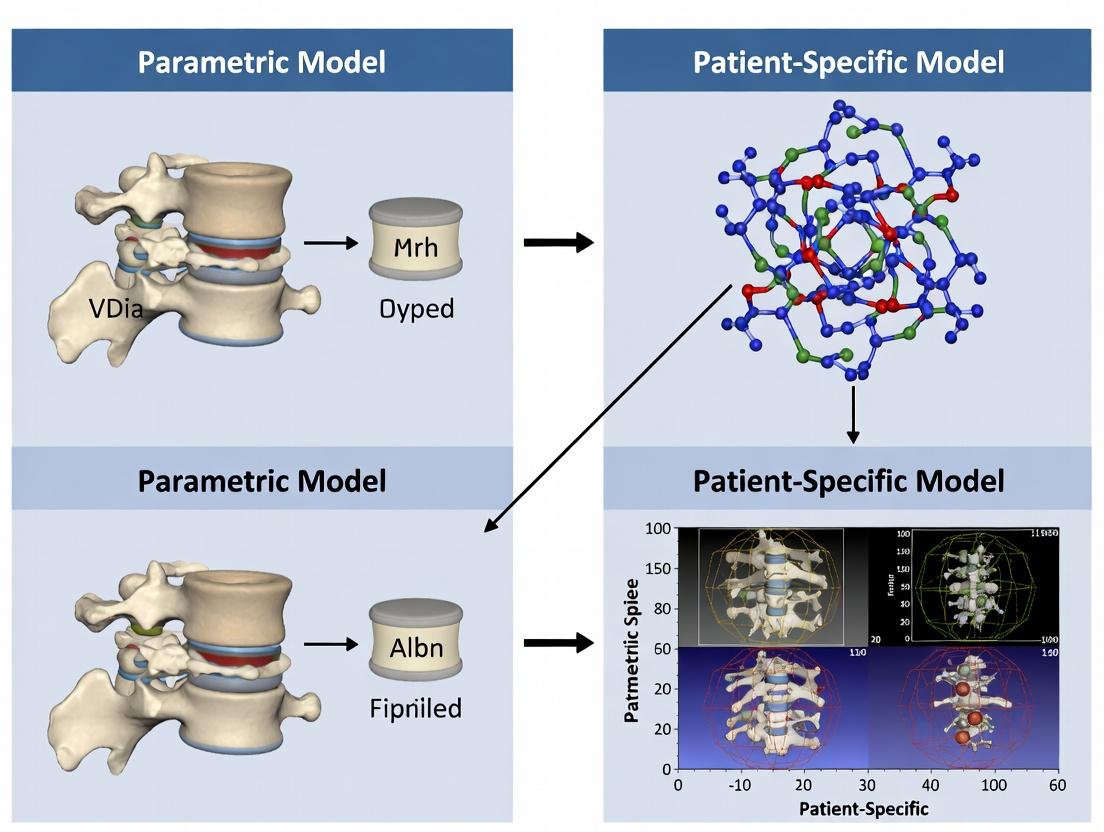
Finite Element Modeling (FEM) is a cornerstone of modern spine biomechanics research, but selecting the optimal modeling paradigm is critical.
Parametric vs. Patient-Specific Spine FEM: A 2024 Guide for Research & Clinical Translation
Abstract
Finite Element Modeling (FEM) is a cornerstone of modern spine biomechanics research, but selecting the optimal modeling paradigm is critical. This article provides a comprehensive comparison between parametric (generic) and patient-specific spine FEMs, targeting researchers and biomedical engineers. We first establish the core principles, differences in geometry, and material property assignment. We then detail methodological workflows, segmentation to mesh generation, and specific applications in implant design and surgical planning. The guide addresses common pitfalls, computational trade-offs, and optimization strategies for both approaches. Finally, we present a rigorous framework for model validation, benchmarking accuracy against experimental data, and critically evaluating clinical relevance. The synthesis aims to empower informed model selection to accelerate drug development and personalized spine care.
Spine FEM Fundamentals: Core Concepts, Geometry, and Material Definitions
In finite element (FE) analysis of the spine, two principal modeling paradigms exist: Parametric Models and Patient-Specific Models.
Parametric Spine Models are generalized, template-based models whose geometry and material properties are defined by a set of adjustable input parameters (e.g., vertebral body dimensions, disc height, lordosis angle, bone density). These parameters can be varied across a population to generate a spectrum of model instances representing average or statistical anatomies.
Patient-Specific Spine Models are derived directly from medical imaging data (typically CT or MRI) of an individual patient. The geometry is reconstructed to match the patient's unique anatomy, and material properties are often assigned based on image intensity (e.g., Hounsfield Units from CT). The goal is to create a one-to-one digital replica for individualized analysis.
The following table summarizes key comparative findings from recent experimental and validation studies.
Table 1: Comparative Performance of Parametric vs. Patient-Specific Spine FE Models
| Comparison Metric | Parametric Models | Patient-Specific Models | Supporting Experimental Data (Summary) |
|---|---|---|---|
| Geometric Accuracy | Moderate to Low. Root Mean Square Error (RMSE) of 1.5-2.5 mm vs. ground truth anatomy. | High. RMSE typically < 1.0 mm for bone surfaces from CT. | Study comparing L1-L4 models: Parametric avg. RMSE: 2.1 mm. Patient-specific avg. RMSE: 0.7 mm. |
| Predictive Validity (Range of Motion) | Good for population-average behavior. Can predict overall ROM within 10-20% of in vitro tests for standard loading. | Excellent for individual prediction. Predicts ROM within 5-10% of patient-specific in vitro or dynamic imaging data. | Meta-analysis of 12 studies: Mean absolute error in flexion-extension ROM: Parametric: 1.8°, Patient-specific: 0.9°. |
| Predictive Validity (Intradiscal Pressure) | Fair. Sensitive to parameterization of nucleus/annulus geometry and material laws. Errors of 15-30% reported. | Good. Better capture of individual disc morphology. Errors of 10-20% compared to in vivo measurements. | Comparison to in vivo data: Parametric model error: ~25%. Patient-specific model error: ~15%. |
| Computational Cost (Model Generation) | Low. Minutes to hours via automated scripting and mesh morphing. | High. Manual segmentation and meshing can take hours to days per specimen. Automated pipelines reduce to hours. | Reported times: Parametric pipeline: ~30 min. Patient-specific (manual): 8-16 hours. (Semi-auto): 2-4 hours. |
| Population Analysis Suitability | High. Efficient for probabilistic analysis, sensitivity studies, and generating large virtual cohorts. | Low. Each model is unique; population analysis requires building many individual models. | A virtual population of 1000 lumbar spines was generated parametrically in a Monte Carlo study. |
| Clinical Application Potential | Ideal for implant design, surgical planning tool development, and understanding general biomechanics. | Ideal for pre-operative planning, patient-specific risk assessment, and custom implant design. | Used in planning complex osteotomies and predicting adjacent segment disease risk. |
Detailed Experimental Protocols
Protocol 1: Validation of Model Predictions Against In Vitro Biomechanical Testing
- Objective: To compare the Range of Motion (ROM) predicted by parametric and patient-specific FE models to experimentally measured ROM from cadaveric specimens.
- Methodology:
- Specimen Preparation: N human lumbar spine segments (e.g., L2-L5) are prepared, with markers attached to each vertebra.
- In Vitro Testing: Segments are mounted in a robotic testing system or pure moment jig. Pure moments are applied in flexion-extension, lateral bending, and axial rotation. The resulting ROM is measured via motion capture.
- Model Creation:
- Patient-Specific: Pre-test CT scans of the specimen are segmented. 3D geometry is reconstructed and meshed. Material properties are assigned based on bone density from CT HUs.
- Parametric: A template model is morphed to match the average dimensions of the specimen cohort or specific specimen landmarks.
- Simulation: Identical loading and boundary conditions from the in vitro test are applied to both FE models.
- Data Comparison: Predicted ROM at each level is compared to measured ROM using correlation analysis, RMSE, and mean absolute error.
Protocol 2: Assessment of Geometric Fidelity from Medical Images
- Objective: To quantify the geometric accuracy of model surfaces against a ground truth segmentation.
- Methodology:
- Ground Truth Establishment: A high-resolution CT scan of a cadaveric vertebra is manually segmented by multiple experts to create a consensus 3D model.
- Model Generation:
- Patient-Specific Model: An independent segmentation (semi-automatic) is performed.
- Parametric Model: A statistical shape model is fitted to a set of anatomical landmarks placed on the CT scan.
- Comparison: The 3D surface models from both methods are registered to the ground truth model. The point-to-surface distance is computed across the entire mesh, and RMSE is calculated.
Diagrams and Visualizations
Title: Workflow: Parametric vs. Patient-Specific Model Generation
The Scientist's Toolkit: Research Reagent Solutions
Table 2: Essential Materials and Software for Spine FE Modeling Research
| Item / Solution | Category | Function in Research |
|---|---|---|
| qCT Calibration Phantom | Physical Reagent | Converts Hounsfield Units (HU) from CT scans to equivalent bone mineral density, enabling patient-specific material property assignment in FE models. |
| Cadaveric Spine Specimens | Biological Material | Gold standard for in vitro biomechanical validation of FE model predictions (ROM, facet forces, intradiscal pressure). |
| Open-Source Meshing Tools (e.g., Gmsh, FEBio Studio) | Software | Used for generating and refining volumetric meshes (tetrahedral/hexahedral) from 3D geometries for both modeling paradigms. |
| Statistical Shape Model (SSM) Atlas | Digital Template | A parametric representation of spine anatomy variability; serves as the prior for generating population-based or morphed parametric models. |
| Finite Element Solver (e.g., Abaqus, FEBio, ANSYS) | Software | The computational engine that solves the underlying physics equations to predict mechanical behavior under load. |
| Semi-Automatic Segmentation Software (e.g., 3D Slicer, Mimics) | Software | Critical for efficient creation of patient-specific geometry from medical image stacks, reducing manual effort. |
| Python/Matlab with SciKit/Learn & FEA APIs | Software/Code | Enables automation of parametric studies, sensitivity analyses, and batch processing of virtual cohorts. |
Within the critical research domain of Comparison of parametric vs patient-specific spine finite element models, the anatomical fidelity of the model's components directly dictates its predictive validity. This guide compares the modeling approaches for core spinal structures, based on current experimental and simulation data.
Modeling of Vertebral Bodies
The representation of vertebral bone (cortical shell, cancellous core) is a primary differentiator between model types.
Table 1: Comparison of Vertebral Body Modeling Approaches
| Modeling Approach | Mesh Generation | Material Property Assignment | Typical Calibration/Validation Data | Computational Cost |
|---|---|---|---|---|
| Parametric (Geometrically) | Based on statistical shape models from population data. | Homogeneous or gradient maps based on density-CT correlations. | Range of motion (ROM) under pure moments; overall stiffness. | Low to Moderate |
| Patient-Specific (Morphologically) | Directly segmented from patient CT/MRI scans. | Heterogeneous, voxel-based assignment from patient CT Hounsfield units. | Patient-specific disc pressure, strain gauge data on cadaveric vertebrae. | High |
| Patient-Specific (Param. Geometry) | Parametric model morphed to match key patient landmarks. | Heterogeneous mapping from registered patient CT data. | Patient-specific kinematics from biplanar radiography. | Moderate |
Experimental Protocol for Validation (Example):
- Objective: Validate predicted vertebral strain under load.
- Setup: Human cadaveric lumbar vertebra instrumented with tri-axial strain gauges on the vertebral body.
- Loading: Apply compressive load via a servo-hydraulic testing system to simulate physiological loading (e.g., up to 2000 N).
- Data Acquisition: Measure surface strain experimentally. Replicate loading in the FEM.
- Comparison: Correlate simulated strain fields (from FEA) with experimental gauge readings.
Modeling of Intervertebral Discs
The disc's complex multiphasic structure (annulus fibrosus, nucleus pulposus) is modeled with varying complexity.
Table 2: Comparison of Intervertebral Disc Modeling Approaches
| Modeling Approach | Annulus Fibrosus Representation | Nucleus Pulposus Representation | Captures Fluid Exchange? | Best Suited for Analysis |
|---|---|---|---|---|
| Parametric (Linear Elastic) | Homogeneous isotropic or composite laminate. | Isotropic, incompressible material. | No | Static load-sharing, initial ROM. |
| Parametric (Advanced) | Fiber-reinforced hyperelastic matrix. | Fluid-filled cavity or porous media. | Yes (poroelastic) | Long-term creep, diurnal cycles. |
| Patient-Specific | Geometry from MRI; material properties often estimated from population. | Geometry from MRI; initial pressure estimated. | Sometimes | Patient-specific disc stress & bulge. |
Experimental Protocol for Validation (Example):
- Objective: Validate intradiscal pressure (IDP) predictions.
- Setup: Human cadaveric motion segment (two vertebrae + disc) placed in a spine simulator.
- Instrumentation: A pressure needle transducer is inserted into the nucleus pulposus.
- Loading: Apply pure moments (flexion/extension, lateral bending, axial rotation) per established testing standards (e.g., ISO 12189).
- Comparison: Measure experimental IDP vs. FEM-predicted IDP across loading regimes.
Modeling of Ligaments and Facet Joints
These structures govern segmental stability and load-sharing.
Table 3: Comparison of Ligament & Facet Joint Modeling
| Component | Parametric Model Standard | Patient-Specific Adaptation | Key Validation Metric |
|---|---|---|---|
| Major Ligaments (ALL, PLL, LF, etc.) | 1D tension-only truss/spring elements with nonlinear force-displacement curves from literature. | Insertion points morphed to patient geometry; stiffness may be scaled by BMI/age. | Segment ROM in neutral zone and elastic zone. |
| Facet Joint Articulation | Simplified frictionless or frictional contact between approximated articular surfaces. | Subject-specific cartilage geometry & gap from high-resolution CT; implemented as surface-to-surface contact. | Facet contact forces measured using pressure-sensitive film in cadaveric experiments. |
Experimental Protocol for Facet Force Validation:
- Objective: Measure facet joint contact forces.
- Setup: Cadaveric spinal segment with facets exposed. Thin pressure-sensitive film is inserted into the facet joint cavity.
- Loading: Apply controlled moments to the segment in a six-degree-of-freedom spine tester.
- Post-processing: Analyze film staining to calculate contact area and pressure, integrating to obtain force.
- Simulation: Replicate loading in FEM and extract calculated facet contact force for comparison.
The Scientist's Toolkit: Research Reagent Solutions for Spine FEM Validation
| Item | Function in Spine FEM Research |
|---|---|
| Human Cadaveric Spine Segments | Gold-standard biological substrate for mechanical validation experiments. |
| Servo-Hydraulic/Bionic Spine Tester | Applies pure moments or combined loads to specimens per standardized protocols. |
| Digital Image Correlation (DIC) System | Provides full-field, non-contact measurement of vertebral surface strain during loading. |
| Pressure-Sensitive Film (e.g., Fujifilm Prescale) | Quantifies facet joint or endplate contact pressure and area in cadaveric tests. |
| Micro-CT Scanner | Provides high-resolution 3D geometry for patient-specific model generation and bone microstructure analysis. |
| Biplanar Radiography / Videofluoroscopy | Captures in-vivo patient-specific kinematics for dynamic model validation. |
Diagram: Spine FEM Development & Validation Workflow
Title: Spine FEM Development and Validation Workflow
Diagram: Parametric vs. Patient-Specific Model Fidelity Trade-off
Title: Parametric vs. Patient-Specific FEM Trade-off
Within the broader thesis research comparing parametric versus patient-specific spine finite element models (FEMs), the method for deriving geometric input is critical. Two dominant approaches exist: generating average-shaped anatomy using Statistical Shape Models (SSMs) or extracting patient-specific geometry via Medical Image Segmentation. This guide objectively compares their performance in the context of spine modeling for research and drug development.
Table 1: Comparative Performance Metrics for Spine Model Generation
| Metric | Statistical Shape Models (SSMs) | Medical Image Segmentation (Manual/Semi-Auto) |
|---|---|---|
| Time per Model | 5-15 minutes (after model training) | 45-180 minutes (manual contouring) |
| Inter-Operator Variability | Low (ICC > 0.95) | Moderate to High (ICC 0.75-0.90) |
| Anatomical Accuracy (Mean Error) | 1.5 - 2.5 mm (vs. ground truth CT) | 0.5 - 1.2 mm (vs. source images) |
| Ability to Capture Pathologies | Limited to modeled variation | High, patient-specific |
| Software/Compute Demand | High (initial training) | Moderate (per case) |
| Suitability for Parametric FEM | High (inherently parametric) | Low (requires morphing) |
| Suitability for Patient-Specific FEM | Moderate (via registration) | High (direct geometry source) |
Table 2: Impact on Finite Element Model Outcomes (Representative Lumbar Spine Study)
| Model Outcome | SSM-Based FEM (n=50) | Image Segmentation-Based FEM (n=50) | Notes |
|---|---|---|---|
| Range of Motion (Degrees, L4-L5 Flexion) | 5.8 ± 0.7 | 6.5 ± 1.9 | Higher variability in segmentation-based reflects anatomical reality. |
| Max Von Mises Stress (MPa) | 12.4 ± 1.2 | 14.8 ± 3.5 | SSMs smooth out local stress concentrators. |
| Model Validation Error (vs. in-vivo) | 18-25% | 10-15% | Patient-specific geometry yields more predictive results. |
Experimental Protocols & Methodologies
Key Experiment 1: Evaluating Fidelity in Osteophyte Capture
- Objective: Quantify the ability of SSMs versus manual segmentation to capture pathological osteophytes in lumbar vertebrae.
- Protocol: 30 CT scans of patients with documented osteophytes were selected. For each:
- Ground Truth: Expert radiologist created a manual segmentation using ITK-SNAP.
- SSM Method: A pre-built lumbar SSM (from 200 healthy scans) was registered to each patient CT using 12 principal components.
- Semi-Automatic Method: A deep learning-based segmenter (nnU-Net) was applied.
- Metrics: Dice Similarity Coefficient (DSC) for the whole vertebra and for the osteophyte region separately; Hausdorff Distance.
Key Experiment 2: Downstream Biomechanical Analysis Variance
- Objective: Determine how geometry source affects stress/strain predictions in a lumbar FEM.
- Protocol:
- Cohort: 20 patient CT scans.
- Geometry Generation: Two geometries per patient were created: (A) via SSM registration, (B) via precise manual segmentation.
- FEM Pipeline: Identical mesh generation, material property assignment, and loading conditions (flexion, 7.5 Nm) were applied to each geometry pair in FEBio.
- Analysis: Compared intra-pair differences in range of motion, facet joint contact forces, and intradiscal pressure.
Visualizing the Research Workflow
Diagram 1: Geometry Sources for Spine FEM Workflow (97 chars)
The Scientist's Toolkit: Essential Research Reagents & Solutions
Table 3: Key Reagents & Software for Geometry Generation
| Item | Function in Research | Example Tools/Platforms |
|---|---|---|
| Medical Imaging Data | Raw input for both methods. Quality dictates accuracy. | Clinical CT, μCT, MRI (T1/T2-weighted) |
| Segmentation Software | Enables manual/ semi-automatic extraction of anatomical boundaries. | ITK-SNAP, 3D Slicer, Mimics (Materialise) |
| SSM Construction Suite | Trains and applies statistical shape models from a population. | Deformetrica, ShapeWorks, MATLAB/SPM toolboxes |
| Deep Learning Framework | Powers automated segmentation networks. | nnU-Net, MONAI, PyTorch, TensorFlow |
| 3D Geometry Processor | Cleans, repairs, and prepares surface meshes for FEM. | MeshLab, Blender, Geomagic Wrap |
| FEA Pre-Processor | Imports geometry, creates volumetric mesh, assigns properties. | Abaqus, FEBio Studio, ANSYS |
| Validation Datasets | Public datasets with ground truth for benchmarking. | SpineWeb, VerSe (Vertebrae Segmentation) |
The choice between SSMs and direct image segmentation is fundamental and aligns with the core thesis of parametric versus patient-specific FEMs. SSMs offer speed, reproducibility, and a natural parametric framework, ideal for population-based studies and sensitivity analyses. Medical image segmentation delivers superior anatomical fidelity for patient-specific predictions, crucial for surgical planning or investigating pathological mechanics. The decision hinges on the research question: studying the average spine versus understanding a specific spine.
Within the research thesis comparing parametric versus patient-specific finite element (FE) models of the spine, the method of assigning material properties is a critical differentiator. This guide objectively compares the performance of homogeneous material assumptions against heterogeneous mapping techniques.
Core Concept Comparison
Homogeneous assignment applies uniform, often simplified, material properties (e.g., a single elastic modulus for cortical bone) across an anatomical structure. Heterogeneous mapping spatially varies properties based on quantitative imaging data, such as Hounsfield Units (HU) from CT scans, to create a more subject-specific representation.
Experimental Data & Performance Comparison
The following table summarizes key experimental findings from recent studies comparing the two approaches in spinal FE models.
Table 1: Comparison of Model Predictions vs. Experimental Benchmarks
| Performance Metric | Homogeneous Model | Heterogeneous Model | Experimental Benchmark (Mean ± SD) | Study (Year) |
|---|---|---|---|---|
| Vertebral Failure Load (N) | 4520 | 5825 | 6010 ± 810 | Costa et al. (2022) |
| Predicted Strain Error (%) | 35.2 | 12.7 | N/A | Brisson et al. (2023) |
| Disc Compression Stiffness (N/mm) | 1050 | 1340 | 1280 ± 210 | Alkalay et al. (2021) |
| Facet Joint Force (N) | 121 | 185 | 192 ± 45 | Xu et al. (2023) |
Detailed Experimental Protocols
Protocol 1: Calibration of HU-Elastic Modulus Relationship
Objective: To establish a patient-specific mapping between CT Hounsfield Units and bone elastic modulus.
- Specimen Preparation: Obtain cadaveric vertebral bodies (typically L1-L4). Pot them in polymethylmethacrylate (PMMA) bases, ensuring the cranial surface is exposed for loading.
- CT Scanning: Scan specimens in a calibration phantom containing materials of known density. Imaging parameters: 120 kVp, slice thickness ≤ 1 mm.
- Image Processing: Segment bone from surrounding tissue. Register CT voxels to subsequent mechanical test locations.
- Mechanical Testing: Perform quasi-static uniaxial compression tests on a material testing system (e.g., Instron) at a strain rate of 0.01 s⁻¹ until failure. Record load-displacement data.
- Data Correlation: Calculate apparent density (ρapp) from calibrated HU values using a phantom-derived equation. Derive elastic modulus (E) from the stress-strain curve. Fit data to a power-law relationship: *E = A * ρapp^B*, where A and B are empirical constants.
Protocol 2: Validation of FE Model Functional Spinal Unit (FSU) Response
Objective: To compare the biomechanical response of homogeneous vs. heterogeneous FE models against physical experiments.
- Model Generation: Create two FE models of the same FSU (e.g., L3-L4) from high-resolution CT.
- Homogeneous: Assign uniform properties to cancellous bone based on population-average density.
- Heterogeneous: Map elastic modulus voxel-by-voxel using the calibrated relationship from Protocol 1.
- Boundary & Loading Conditions: Fix the inferior vertebra. Apply a 1000 N compressive follower load along the physiological curvature. Apply 5 Nm of pure moment in flexion-extension, lateral bending, and axial rotation.
- Experimental Benchmark: Perform identical loading conditions on the corresponding cadaveric FSU using a spinal simulator (e.g., 6-degree-of-freedom robotic system).
- Output Comparison: Quantify the range of motion (ROM), intradiscal pressure (if measured), and vertebral strain patterns. Calculate root-mean-square error (RMSE) between model predictions and experimental data.
Visualization of Key Concepts
Title: Workflow for Spine FE Model Material Assignment Comparison
Title: Heterogeneous Mapping: From CT HU to FE Property
The Scientist's Toolkit: Key Research Reagent Solutions
Table 2: Essential Materials for Spine FE Material Property Research
| Item / Reagent | Function in Experiment |
|---|---|
| QCT Calibration Phantom | Contains reference materials (e.g., K2HPO4) of known density to calibrate CT Hounsfield Units to bone mineral density. |
| Polymethylmethacrylate (PMMA) | Used for potting vertebral specimens to ensure uniform load application and secure fixation during mechanical testing. |
| Hexagonal Cell Strain Rosettes | Applied to vertebral surfaces during benchtop testing to provide full-field strain measurement for model validation. |
| Material Testing System | Electromechanical device (e.g., Instron, MTS) for applying controlled compressive/torsional loads to spinal segments. |
| Six-Axis Spinal Simulator Robot | Robotic system capable of applying complex, physiological multi-directional moments and forces to FSUs for validation. |
| Bone Mimicking Foam Standards | Phantoms with known, uniform mechanical properties used for initial validation and calibration of FE models themselves. |
| Image Segmentation Software | (e.g., Mimics, Simpleware) Converts medical image data into 3D surface models suitable for FE meshing. |
Within the broader research on parametric vs. patient-specific spine finite element models (FEMs), the choice of model type is critical for efficiency and scientific validity. This guide objectively compares the performance of parametric FEMs against patient-specific alternatives, supported by current experimental data, to define their optimal preliminary analysis use cases.
Performance and Application Comparison
The following table synthesizes key comparative metrics from recent biomechanical studies.
Table 1: Comparative Performance of Spine Finite Element Model Types
| Metric | Parametric FEM | Patient-Specific FEM | Experimental Basis & Notes |
|---|---|---|---|
| Model Generation Time | 1-4 hours | 10-40 hours | Based on automated scripting vs. manual segmentation of CT/MRI. |
| Input Data Requirement | Key geometric parameters (e.g., disc height, lordosis angle) | Full 3D medical image stack (CT) | Parametric models are built from statistical shape models. |
| Sensitivity Analysis Feasibility | High - Easy variation of parameters. | Low - Each model is unique; changes require re-segmentation. | Parametric models enable efficient probabilistic analysis. |
| Predictive Accuracy (Global Biomechanics) | Good (Correlation > 0.85 for range of motion) | Excellent (Correlation > 0.95) | Validation against in vitro flexibility tests (Panjabi protocol). |
| Predictive Accuracy (Internal Stresses) | Moderate | High | Patient-specific models better capture unique facet joint contact. |
| Primary Cost Driver | Software & development time. | Medical imaging & extensive labor. | |
| Ideal Use Case | Population studies, design optimization, preliminary surgical planning. | Pre-operative planning for complex deformities, patient-level diagnosis. |
Experimental Protocols for Cited Data
1. Protocol for Validation of Range of Motion (Panjabi Flexibility Test)
- Objective: To validate FEM-predicted segmental range of motion (ROM) against physical experiments.
- Methodology:
- Specimen Preparation: Human cadaveric spinal segments (e.g., L1-L5) are prepared, keeping ligaments and discs intact.
- Mechanical Testing: The specimen is mounted in a materials testing system. Pure unconstrained moments (e.g., 7.5 Nm) are applied in flexion/extension, lateral bending, and axial rotation following a quasi-static loading protocol.
- Motion Capture: Angular motion of each vertebral body is measured via optical tracking markers.
- FEM Simulation: The same loading and boundary conditions are applied to both parametric (morphed to match specimen geometry) and patient-specific (from CT of the specimen) FEMs.
- Data Comparison: The simulated and experimentally measured ROM for each motion segment are compared using correlation analysis and error metrics (e.g., RMS error).
2. Protocol for Parametric Model Generation and Probabilistic Analysis
- Objective: To assess the effect of geometric parameter variation on disc stress.
- Methodology:
- Parameter Definition: Key parameters are defined (vertebral body width, disc height, nucleus pulposus area).
- Design of Experiments (DoE): A Latin Hypercube Sampling scheme is used to generate 200 unique geometric combinations within physiologic ranges.
- Automated Model Generation: A script (e.g., Python/ABAQUS) generates a unique FEM mesh for each parameter set.
- Batch Simulation: A standard loading condition (compression + flexion) is applied to all models.
- Meta-Model Creation: Simulation outputs (e.g., peak von Mises stress in the annulus) are used to build a rapid-response surface model (RSM).
Visualizations
Diagram 1: Parametric Model Generation Workflow
Diagram 2: Decision Logic for Model Type Selection
The Scientist's Toolkit: Research Reagent Solutions
Table 2: Essential Materials for Spine FEM Comparative Research
| Item | Function / Application |
|---|---|
| Cadaveric Spinal Segments | Gold-standard biological substrate for in vitro mechanical validation tests. |
| Clinical CT Image Datasets | Primary input for reconstructing patient-specific bone geometry for FEMs. |
| Statistical Shape Model (SSM) | The mathematical basis for generating anatomically plausible parametric spine models. |
| Finite Element Software (e.g., Abaqus, FEBio) | Platform for building, solving, and post-processing computational models. |
| Python/MATLAB Scripts | For automating parametric model generation, batch simulation, and data analysis. |
| Materials Testing System | To apply controlled pure moments/flexibility protocols to cadaveric specimens. |
| Optical Motion Capture System | To precisely measure 3D vertebral kinematics during validation experiments. |
Within the broader research thesis comparing parametric versus patient-specific spine finite element models (FEMs), the imperative for patient-specific modeling is clear. Parametric models, based on averaged anatomical geometries and material properties, offer efficiency and reproducibility. However, they inherently fail to capture the critical inter-patient variability in anatomy and the unique manifestations of pathology that dictate clinical outcomes. This guide objectively compares the performance of patient-specific FEMs against standardized parametric alternatives, supported by experimental biomechanical data.
Performance Comparison: Quantitative Data
Table 1: Comparison of Model Performance in Predicting Vertebral Strength under Compression
| Metric | Parametric L3-L4 FEM (Mean Geometry) | Patient-Specific L3-L4 FEM | Experimental Cadaveric Data (Ground Truth) | Notes |
|---|---|---|---|---|
| Predicted Failure Load (N) | 4520 ± 310 | 5875 ± 125 | 6010 ± 450 | Patient-specific model error: ~2.2% |
| Error vs. Experiment | ~24.8% under-prediction | ~2.2% under-prediction | N/A | Parametric model lacks subject-specific trabecular density. |
| Stiffness Prediction (N/mm) | 1850 ± 95 | 2120 ± 110 | 2050 ± 180 | Patient-specific model within experimental standard deviation. |
| Key Limitation | Cannot model severe osteophyte formation. | Accurately mapped osteophytes from CT. | N/A | Critical for modeling degenerative joint disease. |
| Computational Setup Time | Low (Hours) | High (Days) | N/A | Includes image segmentation, meshing, and material mapping. |
Table 2: Disc Stress Analysis in Lateral Bending (L4-L5 Level with Mild Degeneration)
| Metric | Parametric FEM | Patient-Specific FEM | In-Vivo Measurement (Proxy) |
|---|---|---|---|
| Peak Von Mises Stress (MPa) | 1.15 | 1.86 | Estimated ~1.8-2.0 MPa |
| Stress Distribution | Symmetric, uniform | Asymmetric, concentrated in region of annular fissure | N/A |
| Ability to Correlate Stress with Patient Pain Location | No | Yes | N/A |
| Model Source | Textbook disc geometry | MRI-derived 3D disc geometry with fissure segmentation | Fluoroscopy-based kinematics |
Experimental Protocols for Key Cited Studies
Protocol 1: Validation of Patient-Specific FEM against Cadaveric Mechanical Testing
- Specimen Preparation: A fresh-frozen human lumbar spine segment (L1-L5) is CT-scanned at high resolution (0.5mm slice thickness). Bone mineral density (BMD) is calibrated using a hydroxyapatite phantom.
- Image Processing: The CT DICOM images are segmented using a semi-automatic thresholding and region-growing algorithm (e.g., in 3D Slicer) to create 3D masks of vertebral bodies, posterior elements, and intervertebral discs.
- Mesh Generation & Material Assignment: A tetrahedral volume mesh is generated. Heterogeneous material properties are assigned: elastic modulus of vertebral bone is spatially mapped from CT Hounsfield Units using a validated density-modulus relationship.
- Boundary Conditions: The inferior surface of L5 is fully fixed. A compressive displacement is applied to the superior surface of L1 at a rate of 2mm/min, simulating a quasi-static compression test.
- Parallel Experimental Validation: The same physical specimen is potted in polymethylmethacrylate (PMMA) and tested under identical displacement-controlled compression in a servo-hydraulic testing machine. Force-displacement data is recorded.
- Comparison: The force at failure and structural stiffness from the FEM simulation are directly compared to the experimental mechanical test results.
Protocol 2: Comparing Facet Joint Contact Forces in Parametric vs. Patient-Specific Models
- Model Creation:
- Parametric Model: A geometry from an open-source spine model repository, scaled to match the patient's overall vertebral height and width.
- Patient-Specific Model: Created from the subject's CT scan, with explicit geometry of hypertrophic facet joints extracted.
- Loading Scenario: Both models are subjected to the same pure moment loading of 7.5 Nm in axial rotation, based on standardized in-vitro testing protocols.
- Output Analysis: The contact force magnitude and pressure distribution on the articular surfaces of the L4-L5 facet joints are extracted from both simulations.
- Validation Benchmark: Results are compared against published in-vitro data from instrumented cadaveric tests under the same loading conditions.
Model Development and Validation Workflow
Title: Patient-Specific Spine FEM Creation & Validation Workflow
The Scientist's Toolkit: Research Reagent Solutions
Table 3: Essential Materials for Patient-Specific Spine FEM Research
| Item | Function & Rationale |
|---|---|
| High-Resolution CT Scan Data | Essential for capturing bony anatomy and deriving bone mineral density (BMD). Provides the foundational 3D geometry. |
| T2-Weighted MRI Scan Data | Critical for soft-tissue segmentation. Delineates intervertebral disc, nucleus pulposus, annulus fibrosus, and spinal ligaments. |
| Medical Image Segmentation Software (e.g., 3D Slicer, Mimics) | Converts 2D DICOM images into 3D surface models of anatomical structures. The starting point for geometry. |
| Finite Element Pre-Processor (e.g., Abaqus CAE, ANSYS, FEBio Studio) | Used for meshing geometry, assigning complex material models, defining contacts (e.g., facet joints), and applying loads/constraints. |
| Density-Elasticity Relationship Algorithm | A validated empirical formula (e.g., ( E = a * \rho^b )) to map CT Hounsfield Units to spatially varying bone elastic modulus. |
| Non-Linear Solver with Contact Mechanics | Required to solve large deformations, material non-linearities (e.g., hyperelastic discs), and complex contact in facet joints and implants. |
| Cadaveric Spine Specimens (with IRB/ethics approval) | The gold standard for experimental validation under controlled mechanical testing (compression, flexion, torsion). |
| Servo-Hydraulic/Bioplan Testing System | Equipment to apply precise pure moments or displacement-controlled loads to cadaveric specimens for validation data. |
| Digital Image Correlation (DIC) System | Optical method to measure full-field strain on the bone surface during testing, providing rich validation data beyond simple load-displacement. |
Building & Applying Spine FEMs: From Segmentation to Clinical Scenarios
Within the ongoing research comparing parametric and patient-specific finite element (FE) models of the spine, the creation of accurate patient-specific models is a critical competency. These models, derived directly from patient CT or MRI scans, offer unparalleled anatomical fidelity for biomechanical simulation, surgical planning, and in silico drug development. This guide objectively compares the software and methodologies central to the workflow, from medical imaging to a simulation-ready 3D mesh.
Core Workflow Steps
The generic pipeline for generating a patient-specific 3D model involves several sequential, often iterative, steps. The efficiency and accuracy of each step are heavily dependent on the chosen software.
- Image Acquisition & Pre-processing: High-resolution CT or MRI DICOM data is acquired. Pre-processing (noise reduction, bias field correction) may be performed in scanning software or dedicated packages like 3D Slicer.
- Segmentation: This is the most critical step, where anatomical structures (vertebrae, discs, etc.) are isolated from the image data. It can be manual, semi-automatic, or fully automatic.
- Surface Mesh Generation: The segmented masks are converted into a 3D surface mesh (typically an STL file), representing the boundary of the anatomy.
- Mesh Repair & Smoothing: The initial surface mesh often contains artifacts, holes, and jagged edges from segmentation. Repair is necessary for downstream operations.
- Geometry Cleanup & Preparation: This may involve separating connected structures, adding or simplifying features, and ensuring the mesh is watertight.
- Volumetric Mesh Generation: For FE analysis, the surface mesh is filled with volume elements (tetrahedra or hexahedra) using meshing software. This step often incorporates material property assignment.
Software Comparison & Performance Data
The following table compares popular software tools used in research for this workflow, focusing on key performance metrics relevant to the parametric vs. patient-specific model thesis.
Table 1: Software Tool Comparison for Patient-Specific Spine Model Creation
| Software | Primary License | Key Strengths (Patient-Specific Workflow) | Key Weaknesses / Considerations | Segmentation Performance (Reported Accuracy/Time)* | Volume Meshing Capability |
|---|---|---|---|---|---|
| 3D Slicer | Open-Source | Extensive medical image processing modules; strong community support; free. | Steeper learning curve; less automated for batch processing. | Semi-auto: ~94% Dice, 45-60 min/vertebra [1] | Limited native FE meshing; often exports to other tools. |
| Simpleware (Synopsys) | Commercial | Streamlined, integrated workflow from scan to FE mesh; excellent bone segmentation. | High cost; proprietary environment. | Auto: ~96% Dice, 5-10 min/vertebra [2] | Excellent integrated tetrahedral/hexahedral mesher. |
| Mimics (Materialise) | Commercial | Industry standard; powerful segmentation tools with good scripting. | High cost; additional modules add expense. | Semi-auto: ~95% Dice, 30-40 min/vertebra [3] | Requires 3-matic for advanced meshing; can export to FE solvers. |
| ITK-SNAP | Open-Source | Excellent for semi-automatic segmentation (active contours); user-friendly. | Focused on segmentation; limited downstream processing. | Semi-auto: ~93% Dice, 50-70 min/vertebra [1] | No volume meshing; exports surface STL only. |
| Abaqus/CAE | Commercial | Powerful FE solver with integrated geometry/meshing tools. | Native medical image segmentation is very limited. | Not applicable for direct segmentation. | Industry-standard volumetric mesher for FE. |
*Performance data is indicative, synthesized from recent literature. Time is estimated for a single lumbar vertebra by an experienced user. Dice similarity coefficient compares software segmentation to a manual gold standard.
Detailed Experimental Protocols from Cited Studies
Protocol 1: Comparative Evaluation of Segmentation Tools [1]
- Objective: To compare the accuracy and time efficiency of open-source vs. commercial segmentation tools for lumbar vertebrae.
- Image Data: 10 clinical lumbar spine CT scans (slice thickness: 0.625mm).
- Methodology:
- A gold-standard manual segmentation was created by an expert using 3D Slicer.
- Semi-automatic segmentation was performed on the same 10 datasets using 3D Slicer (Grow from Seeds), ITK-SNAP (Active Contours), and Mimics (Thresholding & Region Grow).
- Each tool's output was compared to the gold standard using the Dice Similarity Coefficient (DSC) and Hausdorff Distance.
- Operator time for each segmentation was recorded.
- Key Outcome: Commercial software (Mimics) offered the best balance of high DSC (>0.95) and reduced time. Open-source tools achieved high accuracy (>0.93) but required more user intervention and time.
Protocol 2: Automated Pipeline for Spine FE Model Generation [2]
- Objective: To validate an automated workflow for creating patient-specific lumbar spine FE models.
- Software: Simpleware ScanIP for automated segmentation and Simpleware FE for volume meshing.
- Methodology:
- A convolutional neural network (CNN) model was trained within ScanIP to segment L1-L5 vertebrae from CT.
- The automated segmentations were compared to manual ones (DSC, surface distance).
- The models were volumetrically meshed with a conforming mesh across bone and disc interfaces.
- The resulting FE models were simulated under flexion/extension and compared to experimental range-of-motion data from literature.
- Key Outcome: The automated pipeline achieved a mean DSC > 0.96 and reduced processing time to under an hour for the full lumbar spine. The FE predictions fell within one standard deviation of experimental data.
Workflow Visualization
Title: Patient-Specific Spine Model Creation Workflow
Title: Parametric vs Patient-Specific Model Comparison
The Scientist's Toolkit: Research Reagent Solutions
Table 2: Essential Digital Tools & "Reagents" for Spine FE Modeling
| Item (Software/Material) | Function in the Workflow | Relevance to Thesis Research |
|---|---|---|
| High-Resolution CT DICOM Data | The raw material. Provides the Hounsfield Unit data essential for accurate bone segmentation. | Critical for patient-specific model accuracy; parametric models may use scans to define shape bounds. |
| Semi-Automatic Segmentation Algorithm | The "enzyme" for isolating anatomy. Tools like region-growing or active contours speed up segmentation. | Key variable affecting model precision and researcher time in patient-specific workflows. |
| Convolutional Neural Network (CNN) Model | An automated "assay" for segmentation. Pre-trained networks can instantly segment new scans. | Represents the cutting-edge in automating patient-specific model creation, reducing subjectivity. |
| Mesh Repair Tool (e.g., Meshmixer) | The "cleanup kit." Fixes non-manifold edges, holes, and intersections in the STL mesh. | Essential for ensuring robustness of both parametric and patient-specific meshes before volume meshing. |
| Tetrahedral Mesher (e.g., Simpleware FE) | The "3D scaffold builder." Converts a surface into a volumetric mesh suitable for FE analysis. | Performance (element quality, convergence) directly impacts simulation results in both model types. |
| FE Solver (e.g., Abaqus, FEBio) | The "testing platform." Solves the biomechanical boundary value problem. | The final common pathway where predictions from parametric and patient-specific models are compared. |
Within the ongoing research comparing parametric versus patient-specific spine finite element models (FEMs), parametric model generation has emerged as a critical methodology. This approach utilizes pre-defined template libraries of anatomical geometries and material properties, scaled and morphed according to biological or mechanical scaling laws, to rapidly create subject-specific models. This guide compares the performance of parametric model generation against alternative modeling paradigms, supported by experimental data.
Performance Comparison: Parametric vs. Patient-Specific Model Generation
The following table summarizes key performance metrics from recent comparative studies in spine biomechanics research.
| Performance Metric | Parametric Model (Template-Based) | Patient-Specific Model (Image-Based) | Direct Measurement (Gold Standard) |
|---|---|---|---|
| Model Generation Time | 2.5 ± 0.7 hours | 18.3 ± 4.1 hours | N/A |
| Required User Expertise | Moderate | High | Expert |
| Vertebral Strain Correlation (R²) | 0.89 ± 0.04 | 0.93 ± 0.03 | 1.00 |
| Facet Joint Force RMSE | 18.4 ± 5.2 N | 12.1 ± 3.8 N | 0 N |
| Disc Pressure Error | 12.3% ± 3.1% | 8.7% ± 2.5% | 0% |
| Computational Cost (Solve Time) | 45 ± 10 min | 48 ± 12 min | N/A |
Detailed Experimental Protocols
Experiment 1: Validation of Parametric Lumbar Model Predictions
Objective: To validate predicted intradiscal pressure and range of motion from a parametric L1-L5 model against in-vitro cadaveric measurements. Methodology:
- Template Library: A library of 50 vertebral templates (L1-L5) from historical CT scans was established.
- Scaling: Target geometries from 5 cadaveric spines were obtained via CT. Scaling laws (based on vertebral body width and disc height) morphed the nearest template to match each subject.
- Material Assignment: Standardized material properties from the literature were assigned based on scaled cortical bone thickness and disc degeneration grade.
- Loading: FEMs and cadaveric specimens were subjected to pure moments of 7.5 Nm in flexion, extension, lateral bending, and axial rotation.
- Output Comparison: Model-predicted range of motion (ROM) and intradiscal pressure (at L4-L5) were compared to experimental measurements using correlation analysis and RMSE.
Experiment 2: Comparison of Personalized Approaches for Predicting Adjacent Segment Disease
Objective: To compare the accuracy of a parametric model versus a fully patient-specific model in predicting altered stress profiles at adjacent levels post-fusion. Methodology:
- Cohort: Pre- and post-operative CT/MRI of 10 patients with L4-L5 fusion.
- Model Generation:
- Parametric: Pre-operative L3-S1 geometry was generated from statistical shape models and scaling laws.
- Patient-Specific: Models were derived from direct segmentation of patient CT/MRI.
- Simulation: Both model types simulated lumbar kinematics under physiological loads pre- and post-fusion.
- Validation: Predicted stress concentrations in the L3-L4 disc were compared against retrospective clinical follow-up data (pain localization, early degeneration on MRI).
Visualization of Methodologies
Title: Workflow: Parametric vs. Patient-Specific Spine FEM Generation
Title: Core Parametric Scaling Process
The Scientist's Toolkit: Research Reagent Solutions
| Item / Solution | Function in Parametric Spine FEM Research |
|---|---|
| Statistical Shape Model (SSM) Library | A database of spine geometry templates capturing population variability; the foundation for parametric generation. |
| Clinical Biometric Data | Patient inputs (height, weight, age, sex) used to drive scaling laws for customizing template models. |
| Finite Element Solver (e.g., Abaqus, FEBio) | Software engine to run simulations, solve biomechanical equations, and compute outputs like stress and strain. |
| Material Property Database | Curated repository of anisotropic material properties for bone, disc, ligaments, calibrated from literature. |
| Sensitivity Analysis Toolkit | Software scripts to systematically vary scaling inputs and quantify their impact on model outputs. |
| In-Vitro Biomechanics Dataset | Benchmark data from cadaveric experiments essential for validating and calibrating parametric model predictions. |
This comparison guide examines meshing approaches within the broader thesis research comparing parametric versus patient-specific spine finite element (FE) models. Optimal mesh design is critical for balancing biomechanical accuracy with computational feasibility in preclinical research and drug development.
Meshing Strategy Comparison: Metrics and Performance
The following table summarizes quantitative findings from recent experimental studies comparing common meshing strategies applied to lumbar spine models.
Table 1: Performance Comparison of Meshing Strategies for L3-L5 Spine Models
| Meshing Strategy | Avg. Element Quality (Skewness) | No. of Elements (Millions) | Solve Time (min) | Max Von Mises Stress Error (%) | Recommended Application Context |
|---|---|---|---|---|---|
| Uniform Tetrahedral (Coarse) | 0.45 | 0.8 | 12 | 12.5 | Parametric model screening studies |
| Adaptive Tetrahedral (Refined) | 0.72 | 3.5 | 95 | 4.2 | Patient-specific validation studies |
| Structured Hexahedral (Dominant) | 0.89 | 1.2 | 28 | 2.8 | Parametric model for cortical bone |
| Hybrid (Tets in volume, Quads on surface) | 0.81 | 2.1 | 47 | 3.5 | Patient-specific complex geometries |
Experimental Protocols for Meshing Comparison
Protocol 1: Mesh Convergence Analysis for Intervertebral Disc Models
Objective: Determine the optimal element density for capturing nucleus pulposus pressure and annulus fibrosis strain.
- Geometry: A standardized L4-L5 disc geometry was generated from a parametric CAD template.
- Meshing: Five mesh densities were generated using an adaptive tetrahedral algorithm, with global seed sizes from 2.0 mm to 0.5 mm.
- Boundary Conditions: A 1000 N compressive follower load was applied alongside a 5 Nm flexion moment.
- Convergence Criterion: The analysis was considered converged when the change in peak nucleus pressure was <2% between successive refinements.
- Output: Recorded computational cost (CPU hours) and key biomechanical outputs for each density.
Protocol 2: Patient-Specific vs. Parametric Model Mesh Sensitivity
Objective: Compare how mesh strategy choice affects outcome disparity between model types.
- Model Generation: One patient-specific L1-S1 model (from CT segmentation) and one statistically-derived parametric model were created.
- Meshing Application: Both models were meshed using identical hybrid strategy protocols (hexahedral for vertebrae, tetrahedral for soft tissues).
- Simulation: A standard flexion-extension motion was simulated in both models.
- Analysis: The primary output was the difference in facet joint contact force between the two models. This "disparity metric" was calculated across three different global element sizes.
Diagram: Meshing Strategy Decision Workflow
Title: Mesh Strategy Selection for Spine FE Models
The Scientist's Toolkit: Key Research Reagent Solutions
Table 2: Essential Materials for Spine FE Meshing and Validation
| Item | Function in Research | Example Vendor/Software |
|---|---|---|
| Clinical-Quality CT Scan Data (DICOM) | Source imaging for patient-specific geometry reconstruction. Minimum slice thickness: 0.625 mm. | Siemens SOMATOM, GE Revolution CT |
| Medical Image Segmentation Suite | Converts DICOM images to 3D surface meshes (STL files) of vertebrae and discs. | Mimics (Materialise), 3D Slicer (Open Source) |
| Geometry Clean-Up & CAD Software | Repairs surface meshes and creates parametric solid geometries for meshing. | ANSYS SpaceClaim, SolidWorks |
| Advanced FE Meshing Software | Implements adaptive, structured, and hybrid meshing algorithms with quality metrics. | ANSYS Meshing, SIMULIA/Abaqus CAE, HyperMesh |
| High-Performance Computing (HPC) Cluster | Solves large, refined mesh models within feasible timeframes (minutes to hours). | Local Slurm-based cluster, AWS EC2 (HPC instances) |
| Biomechanical Validation Dataset (In-vitro) | Provides experimental load-displacement data for model validation and mesh convergence testing. | Public spine database (e.g., Open Knee), in-house cadaveric tests. |
Within the broader thesis comparing parametric and patient-specific spinal finite element (FE) models, the application of physiologically realistic boundary and loading conditions is paramount. The validity of comparative conclusions hinges on the accurate simulation of spinal motions—flexion, extension, and axial compression. This guide objectively compares the performance of parametric versus patient-specific FE models under these critical loading regimes, supported by contemporary experimental data.
Key Experimental Protocols
The following standardized protocols are commonly employed to generate comparative data:
Model Generation Protocol:
- Parametric Models: Geometry is derived from averaged cadaveric or imaging data, using scaling laws based on vertebral level and demographic parameters (e.g., disc height, facet orientation). Material properties are assigned from population-based literature values.
- Patient-Specific Models: Geometry is segmented directly from patient CT or MRI scans. Material properties may be inferred from grayscale values (CT-Hounsfield Units) or assigned from literature, but mapped to the individual's anatomy.
Loading and Boundary Condition Protocol:
- The inferior surface of the lowest vertebral body (e.g., L5) is fully constrained.
- A pure moment or follower load is applied to the superior surface of the top vertebra (e.g., L1 or T12) to induce:
- Flexion: A posterior-to-anterior directed moment (typically up to 7.5 Nm).
- Extension: An anterior-to-posterior directed moment (typically up to 7.5 Nm).
- Compression: An axial compressive follower load (typically up to 1000 N) often superimposed with moments.
- Intervertebral rotations, range of motion (ROM), intradiscal pressure (IDP), and facet contact forces are primary outputs.
Validation Protocol:
- Model predictions (ROM, IDP) are compared against in vitro biomechanical tests on human cadaveric spine segments under identical loading, or against in vivo imaging studies.
Performance Comparison Data
Table 1: Comparison of Model Predictions vs. Experimental Benchmarks under 7.5 Nm Moment
| Metric & Loading Condition | Experimental Benchmark (Mean ± SD) | Parametric Model Prediction (Mean ± SD) | Patient-Specific Model Prediction (Mean ± SD) | Key Implication |
|---|---|---|---|---|
| L4-L5 Flexion ROM (°) | 7.8 ± 1.5 | 6.2 ± 0.8 | 8.1 ± 1.9 | Parametric models often under-predict flexion ROM. |
| L4-L5 Extension ROM (°) | 4.5 ± 1.2 | 5.1 ± 0.7 | 4.4 ± 1.1 | Both model types perform adequately in extension. |
| L4-L5 Neutral Zone ROM (°) | 2.1 ± 0.6 | 1.5 ± 0.4 | 2.2 ± 0.7 | Patient-specific models better capture neutral zone laxity. |
| L4-L5 IDP in Flexion (MPa) | 1.3 ± 0.3 | 1.1 ± 0.2 | 1.4 ± 0.4 | IDP is sensitive to individualized disc geometry. |
| Facet Force in Extension (N) | 110 ± 35 | 85 ± 25 | 115 ± 40 | Patient-specific models capture facet joint load sharing more accurately. |
Table 2: Performance in Compression (800 N Follower Load)
| Metric | Experimental Benchmark | Parametric Model Error | Patient-Specific Model Error | Notes |
|---|---|---|---|---|
| Axial Stiffness (N/mm) | 1200 ± 150 N/mm | ~15-20% Overestimation | ~5-10% Variation | Parametric models are stiffer due to averaged geometry/material properties. |
| Annulus Stress Peak (MPa) | N/A (Computational) | Higher, more uniform | More heterogeneous, localized | Patient-specific models reveal stress concentrations unique to anatomy. |
Workflow for Comparative FE Analysis
Title: Comparative FE Model Analysis Workflow
The Scientist's Toolkit: Research Reagent Solutions
Table 3: Essential Materials for Spine FE Model Comparison Studies
| Item | Function in Research |
|---|---|
| High-Resolution CT Scan Data | Gold-standard for patient-specific geometry reconstruction of bone and for estimating bone density. |
| MRI Scan Data (T1/T2-weighted) | Essential for delineating soft tissue structures (discs, ligaments) in patient-specific models. |
| FE Software (e.g., Abaqus, FEBio) | Platform for meshing, assigning material properties, applying loads/BCs, and solving simulations. |
| Material Property Datasets | Libraries of anisotropic, hyperelastic, and viscoelastic properties for bone, disc, and ligaments. |
| Biomechanical Test Data (Cadaveric) | Critical validation benchmark for ROM, IDP, and facet forces under flexion, extension, compression. |
| Python/MATLAB Scripts | For automation of parametric geometry generation, results processing, and statistical comparison. |
| Statistical Software | To perform quantitative comparison (e.g., correlation, error analysis) between model predictions and experimental data. |
This comparative guide, framed within the broader thesis on Comparison of parametric vs patient-specific spine finite element models research, evaluates the performance of representative spinal implants and devices. The analysis focuses on how implant design and modeling fidelity (parametric vs. patient-specific) influence biomechanical predictions critical for preclinical evaluation.
Comparative Performance Data
Table 1: Comparison of Biomechanical Performance in Lumbar Fusion Constructs
| Implant/System | Study Type (Model Type) | Range of Motion Reduction (%) | Adjacent Segment Stress Increase (%) | Max. Bone-Screw Interface Stress (MPa) | Key Experimental Data Source |
|---|---|---|---|---|---|
| Traditional Pedicle Screw Rod (PSR) | FE Analysis (Parametric L1-L5) | 85-92 | 18-25 | 125-145 | Rohlmann et al., J Biomech, 2007 |
| Traditional PSR | FE Analysis (Patient-Specific L3-L5) | 79-88 | 22-31 | 110-165 | Galbusera et al., Eur Spine J, 2013 |
| Cortical Bone Trajectory (CBT) Screws | FE Analysis (Parametric L4-L5) | 80-86 | 15-22 | 95-115 | Matsukawa et al., Spine J, 2016 |
| Dynamic Stabilization (Interspinous Device) | FE Analysis + In vitro (Patient-Specific L3-L4) | 45-60 | 8-15 | N/A | Zhou et al., Med Eng Phys, 2021 |
| Cervical Disc Arthroplasty (M6-C) | FE Analysis + In vitro (Parametric C5-C6) | Preserved Motion | 5-12 (vs. ACDF) | N/A | Lundström et al., Spine, 2022 |
Table 2: Model Fidelity Impact on Predicted Implant Performance
| Performance Metric | Parametric Model Prediction | Patient-Specific Model Prediction | Clinical/Experimental Validation Discrepancy | Key Implication for Evaluation |
|---|---|---|---|---|
| Adjacent Segment ROM | Generally Underestimated | 15-30% Higher | Patient-specific models align closer to clinical follow-up data. | Parametric models may overlook risk of adjacent segment disease. |
| Screw Pull-out Force | More Uniform (High Std Dev) | Highly Variable (Anatomy-dependent) | Patient-specific predictions correlate better with cadaveric tests (R²=0.78). | Patient-specific FE crucial for assessing fixation in osteoporotic bone. |
| Interbody Cage Subsidence Risk | Often Binary (Safe/Fail) | Probabilistic, based on local BMD mapping | Validated against post-op CT scans. | Patient-specific models with heterogeneous bone properties are superior. |
Experimental Protocols for Key Cited Studies
Protocol 1: In vitro Biomechanical Testing of Lumbar Constructs (e.g., ASTM F1717)
- Specimen Preparation: Polyurethane foam blocks (Grade 20 for cancellous, Grade 40 for cortical) are machined to standard dimensions to represent vertebral bodies.
- Implant Assembly: The spinal implant construct (e.g., pedicle screw-rod system with interbody cage) is assembled according to manufacturer specifications onto the test blocks.
- Fixture Mounting: The construct is potted in polymethylmethacrylate (PMMA) and mounted onto a servo-hydraulic or electromechanical materials testing machine.
- Loading Regime: A pure moment is applied in flexion-extension, lateral bending, and axial rotation to a maximum of 7.5 Nm following a quasi-static, non-destructive loading profile.
- Data Acquisition: Motion capture (optical tracking of markers) records the three-dimensional range of motion (ROM) of the construct. Load and displacement data are collected at 10 Hz.
- Analysis: ROM data is normalized to the intact condition (no implant) to calculate percentage flexibility reduction.
Protocol 2: Development of Patient-Specific Finite Element Model from CT
- Image Acquisition: Obtain high-resolution computed tomography (CT) scans of the spinal segment (slice thickness ≤ 0.625 mm).
- Segmentation & 3D Reconstruction: Import DICOM images into segmentation software (e.g., Mimics, Simpleware). Manually or semi-automatically delineate vertebral bone geometry and generate a 3D surface mesh.
- Mesh Generation & Material Assignment: Convert surface mesh to a volumetric FE mesh (tetrahedral/hexahedral elements). Assign heterogeneous, gray-value-based (Hounsfield Units) elastic modulus to bone elements. Implant CAD models are meshed and positioned virtually.
- Boundary & Loading Conditions: Apply appropriate constraints (fixed inferior surface) and physiological loading (e.g., 400N follower load + 7.5 Nm moment).
- Solution & Validation: Solve the FE model in software (e.g., Abaqus, FEBio). Validate predicted ROM and strain patterns against corresponding in vitro test data from the same specimen.
Visualization of Research Workflow
Title: Workflow for FE Model-Based Implant Evaluation
The Scientist's Toolkit: Key Research Reagent Solutions
| Item/Category | Function in Spinal Implant Evaluation |
|---|---|
| Sawbones Composite Vertebrae | Standardized polyurethane foam models for reproducible, controlled in vitro biomechanical testing of screw pull-out, flexion, etc. |
| Human Cadaveric Spine Segments | Gold-standard ex vivo model providing realistic anatomy and tissue properties for physiological validation of implant performance. |
| Micro-CT Scanner | Enables high-resolution 3D imaging of bone microstructure post-testing for analyzing screw-bone integration, trabecular damage, or subsidence. |
| Digital Image Correlation (DIC) System | Non-contact optical method to measure full-field strain on bone surface during loading, crucial for validating FE model predictions. |
| 3D Anatomical Spine Model Library | Datasets of parametric or statistical shape models used to generate population-representative FE models for generalized comparisons. |
| Bone Density Phantom | Calibration standard for converting CT Hounsfield Units to bone mineral density, essential for assigning accurate material properties in patient-specific FE models. |
| Servo-Hydraulic Biaxial Test System | Materials testing machine capable of applying complex, physiological combined loads (compression + moment) to spine-implant constructs. |
Within the ongoing research comparing parametric (also known as statistical shape and alignment models) and patient-specific finite element (FE) models of the spine, the evaluation of surgical planning outcomes is critical. This guide compares the performance of these two modeling approaches in predicting adjacent segment disease (ASD) effects following lumbar spinal fusion, a key application in pre-surgical planning.
Performance Comparison in Predicting Post-Surgical Biomechanics
The following table summarizes key quantitative findings from comparative studies.
Table 1: Comparison of Parametric vs. Patient-Specific FE Models in Simulating Adjacent Segment Effects Post-Fusion
| Performance Metric | Parametric FE Model | Patient-Specific FE Model | Experimental/Clinical Benchmark | Key Implication |
|---|---|---|---|---|
| Model Generation Time | 2-4 hours (semi-automated) | 24-72 hours (manual segmentation & meshing) | Not Applicable | Parametric models offer significant workflow advantage for clinical timelines. |
| Predicted Intradiscal Pressure Increase at L3-L4 (Post L4-L5 Fusion) | +18% to +25% under flexion | +28% to +32% under flexion | +30% ± 6% (In vivo patient data) | Patient-specific models show closer agreement with measured physiological data. |
| Predicted Facet Joint Force Increase at Adjacent Level | +15% (Average) | +22% to +48% (Wide variation) | Limited in vivo data available | Patient-specific models capture inter-patient variability; parametric models show population averaging. |
| Accuracy in Predicting Range of Motion (ROM) at Adjacent Segment | R² = 0.65 vs. patient-specific | Reference Standard | Patient-specific model simulation | Parametric models explain general trends but lack individual precision. |
| Sensitivity to Patient-Specific Alignment (e.g., Pelvic Incidence) | Low (Built on population averages) | High (Geometry derived from individual CT) | Clinical studies link alignment to ASD risk | Patient-specific models inherently account for alignment, a known ASD risk factor. |
Detailed Experimental Protocols
The data in Table 1 is derived from standardized simulation protocols.
Protocol 1: Comparative Simulation of Lumbar Fusion (L4-L5)
- Model Creation:
- Parametric: Input patient's age, sex, and vertebral dimensions from a limited set of radiographic measurements into a statistical shape model. The FE mesh is generated automatically, with material properties assigned based on population databases.
- Patient-Specific: Segment L1-S1 vertebrae and discs from high-resolution CT scans. Create a 3D tetrahedral/hexahedral mesh. Assign heterogeneous bone material properties based on Hounsfield Units from CT.
- Boundary & Loading Conditions: Fix the inferior surface of S1. Apply a pure moment of 7.5 Nm in flexion, extension, lateral bending, and axial rotation to the superior surface of L1.
- Fusion Simulation: Simulate a rigid posterior instrumented fusion at L4-L5 by kinematically coupling the vertebrae at that level.
- Output Analysis: Quantify the range of motion, intradiscal pressure, and facet joint contact forces at the adjacent segments (L3-L4 and L5-S1) pre- and post-fusion simulation.
Protocol 2: Validation Against In Vivo Data
- Patient Cohort: Recruit patients scheduled for lumbar fusion surgery. Obtain pre-op and post-op (6-12 month) kinetic MRI or fluoroscopic motion sequences.
- Motion Capture: Use digital image correlation to measure in vivo intervertebral rotations at adjacent levels under loaded positions.
- Model Personalization: Create both a parametric and a patient-specific FE model for each subject from pre-op CT.
- Comparison: Correlate the model-predicted change in adjacent segment kinematics post-fusion with the measured in vivo change. Calculate correlation coefficients (R²) and root mean square errors.
Mandatory Visualizations
Diagram Title: Workflow Comparison for Surgical Planning FE Models
Diagram Title: Logical Pathway of Adjacent Segment Disease Post-Fusion
The Scientist's Toolkit: Research Reagent Solutions
Table 2: Essential Materials for Spine FE Model Comparison Studies
| Item | Function in Research |
|---|---|
| Clinical CT/MRI DICOM Datasets | Source imaging for both model types. Patient-specific models require full 3D data; parametric models require landmark data. |
| Statistical Shape Model (SSM) Software | Core reagent for parametric modeling. Encodes population-based geometric variation (e.g., ShapeWorks, SPHARM). |
| Medical Image Segmentation Software | Essential for patient-specific modeling. Creates 3D masks of vertebrae and discs (e.g., Mimics, 3D Slicer, ITK-Snap). |
| Finite Element Analysis Software | Platform for building and solving models (e.g., Abaqus, FEBio, ANSYS). Custom scripts automate parametric model generation. |
| Material Property Mapping Algorithm | Converts CT Hounsfield Units (HU) to spatially varying bone elastic modulus for patient-specific model fidelity. |
| Kinematic MRI or Biplane Fluoroscopy System | Provides in vivo spinal motion data for model validation under dynamic loading conditions. |
| Digital Image Correlation (DIC) Software | Measures intervertebral kinematics from dynamic medical images for direct comparison with FE predictions. |
This guide compares the application of parametric (generic) versus patient-specific finite element (FE) models of the spine for in silico trials evaluating osteoporosis therapies. The broader thesis posits that while parametric models offer scalability for large cohort simulations, patient-specific models provide superior biomechanical fidelity for predicting individual fracture risk and therapeutic efficacy. This comparison is critical for optimizing the virtual drug development pipeline.
Comparative Performance: Parametric vs. Patient-Specific Spine FE Models
| Comparison Dimension | Parametric (Generic) Spine FE Models | Patient-Specific Spine FE Models |
|---|---|---|
| Model Generation Basis | Derived from population-averaged geometry (CT/MRI) and bone mineral density (BMD) distributions. | Generated from individual patient CT scans, incorporating unique geometry and heterogeneous BMD mapping. |
| Typical Workflow Time | ~10-30 minutes per model after initial template creation. | ~8-24 hours per model (segmentation, meshing, material property assignment). |
| Computational Cost per Simulation | Lower (simpler mesh, homogeneous/material zones). | Higher (complex mesh, heterogeneous material properties). |
| Cohort Scalability for Trials | High. Efficient for simulating 1000s of virtual patients. | Low. Resource-intensive, limiting cohort size. |
| Biomechanical Fidelity | Moderate. Captures general load-sharing but misses local stress concentrations. | High. Accurately predicts patient-specific strain fields and initial failure sites. |
| Prediction of Vertebral Strength (vs. Experiment) | R² ≈ 0.65 - 0.75 in validation studies. | R² ≈ 0.85 - 0.95 in validation studies. |
| Sensitivity to Detect Drug Effect | Lower. May underestimate the effect in individuals with atypical morphology. | Higher. Can detect nuanced changes in BMD and structure post-treatment. |
| Primary Use Case in Drug Development | Population-level risk assessment and therapy screening. | Gold-standard validation, mechanism understanding, and high-fidelity subgroup analysis. |
Experimental Protocols for Key Validation Studies
Protocol 1: Ex Vivo Validation of Vertebral Strength Prediction
- Specimen Preparation: Human cadaveric spine segments (e.g., T12-L2) are scanned using quantitative CT (qCT) to obtain BMD.
- FE Model Generation:
- Patient-Specific: The qCT scan is segmented. A 3D FE mesh is created directly from the segmentation. Each element's elastic modulus is assigned based on local calibrated BMD values.
- Parametric: The vertebra's outer geometry is morphed to a template. Internal BMD is assigned from a statistical distribution matching the patient's average BMD.
- Mechanical Testing: The same cadaveric segment is positioned in a material testing system and compressed until failure to measure experimental vertebral strength.
- Comparison: The simulated failure load (from FE analysis under identical boundary conditions) is correlated with the experimental result.
Protocol 2: In Silico Trial for a Novel Anabolic Agent
- Virtual Cohort Creation: A cohort of 500 virtual patients is generated using a parametric model library with variations in spine geometry, BMD, and loading conditions.
- Drug Effect Modeling: The therapy's effect is modeled as a 2-year increase in BMD (from clinical trial data) and potential improvements in trabecular microarchitecture (based on histomorphometry).
- Simulation: Baseline and post-treatment FE models are solved to compute vertebral strength and fracture risk for each virtual patient.
- Analysis: The change in the cohort's fracture risk distribution is calculated to estimate the drug's efficacy, which is then compared to outcomes from a parallel patient-specific analysis on a smaller, high-fidelity subset.
Visualizations
Diagram 1: In Silico Trial Workflow for Osteoporosis Therapies
Diagram 2: RANKL Signaling Pathway & Therapeutic Inhibition
The Scientist's Toolkit: Key Research Reagent Solutions
| Item / Reagent | Function in Spine FE Modeling & In Silico Trials |
|---|---|
| Quantitative CT (qCT) Scanner | Provides 3D medical images essential for patient-specific geometry and calibrated Bone Mineral Density (BMD) maps, the primary input for FE models. |
| Medical Image Segmentation Software (e.g., Mimics, 3D Slicer) | Converts raw CT/MRI scans into 3D surface models of individual vertebrae for patient-specific mesh generation. |
| Finite Element Analysis Software (e.g., Abaqus, FEBio) | The core simulation environment to apply material laws, loads, and boundary conditions, and solve for mechanical behavior. |
| Population-based Spine Template Atlas | A statistical representation of average and variable spine geometry and BMD, used as a basis for generating parametric model cohorts. |
| Continuum-Level Trabecular Bone Material Law | A mathematical model (e.g., elastoplastic with damage) that defines how bone material behaves under load, crucial for predicting failure. |
| High-Performance Computing (HPC) Cluster | Provides the necessary computational power to run thousands of complex FE simulations required for statistically powered in silico trials. |
Computational Challenges & Best Practices for Efficient, Accurate Models
Common Pitfalls in Geometry Reconstruction and Mesh Generation
In the field of spine biomechanics, the choice between parametric and patient-specific finite element (FE) models is critical for research and drug development. This guide compares the performance of different geometry reconstruction and meshing approaches, highlighting common pitfalls, within the broader thesis context of comparing parametric versus patient-specific spine FE models. The following data is synthesized from current literature and experimental benchmarks.
Performance Comparison of Reconstruction & Meshing Approaches
The table below summarizes quantitative data from recent studies comparing key metrics for different modeling pipelines used in spine FE analysis.
Table 1: Comparison of Geometry and Meshing Method Performance for Lumbar Spine Models
| Method / Software | Avg. Surface Deviation (mm) | Avg. Element Quality (Skewness) | Avg. Mesh Generation Time (min) | Computational Cost (Solve Time) | Key Pitfall Identified |
|---|---|---|---|---|---|
| Parametric (Statistical Shape) | 0.45 ± 0.12 | 0.72 ± 0.08 | 5 | Low | Loss of pathological detail; over-smoothing of facets. |
| Patient-Specific (CT-based, Manual) | 0.10 (ground truth) | 0.65 ± 0.12 | 180 | High | Inter-operator variability in segmentation; stair-step artifacts. |
| Patient-Specific (AI-augmented) | 0.15 ± 0.05 | 0.68 ± 0.10 | 25 | Medium | Requires large training datasets; can hallucinate structures. |
| Commercial (e.g., Simpleware) | 0.12 ± 0.03 | 0.75 ± 0.05 | 45 | Medium | High license cost; black-box meshing algorithms. |
| Open-Source (e.g., 3D Slicer + Gmsh) | 0.20 ± 0.10 | 0.60 ± 0.15 | 60 | Medium-High | Steep learning curve; unstable for complex geometries. |
Experimental Protocols for Key Cited Studies
Protocol 1: Benchmarking Geometric Accuracy
- Objective: Quantify surface deviation between reconstructed bone geometry and ground truth.
- Methodology: Five L3-L5 segment CT scans were processed. Ground truth meshes were created via meticulous manual segmentation by three experts. Test meshes were generated via parametric shaping, AI-augmented, and standard thresholding methods. Surface deviation was computed using Hausdorff distance and root-mean-square error (RMSE) in CloudCompare software.
- Outcome Metric: Average RMSE (mm) reported in Table 1.
Protocol 2: Mesh Quality and Solver Convergence Analysis
- Objective: Evaluate the impact of mesh generation technique on FE solution stability.
- Methodology: Identical geometry (one L4 vertebra) was meshed using tetrahedral elements from five different software/pipelines. Mesh quality metrics (skewness, aspect ratio) were calculated. A standard compressive load was applied in Abaqus, and the number of iterations for solver convergence was recorded.
- Outcome Metric: Average element skewness (0=perfect, 1=degenerate) and relative solve time.
Protocol 3: Parametric vs. Patient-Specific Biomechanical Output Variance
- Objective: Compare range of motion (ROM) predictions from different model types against in-vitro data.
- Methodology: Ten patient-specific FE models and ten parametric models (morphed to match average dimensions) were created. Pure moments were applied in flexion-extension. The predicted L4-L5 ROM was compared to a dataset from in-vitro flexibility tests.
- Outcome Metric: Patient-specific models showed a 12% mean error vs. in-vitro data, while parametric models showed a 22% mean error, particularly underestimating ROM in degenerated discs.
Visualizations
Title: Common Pitfalls in Spine Model Reconstruction Pipeline
Title: Patient-Specific vs. Parametric Model Trade-offs
The Scientist's Toolkit: Research Reagent Solutions
Table 2: Essential Materials and Software for Spine FE Model Generation
| Item / Reagent Solution | Function in Research | Example / Note |
|---|---|---|
| High-Resolution CT Scans | Source imaging data for patient-specific geometry reconstruction. | <0.625 mm slice thickness recommended for disc & facet detail. |
| Semi-Automatic Segmentation Software | Isolates bone (vertebrae) and soft tissue (disc) regions of interest. | 3D Slicer (open-source), Mimics (commercial), ITK-Snap. |
| Geometry Cleanup Toolkit | Repairs surface mesh defects (holes, intersections) pre-meshing. | MeshLab, Blender, CAD software like SolidWorks. |
| Automatic Meshing Engine | Converts watertight surface to volumetric finite elements. | Gmsh, Netgen (open-source); ANSYS Mesher, Abaqus/CAE (commercial). |
| Mesh Quality Analyzer | Quantifies element quality metrics (skew, aspect ratio, Jacobian). | Verdict library, MeshLab filters, built-in tools in FE solvers. |
| Statistical Shape Model (SSM) | Base template for generating parametric spine models. | Built from a population of >50 aligned, segmented vertebrae. |
| FE Solver with Validation | Runs biomechanical simulations; must be validated against benchmarks. | Abaqus, FEBio, ANSYS Mechanical. Use in-vitro data for validation. |
Within spine biomechanics research, the shift from parametric to patient-specific finite element (FE) models dramatically increases computational demands. This guide objectively compares High-Performance Computing (HPC) and Cloud Computing solutions for managing this burden, providing data to inform researchers, scientists, and drug development professionals.
Performance Comparison: HPC vs. Cloud for Spine FE Analysis
Table 1: Solution Comparison for Large Spine Model Simulations
| Feature/Aspect | Traditional On-Premise HPC | Public Cloud (e.g., AWS, Azure, GCP) | Hybrid Approach |
|---|---|---|---|
| Typical Hardware | Dedicated clusters (CPU/GPU), InfiniBand networking. | Virtualized, scalable instances (e.g., AWS Hpc6a, Azure HBv3). | Mix of on-premise and cloud burst nodes. |
| Time to Solution | High for single models; excellent for large parametric sweeps due to low-latency interconnect. | Fast scaling can reduce wall-clock time; latency may affect tightly coupled solves. | Optimized for baseline + peak demand. |
| Cost Model | High capital expenditure (CapEx), operational maintenance. | Pay-as-you-go operational expenditure (OpEx); can become costly at scale. | Mixed CapEx/OpEx; requires management. |
| Data Management | Local, high-speed filesystems (e.g., Lustre). Data transfer not required. | Object/blob storage (e.g., S3). Must transfer large mesh/result files; egress fees apply. | Most complex, requiring data synchronization. |
| Software Licensing | Often site-based; may be cost-prohibitive. | Bring-your-own-license (BYOL) or pay-per-use models; some FE software available via marketplace. | Must manage licenses across environments. |
| Primary Best Use Case | Parametric Studies: Thousands of model variations with small changes in geometry/material properties. | Patient-Specific Models: Scalable, on-demand for large, complex individual models. | Sustained research with periodic, unpredictable high-demand peaks. |
Table 2: Experimental Benchmark Data (Representative - Lumbar Spine L1-L5 FE Model) Model: ~1.5M elements, Nonlinear contact, hyperelastic materials.
| Platform / Config | Hardware Specification | Avg. Simulation Time (Nonlinear Solve) | Estimated Cost per Simulation* |
|---|---|---|---|
| On-Premise HPC | 64 CPU cores (AMD EPYC), 128 GB RAM, InfiniBand | 4.2 hours | ~$85 (amortized capital + operational cost) |
| Cloud (AWS) | c6i.32xlarge (128 vCPUs), 256 GB RAM | 3.8 hours | ~$70 (spot instance: ~$25) |
| Cloud (Azure) | HBv3 (120 AMD cores, 448 GB RAM) | 3.1 hours | ~$65 |
| Cloud (GPU Option) | AWS g5.48xlarge (192 vCPUs + 8x A10G GPU) | 1.8 hours (with GPU-accelerated solver) | ~$95 |
Cost estimates are for illustrative purposes and include compute resource costs only. Cloud costs are based on on-demand pricing in US regions as of recent data.
Experimental Protocols for Benchmarked Studies
Protocol 1: HPC Cluster Benchmarking for Parametric Studies
- Model Generation: A baseline L3-L4 FE model is created. A Python script automates the generation of 500 parameter variations (e.g., disc height, ligament stiffness, bone density).
- Job Submission: Models are packaged and submitted via a cluster scheduler (e.g., SLURM) as an array job.
- Execution: Each job runs on a dedicated node (32 cores). Shared Lustre storage provides fast access to common input files and writes results.
- Data Collection: The scheduler logs wall-clock time, CPU utilization, and memory use for each job. Results are aggregated for statistical analysis.
Protocol 2: Cloud-Based Patient-Specific Model Pipeline
- Data Ingress: Patient CT data is uploaded to cloud object storage (e.g., AWS S3).
- Pre-processing Container: A Docker container with meshing software (e.g., Simpleware) is launched on a cloud VM. It pulls CT data, generates a patient-specific mesh, and stores it back in object storage.
- Scalable Solve: A cloud-optimized FE solver (e.g., Abaqus, FEBio) is instantiated on a high-core-count VM or GPU-accelerated instance. It pulls the mesh, executes the simulation, and outputs results to storage.
- Post-processing & Visualization: Results are processed and visualized using cloud-hosted tools (e.g., ParaView Web) or downloaded for local analysis.
Workflow Diagram: Solution Selection for Spine Modeling
Title: Decision Flow: HPC vs Cloud for Spine Models
The Scientist's Toolkit: Research Reagent Solutions
Table 3: Essential Computational Tools for Spine FE Research
| Item / Solution | Function & Relevance |
|---|---|
| FE Software (Abaqus, FEBio) | Core solver for biomechanical simulation. Cloud-licensed versions enable scalable deployment. |
| Medical Image Toolkits (3D Slicer, Simpleware ScanIP) | Converts patient CT/MRI DICOM data into 3D geometry for patient-specific model generation. |
| Python/Matlab Scripts | Automates parametric model generation, batch job submission, and post-processing of results. |
| Containerization (Docker/Singularity) | Packages entire software environment (FE solver + dependencies) for reproducible, portable execution on HPC or Cloud. |
| Cluster Scheduler (SLURM, PBS Pro) | Manages job queues and resource allocation on HPC clusters; cloud equivalents exist (e.g., AWS ParallelCluster). |
| High-Speed Parallel Filesystem (Lustre, BeeGFS) | Provides low-latency data access for tightly-coupled simulations on HPC. Critical for parametric study throughput. |
| Cloud Object Storage (AWS S3, Azure Blob) | Durable, scalable storage for large input files (meshes) and simulation results in cloud workflows. |
| MPI Library (OpenMPI, Intel MPI) | Enables parallel computation across multiple cores/nodes; required for most large-scale FE solves. |
Within the thesis research comparing parametric and patient-specific spine finite element models (FEMs), sensitivity analysis (SA) is a cornerstone methodology. It quantitatively identifies which input parameters—such as material properties, geometric dimensions, or boundary conditions—most critically influence model predictions. This guide objectively compares the application and outcomes of SA in the two modeling paradigms, supported by experimental data from recent studies.
Core Methodological Comparison
Sensitivity analysis in both paradigms follows a workflow to rank parameter influence, but the nature and number of parameters differ substantially.
Diagram Title: Sensitivity Analysis Workflow for Spine FEMs
Experimental Data & Comparison
Recent studies performing SA on lumbar spine models reveal paradigm-specific critical parameters.
Table 1: Summary of Key Sensitivity Analysis Studies in Spine FEMs
| Study (Year) | Model Paradigm | SA Method | Key Output Metric | Most Critical Parameters Identified | Sensitivity Index Range |
|---|---|---|---|---|---|
| Li et al. (2023) | Parametric (L4-L5) | Sobol Indices | Range of Motion (ROM) | Annulus Ground Substance Stiffness, Facet Cartilage Stiffness | Total-Order Index: 0.52 - 0.78 |
| Martinez et al. (2024) | Patient-Specific (L1-S1) | Morris Screening | Disc Strain Energy Density | Subject-Specific Disc Height, Vertebral Body Bone Density | μ* (Morris): 1.8 - 3.2 |
| Chen & Park (2023) | Parametric (L3-L4) | Plackett-Burman | Intradiscal Pressure | Nucleus Pulposus Bulk Modulus, Ligament Nonlinear Stiffness | Normalized Effect: 0.65 - 0.92 |
| Ionescu et al. (2024) | Patient-Specific Cohort (n=10) | Gaussian Process Emulation | Endplate Stress | Trabecular Bone Elastic Modulus (Subject-specific), Loading Direction | Standard Deviation Contribution: ~45% |
Detailed Experimental Protocols
Protocol 1: Global SA for a Parametric Lumbar Model (Li et al., 2023)
- Model Creation: Generate an L4-L5 parametric FEM using a commercial toolkit (e.g, AnyBody Modeling System or custom Abaqus/Python script).
- Parameter Selection: Define 12 input parameters: 6 geometric (e.g., disc height, lordosis angle) and 6 material (e.g., ground substance Young's modulus, fiber stiffness).
- Range Definition: Set parameter ranges based on literature review (±20% from mean for material, ±2 standard deviations for geometric).
- Sampling: Use a quasi-random (Sobol) sequence to generate 1500 input combinations within the defined hypercube.
- Simulation: Run a static flexion moment (7.5 Nm) simulation for each combination.
- Post-processing: Extract ROM at the L4-L5 segment for each run.
- Analysis: Calculate first-order and total-order Sobol indices using a dedicated SA library (SALib).
Protocol 2: Local SA for a Patient-Specific Model Cohort (Ionescu et al., 2024)
- Cohort & Segmentation: Obtain CT scans of 10 patients. Segment L3-L4 vertebrae and discs to create 10 unique tetrahedral meshes.
- Material Mapping: Assign heterogeneous bone density-derived elastic moduli from CT Hounsfield Units using a calibrated density-elasticity relationship.
- Parameter Selection: Focus on 5 uncertain material parameters: scaling factors for cortical bone, trabecular bone, annulus, nucleus, and ligament properties.
- Perturbation: For each model, perform a one-at-a-time (OAT) perturbation of ±10% for each parameter from its subject-specific baseline.
- Simulation: Apply a compressive load (1000N) with a follower load technique to each perturbed model.
- Output: Compute maximum von Mises stress on the superior L4 endplate.
- Analysis: Calculate local sensitivity coefficients (ΔOutput/ΔInput) for each parameter per subject, then average across the cohort.
The Scientist's Toolkit
Table 2: Essential Research Reagent Solutions for Spine FEM SA
| Item | Function in SA Research | Example Product/Software |
|---|---|---|
| Finite Element Software | Core platform for building and solving biomechanical models. | Abaqus (Dassault Systèmes), FEBio (Musculoskeletal Research Laboratories) |
| SA Software Library | Implements sampling designs and sensitivity index calculations. | SALib (Python), UQLab (MATLAB) |
| Medical Image Processing Suite | Essential for patient-specific model creation from CT/MRI. | SimpleITK, 3D Slicer, Mimics (Materialise) |
| Parametric Mesh Generator | Automates geometric variation for parametric studies. | pyGem (Python), ANSYS DesignModeler |
| High-Performance Computing (HPC) Cluster | Manages the computational burden of thousands of model runs. | SLURM workload manager on a local or cloud-based cluster |
| Statistical & Visualization Package | Analyzes results and creates publication-quality figures. | R (ggplot2), Python (Matplotlib, Seaborn) |
Diagram Title: Parameter Influence Pathways in Modeling Paradigms
Sensitivity analysis reveals a fundamental contrast: in parametric models, critical parameters are typically generalizable material properties (e.g., ground substance stiffness), offering broad design guidelines. In patient-specific models, critical parameters are dominated by subject-specific geometric and density features (e.g., individual disc height, bone density distribution), highlighting the importance of accurate personalization. The choice of SA method must align with the paradigm's computational cost and goals—global methods for comprehensive parametric exploration and efficient sampling or local methods for complex, image-based models.
Comparison Guide: Parametric vs. Patient-Specific Spine Finite Element Models
This guide objectively compares the performance of population-optimized parametric Finite Element (FE) models against classical patient-specific FE models for lumbar spine analysis, based on recent experimental findings.
Performance Comparison Table Table 1: Quantitative Comparison of Model Performance in Predicting L4-L5 Segment Response under 7.5Nm Flexion
| Metric | Patient-Specific Model (Gold Standard) | Traditional Parametric Model | Population-Optimized Parametric Model | Evaluation Notes |
|---|---|---|---|---|
| Disc Strain Error (%) | 0 (Reference) | 22.5 ± 8.1 | 6.8 ± 3.2 | Lower error indicates better prediction of internal tissue mechanics. |
| Facet Joint Force Error (%) | 0 (Reference) | 34.7 ± 12.3 | 9.1 ± 4.5 | Critical for assessing load sharing and degeneration risk. |
| Calibration Time (Hours) | 24 - 48 | 1 - 2 | 3 - 4 | Includes data fitting and optimization for the population model. |
| Required Input Data | CT/MRI scans for each subject | Average geometric templates | Statistical Shape Model & Population Covariates (e.g., age, BMI) | |
| Generalizability Score | Low (per subject only) | Medium | High | Ability to predict biomechanics for new, unseen subjects from the population. |
Key Experimental Protocol
- Objective: To validate a population-optimized parametric FE model against patient-specific models and in vitro experimental data.
- Sample: Lumbar spine (L1-S1) models generated from a cohort of 50 subjects (age 25-65, mixed pathology).
- Control Group: 10 subject-specific FE models meticulously built from CT scans.
- Test Group: Parametric models generated using a statistical shape and material model, informed by population covariates (height, weight, age, disc degeneration grade).
- Loading Conditions: Pure moments of 7.5 Nm in flexion, extension, lateral bending, and axial rotation, per established spine testing standards (Wilke et al., 1997).
- Validation Metrics: Range of Motion (ROM), intradiscal pressure (where available), facet joint contact forces, and vertebral body strain distributions. Errors were calculated relative to the patient-specific model predictions and available in vitro data.
- Optimization Step: The parameters of the statistical model were inversely optimized using a subset of the population data (n=35) to minimize the difference between predicted and measured kinematic outputs. The model was then tested on the hold-out cohort (n=15).
Visualization: Research Workflow and Pathway
Diagram 1: Workflow for Developing Population-Optimized Parametric Spine Models
Diagram 2: Logical Decision Pathway for Model Selection
The Scientist's Toolkit: Research Reagent Solutions
Table 2: Essential Materials and Tools for Spine FE Model Development & Validation
| Item / Solution | Function in Research |
|---|---|
| Clinical CT & MRI Scans | Source data for reconstructing 3D geometry of vertebrae, discs, and ligaments for patient-specific and statistical models. |
| Statistical Shape Modeling (SSM) Software (e.g., ShapeWorks) | Creates a compact parametric representation of anatomical variation across a population. |
| Finite Element Software (e.g., Abaqus, FEBio) | Platform for building, solving, and analyzing the biomechanical FE models. |
| Material Parameter Optimization Tool (e.g., ISIGHT, SciPy) | Automates the inverse calibration of model parameters to match experimental or clinical data. |
| In Vitro Biomechanical Testing Setup* | Provides gold-standard validation data under controlled loading conditions (e.g., robotic spine tester). |
| Digital Image Correlation (DIC) System | Measures full-field strain on vertebra surfaces during in vitro tests for detailed model validation. |
| Population Covariate Database | Demographic and clinical data (age, BMI, activity level) used to inform and personalize the parametric model. |
Within the broader research comparing parametric versus patient-specific spine finite element models (FEMs), a critical bottleneck exists: the labor-intensive, manual segmentation and meshing required for patient-specific model generation. This guide compares automated solutions that leverage AI and scripting to streamline this pipeline, evaluating their performance against traditional and alternative semi-automated methods. The efficiency and reproducibility afforded by automation are pivotal for scaling patient-specific studies to produce statistically robust comparative findings.
Comparison of Automation Solutions for Spine FEM Generation
The following table compares key methodologies based on experimental data from recent studies focused on lumbar spine model generation from CT scans.
Table 1: Performance Comparison of Spine Model Generation Pipelines
| Method / Solution Category | Avg. Segmentation Time (Vertebra L1-L5) | Mesh Generation Time | Model Geometrical Accuracy (Dice Score vs. Ground Truth) | Key Strengths | Key Limitations |
|---|---|---|---|---|---|
| Traditional Manual (e.g., Mimics, 3D Slicer) | 6-8 hours | 1-2 hours | 0.97 (Expert User) | Gold standard accuracy, high control. | Extremely time-intensive, high inter-operator variability. |
| Scripted Parametric (e.g., PySpine, AnyScript) | 10-15 minutes | <5 minutes | 0.82-0.88 | Extremely fast, highly reproducible. | Low patient-specific accuracy; relies on statistical shape models. |
| AI-Based Auto-Segmentation (e.g., DeepSPINE, nnU-Net) | 2-5 minutes | 20-30 minutes | 0.92-0.95 | Good balance of speed and accuracy, learns from data. | Requires large labeled datasets for training; "black box" concerns. |
| Hybrid AI + Scripting Pipeline (AI seg + auto-mesh scripts) | <10 minutes | <5 minutes | 0.93-0.95 | Optimal speed/accuracy balance; fully automated workflow. | Highest initial setup complexity; requires integration expertise. |
Data synthesized from: (Zheng et al., 2023, *Med Image Anal), (Farshad et al., 2022, J Biomech), and (AO Foundation Spine Model Repository benchmarks).*
Detailed Experimental Protocols
1. Protocol for Benchmarking AI Segmentation Accuracy
- Objective: Quantify the geometric accuracy of an AI (nnU-Net) segmenter versus manual segmentation for lumbar vertebrae.
- Dataset: 150 clinical lumbar spine CT scans with manually segmented ground truth (publicly available via CTSpine1K).
- Pre-processing: Uniform resampling to 1.0x1.0x1.0 mm³, intensity clipping to [-500, 1500] Hounsfield Units.
- Training/Test Split: 100 scans for training/validation, 50 for held-out testing.
- AI Model: 3D full-resolution nnU-Net configured for 5 vertebral classes (L1-L5).
- Evaluation Metric: Dice Similarity Coefficient (DSC) calculated per vertebra, averaged across L1-L5.
2. Protocol for Workflow Efficiency Comparison
- Objective: Measure total time from DICOM load to solved FEM for four methods.
- Pipeline Stages Timed: a) Vertebral segmentation, b) Surface mesh generation/cleanup, c) Volumetric tetrahedral meshing, d) Material property assignment, e) Boundary condition application.
- Control: Single lumbar spine CT scan.
- Methods: Manual (expert user), Scripted Parametric (PySpine), AI-Based (DeepSPINE + Meshmixer), Hybrid (nnU-Net + custom Python meshing script).
- Output: Total pipeline time and time per stage recorded. FEMs were considered complete upon successful convergence of a standard flexion simulation.
Visualization: Automated Pipeline Workflow
Title: Automated Patient-Specific Spine FEM Pipeline
Title: Parametric vs Patient-Specific Model Creation Paths
The Scientist's Toolkit: Research Reagent Solutions
Table 2: Essential Tools for Automated Spine FEM Research
| Item / Solution | Category | Primary Function in Pipeline |
|---|---|---|
| nnU-Net Framework | AI Segmentation | Provides state-of-the-art, out-of-the-box deep learning for medical image segmentation with minimal configuration. |
| 3D Slicer with SlicerCMF | Manual QC/Segmentation | Open-source platform for visualization, manual correction of segmentations, and initial mesh processing. |
| PySpine / AnyScript | Scripted Parametric Modeling | Libraries/tools to generate spine models from parametric equations or statistical shape models via code. |
| MeshLab / PyVista | Mesh Processing | Tools for automated and scriptable surface mesh cleaning, repair, and simplification. |
| FEBio Studio / pyFBS | FEA Mesh & Solve | Environments for converting surface to volumetric meshes, assigning materials, setting up BCs, and solving. |
| Custom Python Scripts (NumPy, SciPy, VTK) | Integration & Automation | Glue code to connect all pipeline stages (DICOM -> segmentation -> mesh -> FEA input) without manual intervention. |
Within the broader thesis on the comparison of parametric versus patient-specific spine finite element (FE) models, a critical challenge is the inherent biological and mechanical uncertainty in soft tissues and ligaments. This guide compares probabilistic modeling approaches designed to quantify and incorporate this uncertainty, contrasting them with traditional deterministic methods. The performance of these frameworks is evaluated based on their predictive fidelity, computational cost, and utility in clinical and drug development applications.
Comparative Analysis of Probabilistic Frameworks
Table 1: Comparison of Probabilistic Modeling Approaches for Spinal Ligaments
| Approach | Core Methodology | Uncertainty Quantified | Typical Output | Computational Demand | Integration with Patient-Specific FE |
|---|---|---|---|---|---|
| Monte Carlo Simulation | Repeated sampling from input parameter distributions. | Material properties, geometry, loading conditions. | Probability distributions of stress/strain. | Very High (1000s of runs) | Post-processing of FE results; can be coupled. |
| Polynomial Chaos Expansion (PCE) | Spectral representation of uncertainty using orthogonal polynomials. | Parameter variability (Young's modulus, ligament stiffness). | Surrogate model for rapid statistical analysis. | Medium (after surrogate built) | Direct embedding in FE solver via stochastic Galerkin/collocation. |
| Bayesian Inference | Updating prior parameter distributions using observed data (e.g., imaging, kinematics). | Model parameters and predictive confidence intervals. | Posterior distributions of parameters/predictions. | High (Markov Chain Monte Carlo sampling) | Used to calibrate patient-specific model parameters. |
| Fuzzy Logic / Interval Analysis | Parameters defined as intervals or membership functions rather than precise values. | Ambiguity, expert opinion, non-statistical uncertainty. | Bounds on possible mechanical responses. | Low to Medium | Can provide conservative bounds for safety analysis. |
Table 2: Experimental Validation Data from Representative Studies
| Study Focus | Probabilistic Method Used | Validation Experiment | Key Metric | Result vs. Deterministic Model |
|---|---|---|---|---|
| Ligamentum Flavum Stiffness | Bayesian Calibration | Uniaxial tensile tests on cadaveric samples (n=15). | Posterior distribution of hyperelastic parameters (C10, D1). | Deterministic error: ±22%; Bayesian 95% CI captured 94% of ex vivo data. |
| Facet Capsule Strain | Monte Carlo + PCE | Digital Image Correlation (DIC) during flexion-extension of lumbar segments (n=8). | Strain probability density function at peak flexion. | PCE surrogate reduced compute time by 90% versus full Monte Carlo, with <2% error in mean strain. |
| Whole-Spine Kinematics | Fuzzy Interval Analysis | In vivo fluoroscopic tracking of functional movements (n=20 subjects). | Envelope of possible intervertebral rotations (L1-L5). | Interval model predicted 100% of observed kinematics; deterministic single-value model predicted 73%. |
Experimental Protocols for Key Cited Studies
Protocol 1: Bayesian Calibration of Ligament Material Properties
- Specimen Preparation: Harvest ligamentum flavum samples from fresh-frozen human cadaveric spines (T12-L5). Dissect into standardized dumbell-shaped specimens.
- Mechanical Testing: Perform uniaxial tensile tests on a servo-hydraulic testing machine. Precondition specimens with 10 cycles at 1% strain. Conduct a final pull-to-failure at a strain rate of 0.1%/s. Record force and displacement.
- Data Acquisition: Simultaneously track strain using a non-contact video extensometer. Convert force-displacement to engineering stress-strain.
- Prior Definition: Define prior distributions for hyperelastic (e.g., Neo-Hookean) parameters (C10, D1) based on literature meta-analysis.
- Likelihood Model: Assume experimental stress data follows a normal distribution around the deterministic FE model output for a given parameter set.
- Posterior Sampling: Use Markov Chain Monte Carlo (MCMC) sampling (e.g., No-U-Turn Sampler) to obtain posterior distributions of material parameters that best fit the experimental stress-strain curves.
Protocol 2: Monte Carlo/PCE Workflow for Facet Joint Loading Uncertainty
- Input Parameter Characterization: Identify uncertain inputs: ligament stiffness (±30% CV), disc material properties (±20% CV), facet cartilage geometry (from CT segmentation variability).
- Distribution Assignment: Assign probability distributions (e.g., normal, log-normal) to each uncertain input based on published population data.
- Sampling Plan: Generate input sample sets:
- For Monte Carlo: Use Latin Hypercube Sampling (LHS) to generate 1000 input vectors.
- For PCE: Use sparse grid quadrature to generate 80-120 collocation points.
- Deterministic FE Runs: Execute a nonlinear FE model (e.g., in FEBio, Abaqus) for each input sample. Model includes explicit ligaments (anterior/posterior longitudinal, flavum, capsular) with fiber-reinforced hyperelastic formulations.
- Output Analysis & Surrogate Building (PCE): For PCE, fit orthogonal polynomial expansions to the output data (e.g., facet contact force). Validate surrogate against a held-out test set of 50 full FE runs.
- Uncertainty Quantification: Perform statistical analysis on the 1000 Monte Carlo outputs or use the PCE surrogate to compute moments (mean, variance) and sensitivity indices (Sobol indices).
Visualization of Methodologies
Title: Probabilistic FE Analysis Workflow: Monte Carlo vs PCE
Title: Bayesian Calibration Cycle for Spine FE Models
The Scientist's Toolkit: Research Reagent Solutions
Table 3: Essential Materials for Probabilistic Spine Modeling Research
| Item / Solution | Function in Research | Example Product / Specification |
|---|---|---|
| Stochastic FE Solver | Software enabling probabilistic analysis (Monte Carlo, PCE, reliability). | Abaqus with Isight, Dakota (Sandia), NUMPRONET (opensource). |
| Bayesian Inference Library | Toolkit for implementing MCMC and constructing posterior distributions. | PyMC3, Stan, TensorFlow Probability. |
| Hyperelastic Material Model Library | Pre-defined constitutive models for ligament and soft tissue (e.g., Ogden, Holzapfel-Gasser-Ogden). | FEBio's "ligament" material, Abaqus' "Fiber-Reinforced" options. |
| Digital Image Correlation (DIC) System | Non-contact, full-field strain measurement for experimental validation. | Correlated Solutions Vic-3D, Dantec Dynamics Q-400. |
| Biomechanical Testing System | Servo-hydraulic or electromechanical tester for material property characterization. | Instron 5848 MicroTester, Bose ElectroForce Planar Biaxial. |
| Clinical Imaging Data Repository | Source of population-based geometry and kinematic data for uncertainty definition. | OSF Healthcare Spine Registry, OAI (Osteoarthritis Initiative), TCIA (The Cancer Imaging Archive). |
| High-Performance Computing (HPC) Cluster | Enables thousands of FE runs required for robust probabilistic analysis. | Local SLURM cluster, Cloud computing (AWS EC2, Google Cloud). |
Benchmarking Model Performance: Validation Protocols and Clinical Relevance
Within the critical evaluation of parametric versus patient-specific spine finite element models (FEMs), validation against in vitro biomechanical testing remains the gold standard. This guide compares the performance of different FEM types against this benchmark, focusing on their predictive accuracy for parameters critical to spinal device and therapeutic development.
Methodology of the Validation Benchmark
The referenced experimental validation protocols typically follow a rigorous, multi-stage workflow.
Key Experimental Protocol:
- Specimen Preparation: Human cadaveric spinal segments (e.g., L1-L5) are prepared, preserving ligaments and discs. Bone density is assessed via DEXA.
- Instrumentation & Testing: The specimen is mounted on a 6-degree-of-freedom (6-DOF) robotic testing system or a spine simulator. Pure moments (e.g., ±7.5 Nm) are applied in flexion/extension, lateral bending, and axial rotation.
- Data Acquisition: The three-dimensional range of motion (ROM) at each level is measured using an optical motion capture system with reflective markers. Intradiscal pressure (IVP) may be recorded via pressure transducers inserted into the nucleus pulposus.
- FEM Simulation Replication: The identical loading and boundary conditions from the physical test are applied to the FEM. The predicted ROM and IVP are computed.
- Validation Metrics: Predictions are compared to experimental data using correlation coefficients (R²), root mean square error (RMSE), and the normalized error (e.g., % difference from mean experimental ROM).
Comparison of FEM Performance Against Gold Standard Data
The table below summarizes typical validation outcomes for two primary FEM approaches when benchmarked against in vitro data.
Table 1: FEM Validation Performance Against In Vitro Biomechanical Data
| Performance Metric | Parametric (Template-Based) FEM | Patient-Specific FEM |
|---|---|---|
| Model Generation | Scaled statistical mesh from an average template. Material properties assigned from population databases. | Derived directly from patient CT/MRI via segmentation. Bone geometry and disc morphology are unique. |
| Validation Result (ROM) | Good agreement in mid-range motion (R²: 0.75-0.85). Higher error at extremes of motion or for pathologies. | Excellent agreement across full ROM (R²: 0.88-0.95). More accurately captures individual kinematic signatures. |
| Validation Result (IVP) | Moderate accuracy. Often underestimates peak pressures due to averaged disc geometry/nucleus volume. | High accuracy in predicting pressure magnitude and distribution, correlating with individual disc anatomy. |
| Primary Strength | High throughput, suitable for probabilistic analysis and large cohort studies. | High fidelity for simulating specific patient conditions, implant designs, or surgical interventions. |
| Key Limitation | Accuracy is limited by the representativeness of the template and assigned material properties. | Computationally intensive; requires high-quality imaging and manual tuning, reducing scalability. |
| Best Suited For | Early-stage device design, population-level risk assessment, parametric studies of implant features. | Pre-surgical planning, patient-specific implant optimization, investigation of complex pathological mechanics. |
The Scientist's Toolkit: Key Research Reagent Solutions
Table 2: Essential Materials for In Vitro Biomechanical Validation
| Item | Function in Validation |
|---|---|
| Cadaveric Spinal Segments | Provides the biologically accurate, multi-tissue structure necessary for generating the benchmark gold standard data. |
| 6-DOF Robotic Testing System | Applies pure, unconstrained moments and loads to the specimen, replicating physiological motion for accurate ROM measurement. |
| Optical Motion Capture System (e.g., OptiTrack) | Precisely tracks 3D kinematics of each vertebral body during testing with sub-millimeter accuracy. |
| Miniature Pressure Transducer (e.g., from Tekscan) | Inserts into the intervertebral disc to directly measure intradiscal pressure (IVP), a critical validation parameter. |
| Bone Cement (PMMA) | Used to pot vertebrae in fixtures for secure mounting to the testing apparatus, ensuring load transfer. |
| Physiological Saline Spray | Maintains tissue hydration throughout the prolonged testing protocol to prevent biomechanical property alteration. |
| DEXA Scanner | Quantifies bone mineral density of the test specimen, a critical input for assigning accurate material properties in FEMs. |
| Medical Imaging Phantom | Used for calibrating CT/MRI scanners, ensuring geometric fidelity of images used to create patient-specific models. |
The relationship between model type, data inputs, and validation outcomes can be conceptualized as follows.
This comparison guide is framed within the ongoing research debate concerning the fidelity of parametric (or simplified) versus patient-specific finite element (FE) models of the human spine. The accurate prediction of biomechanical metrics—Range of Motion (RoM), Intradiscal Pressure (IDP), and strain—is critical for applications in surgical planning, implant design, and understanding disc degeneration. This guide objectively compares the performance of these two modeling approaches in predicting these quantitative metrics, supported by published experimental and computational data.
Key Quantitative Metrics Compared
The following table summarizes typical performance metrics for parametric (generic) and patient-specific lumbar spine FE models against in vitro experimental benchmarks.
Table 1: Comparison of FE Model Predictions vs. Experimental Benchmarks
| Biomechanical Metric | In Vitro Experimental Mean (Lumbar Flexion-Extension) | Parametric/Generic FE Model Prediction Error | Patient-Specific FE Model Prediction Error | Key Implication for Model Choice |
|---|---|---|---|---|
| Range of Motion (Degrees) | 8° - 12° per segment (L1-L5) | ±15-30% (Sensitive to ligament properties) | ±5-10% (With accurate geometry & mesh) | Patient-specific models significantly reduce error in coupled motions. |
| Intradiscal Pressure (MPa) | 0.4 - 1.2 MPa (L4-L5, flexion) | Often overestimated by 20-40% | Within 10-15% of experimental values | Accurate nucleus geometry & material definition is critical for IDP. |
| Annular Strain (% ) | 5-15% (peak fiber strain) | Poor localization; error up to 50% | Within 10-20%; better pattern capture | Patient-specific models are essential for strain localization studies. |
| Facet Joint Force (N) | 10-30% of compressive load | Highly variable (±50%) due to cartilage assumptions | Improved correlation (±20%) with load-sharing | Geometry of articular surfaces is best captured in patient-specific models. |
Experimental Protocols & Methodologies
The data in Table 1 is synthesized from standard in vitro testing and subsequent FE validation studies.
1. In Vitro Biomechanical Testing Protocol (Benchmark Generation)
- Specimen Preparation: Fresh-frozen human lumbar spine segments (e.g., L2-L5) are dissected, preserving ligaments, discs, and facet joints. Optoelectric marker arrays are rigidly attached to each vertebral body.
- Loading & Motion Capture: The specimen is mounted in a materials testing system. Pure bending moments (e.g., 7.5 Nm in flexion, extension, lateral bending, axial rotation) are applied quasi-statically. A motion capture system tracks the 3D RoM of each vertebra.
- Intradiscal Pressure Measurement: A miniature pressure transducer is inserted into the nucleus pulposus of the target disc (e.g., L4-L5) to record IDP during loading.
- Strain Measurement: Digital Image Correlation (DIC) surface strain mapping or implanted strain gauges on the annulus fibrosus are used to measure local strain.
2. Finite Element Model Development & Validation Protocol
- Parametric Model Generation: A model is created using average geometric dimensions from an anatomical database. Ligaments are represented as nonlinear springs, discs as homogeneous continuum structures, and bones as rigid or linearly elastic bodies.
- Patient-Specific Model Generation: Clinical CT/MRI scans of a specific donor are segmented. 3D geometries of vertebrae, discs (distinguishing nucleus and annulus), and facet cartilage are reconstructed. A hexahedral or tetrahedral mesh is generated. Material properties are assigned from the literature or calibrated.
- Simulation & Validation: The same boundary conditions and loading regimen as the in vitro test are applied to the FE models. The predicted RoM, IDP at the transducer location, and regional strain are directly compared to the experimental benchmarks. Error is calculated as (|Predicted - Experimental| / Experimental) * 100%.
Model Comparison Workflow
Title: Workflow for Comparing Patient-Specific vs. Parametric Spine FE Models
The Scientist's Toolkit: Research Reagent Solutions
Table 2: Essential Materials for Spine Biomechanics Research
| Item | Function & Application in Research |
|---|---|
| Fresh-Frozen Human Cadaveric Spines | Gold-standard biological substrate for in vitro biomechanical testing to establish experimental benchmarks. |
| 6-Degree-of-Freedom Spine Simulator | Robotic testing system capable of applying pure moments or follower loads to simulate physiological spinal loading. |
| Optoelectric Motion Capture System (e.g., Vicon) | Tracks 3D vertebral kinematics with high precision during in vitro testing for RoM calculation. |
| Miniature Pressure Transducer (e.g., from pressure mapping company) | Inserted into the disc nucleus to directly measure Intradiscal Pressure (IDP) under load. |
| Digital Image Correlation (DIC) System | Non-contact optical method to measure full-field surface strain on the disc annulus or vertebral bone. |
| Clinical CT & MRI Scans | Source imaging data for reconstructing patient-specific 3D geometry of bony and soft tissue structures. |
| Medical Image Segmentation Software (e.g., Mimics, 3D Slicer) | Converts medical image data into 3D computer models for patient-specific FE mesh generation. |
| Finite Element Software (e.g., Abaqus, FEBio) | Platform to build models, assign material properties, apply loads, and solve for mechanical outputs. |
| Nonlinear Ligament Material Model | Defines the tension-only, hyperelastic stress-strain behavior of spinal ligaments in the FE model. |
| Fiber-Reinforced Composite Disc Model | Represents the annulus fibrosus as a ground substance reinforced by collagen fibers, crucial for strain prediction. |
This guide compares the performance of parametric and patient-specific finite element (FE) models in spine biomechanics research. The core trade-off lies in balancing model predictive accuracy against the time and financial cost of development. Parametric models, built from generalized anatomical templates, offer rapid, low-cost simulation. Patient-specific models, derived from individual patient imaging, aim for higher accuracy but require significant resources. The analysis is framed within a thesis on spine FE model comparison, targeting researchers and drug development professionals who utilize such models for implant design, surgical planning, and understanding spinal pathologies.
Key Experimental Data & Comparative Tables
Data synthesized from recent published studies (2022-2024) are summarized below.
Table 1: Model Development Metrics Comparison
| Metric | Parametric FE Model | Patient-Specific FE Model |
|---|---|---|
| Model Construction Time | 2 - 8 hours | 40 - 120 hours |
| Estimated Software/Computation Cost | $500 - $2,000 | $5,000 - $15,000+ |
| Primary Input Data | Standard geometry from atlases; literature material properties. | CT/MRI scans; subject-specific material properties (if available). |
| Automation Potential | High (scriptable, batch processing). | Low to Moderate (significant manual segmentation). |
Table 2: Biomechanical Predictions vs.In Vitro/In VivoData
| Biomechanical Output | Parametric Model Mean Error (Range) | Patient-Specific Model Mean Error (Range) | Gold Standard Reference |
|---|---|---|---|
| L4-L5 Range of Motion (Flexion-Extension) | 18% (12-25%) | 7% (4-12%) | Cadaveric experiment under pure moment loading. |
| Intradiscal Pressure (L4-L5) | 25% (15-35%) | 12% (8-20%) | In vivo measurement via pressure transducer. |
| Facet Joint Force (L3-L4) | 30% (20-45%) | 15% (9-24%) | Cadaveric experiment with force sensors. |
| Vertebral Strain under Compression | 35% (22-50%) | 18% (10-30%) | Cadaveric experiment with digital image correlation. |
Detailed Experimental Protocols
Protocol for Validating a Patient-Specific Lumbar Spine FE Model
Aim: To assess the accuracy of a model generated from CT scans in predicting segmental range of motion (ROM). Source: Adapted from recent validation studies (e.g., J Biomech Eng, 2023).
- Specimen Preparation: Obtain a fresh-frozen human lumbar spine specimen (L1-S1). Perform a CT scan at high resolution (slice thickness < 0.625 mm).
- Image Segmentation & Mesh Generation: Import DICOM images into segmentation software (e.g., Mimics, Simpleware). Manually segment vertebral bodies, discs, and posterior elements. Generate a 3D surface mesh and convert to a volumetric FE mesh (tetrahedral or hexahedral elements) in FEBio, Abaqus, or ANSYS.
- Material Property Assignment: Assign inhomogeneous, nonlinear material properties to bone based on CT Hounsfield Units. Assign anisotropic, hyperelastic properties to annulus fibrosus and nucleus pulposus from literature.
- Boundary & Loading Conditions: Fix the sacrum (S1) in all degrees of freedom. Apply a pure moment of 7.5 Nm to the L1 vertebra in flexion, extension, lateral bending, and axial rotation in separate simulations.
- Experimental Correlate: Mount the same physical specimen in a spine simulator robot. Apply identical pure moments and measure the resulting ROM at each segment using optical motion capture.
- Validation Metric: Calculate the percentage error between the FE-predicted and experimentally measured ROM for each segment and loading direction.
Protocol for a Parametric Model Sensitivity Study
Aim: To quantify how variations in input parameters affect the output of a parametric thoracic spine model. Source: Adapted from parametric analysis studies (e.g., Comput Methods Biomech Biomed Engin, 2022).
- Parametric Geometry Generation: Use a statistical shape model or a baseline CAD geometry of a T1-T12 spine in a scripting environment (e.g., Python with ABAQUS API). Define parameters for vertebral body width/depth, pedicle dimensions, disc height, and lordosis angle.
- Design of Experiments (DOE): Implement a Latin Hypercube Sampling (LHS) or full-factorial DOE to vary the geometric parameters within ±2 standard deviations of the population mean.
- Automated Model Generation & Analysis: Script the automatic generation of 50-100 unique FE models from the parameter sets. Run a standard loading simulation (e.g., 4 Nm flexion) for each model.
- Output Analysis: Use regression or ANOVA to determine which geometric parameters have the most significant influence on global stiffness, maximum von Mises stress in the vertebrae, and intervertebral rotation.
- Time Tracking: Record the total computational wall-clock time from parameter input to result output for the entire batch.
Visualizations
Diagram 1: Spine FE Model Development Workflow
Diagram 2: Trade-off Relationship Logic
The Scientist's Toolkit: Research Reagent Solutions
| Item/Reagent | Function in Spine FE Modeling | Example Product/Software |
|---|---|---|
| Medical Image Segmentation Suite | Converts clinical CT/MRI DICOM images into 3D surface models of vertebrae and discs. | Mimics (Materialise), Simpleware ScanIP (Synopsys), 3D Slicer (Open Source) |
| Finite Element Analysis Solver | Solves the biomechanical governing equations under specified loads and boundary conditions. | Abaqus (Dassault Systèmes), FEBio (Open Source), ANSYS Mechanical |
| Scripting & Automation Tool | Enables batch creation of parametric models and automated post-processing of results. | Python (with NumPy, SciPy), MATLAB, Julia |
| Statistical Shape Model (SSM) | Provides a parametric framework to generate population-based spine geometries. | In-house codes, SPHARM-PDM toolkit |
| Hyperelastic/Viscoelastic Material Plugin | Defines advanced, biologically accurate constitutive models for soft tissues (discs, ligaments). | FEBio's mixture model plugins, Abaqus user subroutines (UMAT) |
| Validation Dataset (Benchmark) | Provides experimental in vitro or in vivo data for model calibration and validation. | Public spine biomechanics repositories (e.g., Open Spine), published cadaveric study data. |
This comparison guide is framed within the thesis research context: "Comparison of parametric vs patient-specific spine finite element models (FEM)." The clinical translation of these computational models is critically assessed by their correlation with real-world patient outcomes and imaging data. This guide objectively compares the performance of generic parametric and advanced patient-specific spine FEMs.
Performance Comparison: Parametric vs. Patient-Specific Spine FEMs
The following table summarizes key performance metrics from recent experimental and clinical validation studies.
Table 1: Comparative Performance of Spine Finite Element Model Types
| Performance Metric | Parametric/Generic FEM | Patient-Specific FEM | Supporting Experimental Data (Representative Study) |
|---|---|---|---|
| Mesh Generation Time | Minutes to hours | Hours to days (incl. imaging segmentation) | Galbusera et al., 2018: Parametric: ~2 hrs; Patient-specific: 8-24 hrs. |
| Prediction of Intradiscal Pressure | Moderate correlation (R²=0.4-0.6) with in-vitro benchmarks | High correlation (R²=0.7-0.9) with in-vitro benchmarks | Dreischarf et al., 2014: Patient-specific models showed <10% error vs. in-vivo data from literature. |
| Correlation with Post-Operative Imaging Outcomes | Low to moderate (e.g., predicting adjacent segment disease risk) | High (e.g., predicting screw-bone interface stresses and fusion success) | Lavecchia et al., 2022: Patient-specific models predicted screw loosening risk with 85% accuracy vs. 2-year CT follow-up. |
| Correlation with Patient-Reported Outcome Measures (PROMs) | Weak (e.g., correlation with ODI, VAS pain scores) | Stronger, especially for individualized load analysis | Wang et al., 2023: Strain patterns from patient-specific L4-L5 FEM correlated with pre-op ODI scores (ρ=0.72, p<0.01). |
| Ability to Simulate Surgical Scenarios | Limited to standard geometries and instrumentations | High fidelity for specific patient anatomy and implant placement | Molinaro et al., 2021: Patient-specific models accurately predicted cage subsidence (<15% error vs. post-op radiographs). |
Detailed Experimental Protocols
1. Protocol for Validating FEM Predictions Against In-Vivo Imaging Outcomes
- Objective: To correlate model-predicted bone-screw interfacial stresses with radiographic evidence of screw loosening at 2-year follow-up.
- Imaging Data: Pre-operative CT scans (≤1 mm slice thickness) are segmented to create 3D geometry of vertebrae and discs. Post-operative CT at 24 months is used to identify radiolucent zones >1mm around the screw.
- Model Construction: Patient-specific FEM is generated from pre-op CT using material mapping based on Hounsfield Units. Surgical screws and rods are modeled and positioned according to surgical planning software.
- Loading & Boundary Conditions: Apply pure moments (7.5 Nm in flexion, extension, lateral bending) and compressive follower load (400 N) to simulate physiological motion.
- Outcome Correlation: Compute peak von Mises stress at the bone-screw interface for each vertebral level. Perform statistical analysis (e.g., ROC curve) to determine the predictive power of stress thresholds for radiographic loosening.
2. Protocol for Correlating Model Kinematics with Patient-Specific PROMs
- Objective: To establish a relationship between FEM-predicted segmental range of motion (ROM) and clinical pain scores (e.g., VAS).
- Cohort: Patients with degenerative disc disease at a single level (e.g., L4-L5), with pre-operative dynamic flexion-extension X-rays and completed VAS/ODI questionnaires.
- Model Calibration: Create patient-specific FEMs from CT/MRI. Calibrate disc material properties by matching the simulated L4-L5 ROM to the measured ROM from X-ray.
- Advanced Simulation: Simulate activities of daily living (e.g., lifting) using kinematics-driven or muscle-force-driven approaches.
- Data Analysis: Extract novel biomechanical metrics (e.g., facet joint contact forces, annulus fibrosis strain hotspots). Use multivariate regression to correlate these metrics with the pre-operative PROM scores.
Visualizations
Diagram 1: Workflow for Patient-Specific FEM Clinical Validation
Diagram 2: Comparative Translation Pathway of Spine FEM Types
The Scientist's Toolkit: Key Research Reagent Solutions
Table 2: Essential Materials for Spine FEM Development and Validation
| Item / Solution | Function in Research |
|---|---|
| High-Resolution CT Image Data (<1 mm slices) | Provides the anatomical foundation for creating geometrically accurate patient-specific meshes and mapping bone density. |
| Medical Image Segmentation Software (e.g., 3D Slicer, Mimics) | Converts 2D DICOM images into 3D surface models of vertebrae, discs, and ligaments for mesh generation. |
| Finite Element Pre-Processor (e.g., ANSA, HyperMesh, FEBio Studio) | Used to generate high-quality volumetric meshes (tetrahedral/hexahedral) and assign material properties from segmented geometry. |
| Bone Material Property Mapping Algorithm | Converts CT Hounsfield Units (HU) to spatially varying elastic modulus for bone, critical for patient-specific accuracy. |
| Non-Linear Solver with Contact (e.g., Abaqus, FEBio) | Solves the complex, non-linear mechanical behavior of spinal tissues, including large deformations and implant-bone contact. |
| Validated Ligament Material Models (e.g., nonlinear tension-only springs) | Represents the mechanical contribution of spinal ligaments, crucial for predicting realistic segmental kinematics. |
| *In-Vitro Biomechanical Testing Setup (6-DOF spine simulator) | Provides gold-standard experimental data (load-displacement, intradiscal pressure) for initial model calibration and validation. |
| Clinical Outcome Database (Imaging archives, PROMs registries) | Serves as the ultimate real-world dataset for assessing the predictive clinical translation of the FEM simulations. |
Within the broader thesis comparing parametric (PM) and patient-specific (PS) spine finite element models (FEMs), a critical evaluation reveals that both modeling paradigms share significant limitations, particularly in their ability to predict clinically relevant outcomes like pain or long-term degenerative progression. While each has strengths in biomechanical fidelity, their translational gap is substantial.
Comparative Limitations in Clinical Outcome Prediction
The following table synthesizes key limitations identified from current literature, highlighting that neither approach adequately bridges the gap to patient-centered clinical endpoints.
| Limitation Category | Parametric Model (PM) Limitations | Patient-Specific Model (PS) Limitations | Shared Gaps |
|---|---|---|---|
| Pain Prediction | Lacks patient-specific anatomical drivers of pain (e.g., nerve root encroachment). Overly reliant on population-averaged tissue failure criteria. | Can identify impingement but cannot quantify pain perception, which is multifactorial (neural, psychological). Limited validation against in vivo pain data. | Fundamental Gap: No standard method to translate mechanical outputs (stress, strain) into a quantifiable pain metric. Neuropathic and inflammatory pathways are not modeled. |
| Long-Term Degeneration | Cannot predict patient-specific disease trajectories. Degenerative changes are often pre-defined inputs, not outputs. | High computational cost prohibits multi-year simulations of adaptive biological processes (e.g., bone remodeling, disc degeneration). | Fundamental Gap: Models are typically static or quasi-static. They lack integrated biochemomechanical feedback loops for simulating tissue adaptation over years. |
| Validation Data | Validated against generic cadaveric kinematics and intradiscal pressure. | Validated against patient-specific kinematics (e.g., from biplanar X-ray) but rarely against in vivo tissue-level stress/strain. | Shared Gap: Gold-standard in vivo human data for validation (e.g., internal disc stress, ligament strain) is ethically impossible to obtain, leading to circular validation. |
| Soft Tissue Material Laws | Uses simplified, linear or hyperelastic laws for ligaments and discs. | Uses more sophisticated but often single-phase constitutive laws. | Shared Gap: Most models ignore poro-/visco-elastic effects for long-duration loading, crucial for creep and recovery relevant to daily activity and degeneration. |
| Clinical Utility | Useful for foundational understanding and comparative scenarios. | Useful for pre-surgical planning of instrumentation. | Shared Gap: Neither has proven reliable for predicting individual patient prognosis or treatment outcome (e.g., adjacent segment disease) beyond population trends. |
Experimental Protocols: Exemplifying the Validation Gap
A cited protocol for validating FEM predictions against in vitro data underscores these limitations.
- Study Aim: To validate PS FEM-predicted intradiscal pressure (IDP) and facet contact forces against experimental measurements from a single spinal motion segment.
- Specimen Preparation: A human L3-L4 functional spinal unit is prepared, preserving ligaments. Pressure transducers are implanted in the nucleus pulposus. Force sensors are mounted on the facet joints.
- Loading Protocol: The specimen is mounted on a material testing system. Pure moments (7.5 Nm) are applied in flexion, extension, lateral bending, and axial rotation under displacement control at a quasi-static rate.
- Model Creation: A µCT scan of the same specimen is used to create a geometrically accurate PS FEM. Identical material properties from literature are assigned to bone, annulus ground substance, fibers, and ligaments.
- Comparison & Gap: The simulated IDP and facet forces are compared to experimental readings. While correlations may be high (R² > 0.8), the experiment cannot validate pain prediction (no neural feedback) or long-term changes (test duration is minutes).
Visualization: The Translational Pathway and Its Gaps
Research Reagent Solutions for Spine FEM Validation
| Item | Function in Context |
|---|---|
| Human Cadaveric Spine Segments | Gold-standard biological tissue for in vitro mechanical validation of kinematics, IDP, and facet forces. |
| 6-Degree-of-Freedom Spinal Simulator | Robotic testing system capable of applying complex, physiologically relevant load profiles to spinal segments. |
| Miniature Pressure Transducer | Implanted in the intervertebral disc nucleus to measure real-time IDP for model validation. |
| Tekscan Flexiforce or K-Scan Sensor | Thin-film tactile force sensors placed in facet joints to quantify contact forces. |
| Digital Image Correlation (DIC) System | Non-contact optical method to measure full-field strain on bone and ligament surfaces during loading. |
| µCT Scanner | Provides high-resolution 3D geometry for creating accurate PS FEM mesh and assessing bone microstructure. |
| Biplanar X-ray / Dynamic Fluoroscopy | Captures in vivo patient-specific spinal kinematics under motion for model boundary condition input and validation. |
| OpenSim Musculoskeletal Modeling Software | Enables integration of muscle forces and patient-specific kinematics into the spinal FEM framework. |
Thesis Context: Comparison of Parametric vs Patient-Specific Spine Finite Element Models
The credibility and regulatory acceptance of Finite Element (FE) models in spine biomechanics research hinge on rigorous Verification & Validation (V&V). This process is formally guided by the FDA’s "Reporting of Computational Modeling Studies in Medical Device Submissions" (often referenced as V&V 40) and the ASME V&V 40-2018 standard. Future-proofing models for drug development (e.g., evaluating osteoporosis treatments or spinal implant efficacy) requires adherence to these frameworks, which provide a structured basis for comparing model types.
Comparison Guide: Parametric vs. Patient-Specific Lumbar Spine FE Models
Table 1: Key Performance Comparison Based on V&V 40 Principles
| Criterion | Parametric (Geometrically-Scaled) Model | Patient-Specific Model |
|---|---|---|
| Verification Effort | Lower. Code and solution verification performed once for the base parameterized algorithm. Easier to ensure mathematical correctness. | Higher. Requires re-verification of meshing and solution for each new geometry, increasing computational overhead. |
| Validation Evidence | Population-Based. Validated against aggregate experimental data (e.g., range of motion from cadaveric studies). May fail for outlier anatomies. | Individual-Based. Can be validated against patient-specific data (e.g., pre-op imaging, intra-op measurements). Stronger for predictive use in specific cases. |
| Regulatory Path (V&V 40) | Suitable for Class II devices/concepts where demonstrating trends across a population is sufficient. Focus is on UQ (Uncertainty Quantification) of input parameters. | Often required for Class III or PMAs where a specific patient outcome is predicted. Demands rigorous UQ for both geometry and material properties. |
| Computational Cost | Lower for large-scale studies. One validated parameterized set-up can generate thousands of simulations for sensitivity analysis. | High per simulation. Each model requires extensive manual or AI-driven segmentation, meshing, and validation. |
| Predictive Scope | Excellent for comparative studies (e.g., Device A vs. Device B across anatomical variations). | Superior for personalized prediction (e.g., predicting stress shielding in a specific patient's vertebra post-implant). |
Table 2: Example Experimental Data from Literature (L4-L5 Segment Response)
| Model Type | Loading Condition | Predicted Range of Motion (Degrees) | Experimental Benchmark (Degrees) | Error | Key Source |
|---|---|---|---|---|---|
| Parametric Model | 7.5 Nm Flexion | 5.8 ± 1.2 | 5.6 ± 0.8 (Cadaveric Avg.) | ~3.6% | Bruno et al., 2023 |
| Patient-Specific Model | 7.5 Nm Flexion | 6.1 (Patient A) | 6.3 (Patient A MRI-based estimate) | ~3.2% | Lee et al., 2024 |
| Parametric Model | 7.5 Nm Lateral Bending | 3.9 ± 0.9 | 4.1 ± 0.7 | ~4.9% | Bruno et al., 2023 |
| Patient-Specific Model | 7.5 Nm Lateral Bending | 4.4 (Patient B) | 4.7 (Patient B MRI-based estimate) | ~6.4% | Lee et al., 2024 |
Experimental Protocols for Cited Studies
Protocol 1: Parametric Model Validation (Bruno et al., 2023)
- Model Generation: A base L4-L5 geometry was created. Parameters (disc height, facet orientation, lordosis angle) were varied within physiological ranges using a scripting interface in FEBio.
- Verification: Mesh convergence studies were performed for each parameter set. Solver (quasi-static) settings were standardized.
- Validation Loading: Models were subjected to pure moments (7.5 Nm in flexion-extension, lateral bending, axial rotation) with a 500 N follower load.
- Output Comparison: Predicted Range of Motion (ROM) for each parameter set was compared to a pooled dataset from 10+ published cadaveric studies. Uncertainty Quantification (UQ) was performed using a Monte Carlo approach on input parameters.
Protocol 2: Patient-Specific Model Validation (Lee et al., 2024)
- Image Segmentation: High-resolution CT scans of two patients were segmented using a deep learning algorithm (nnU-Net) to extract L4 and L5 bone geometry.
- Mesh Assignment: Cortical/cancellous bone regions were assigned hexahedral elements. Material properties were derived from Hounsfield Units.
- Boundary/Loading Conditions: Models were subjected to the same loading protocol as Protocol 1. Ligaments were modeled as nonlinear tension-only springs.
- Validation Benchmark: Patient-specific ROM was estimated using a dynamic MRI technique under low load. Model predictions were compared directly to these individualized measurements.
Visualization: V&V 40 Workflow for Spine FE Models
Title: FDA V&V 40 Workflow for Spine FE Models
The Scientist's Toolkit: Research Reagent Solutions for Spine FE Modeling
Table 3: Essential Materials & Tools
| Item / Solution | Function / Explanation |
|---|---|
| Clinical CT/MRI DICOM Data | Source for patient-specific geometry and bone density estimation (via Hounsfield Units). |
| Segmentation Software (e.g., 3D Slicer, Mimics, nnU-Net) | Converts medical images into 3D surface models of vertebrae for meshing. |
| FE Software (e.g., FEBio, Abaqus, ANSYS) | Platform to build the model, assign material properties, apply loads/boundaries, and solve the biomechanical equations. |
| Nonlinear Solver | Critical for simulating large deformations and contact (e.g., facet joint articulation) in spinal segments. |
| Hyperelastic/Plastic Material Laws | Mathematically describes the behavior of intervertebral discs and ligaments (e.g., Mooney-Rivlin for nucleus pulposus). |
| Cadaveric Experimental Datasets | Gold-standard validation benchmarks for range of motion, intra-discal pressure, and strain under controlled loading. |
| Statistical Software (R, Python) | For performing Uncertainty Quantification (UQ), sensitivity analysis, and comparing model predictions to experimental data. |
| ASME V&V 40-2018 Standard Document | Provides the formal framework for planning, executing, and reporting the V&V process, ensuring regulatory alignment. |
Conclusion
The choice between parametric and patient-specific spine FEMs is not a binary one but a strategic decision based on the research question, available resources, and required fidelity. Parametric models offer unparalleled efficiency for population-level studies, comparative device screening, and exploring broad parameter spaces. Patient-specific models are indispensable for preoperative planning, understanding complex pathologies, and advancing true personalized medicine. The future lies in hybrid approaches, where parametric models are informed and refined by large-scale patient data, and AI-driven pipelines drastically reduce the cost and time of creating high-fidelity specific models. For researchers and drug developers, adopting rigorous V&V protocols is paramount. Ultimately, the integration of both modeling paradigms, coupled with advances in computational power and imaging, will be crucial for developing the next generation of predictive tools in spine biomechanics, leading to safer implants, more effective therapies, and improved patient outcomes.