Engineering the Future of Medicine: Functionalizing Biomaterials with Recombinant DNA Technology
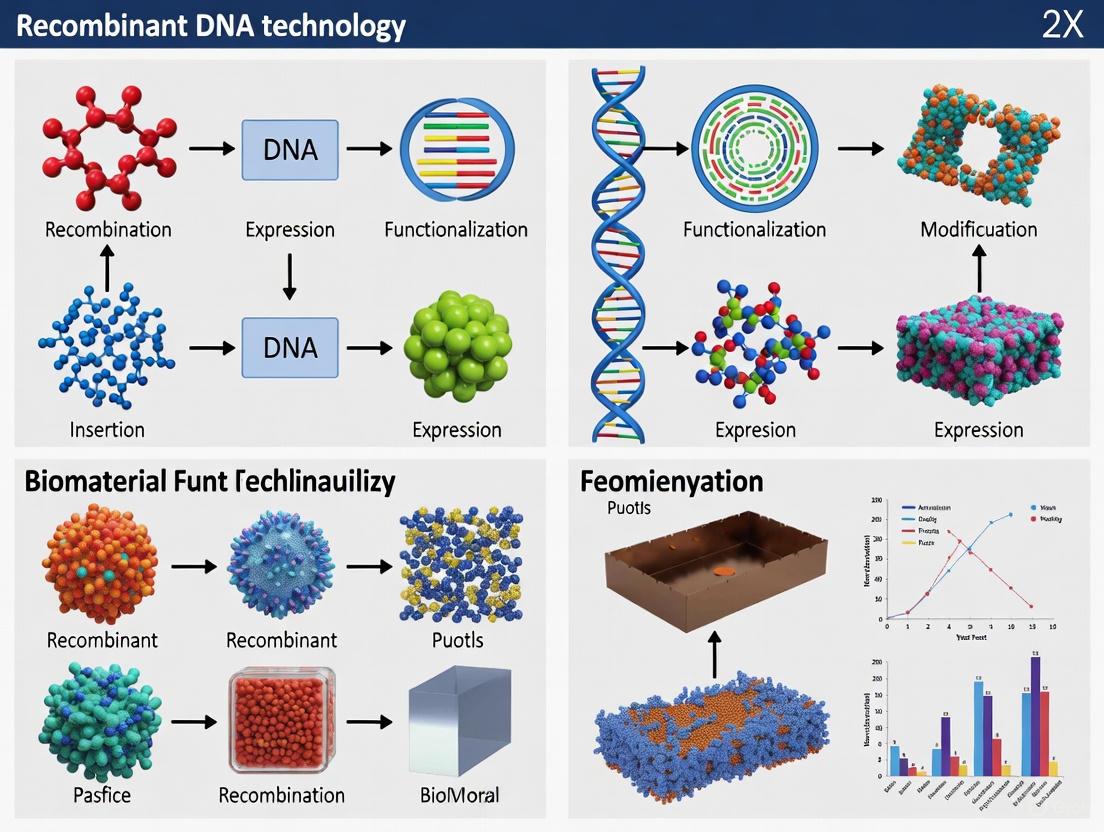
This article provides a comprehensive overview of the transformative role of recombinant DNA technology in the functionalization of advanced biomaterials.
Engineering the Future of Medicine: Functionalizing Biomaterials with Recombinant DNA Technology
Abstract
This article provides a comprehensive overview of the transformative role of recombinant DNA technology in the functionalization of advanced biomaterials. Tailored for researchers, scientists, and drug development professionals, it explores the foundational principles of designing recombinant proteins like collagen and elastin-like polypeptides for tissue scaffolding. It delves into methodological applications in areas such as cartilage regeneration and drug delivery, examines cutting-edge troubleshooting and optimization strategies including AI-driven culture medium design, and validates these approaches through analysis of FDA-approved products and commercial market trends. The synthesis of these insights highlights the immense potential of recombinant biomaterials to revolutionize regenerative medicine and therapeutic development.
The Building Blocks of Innovation: Core Principles of Recombinant DNA in Biomaterial Design
Defining Recombinant DNA Technology and Its Relevance to Biomaterials
Recombinant DNA (rDNA) technology involves using enzymes and various laboratory techniques to manipulate and isolate DNA segments of interest [1]. This foundational method allows scientists to combine (or splice) DNA from different species or to create genes with new functions [1]. The resulting copies, known as recombinant DNA, are typically propagated in bacterial or yeast cells, which copy the engineered DNA along with their own genetic material during cell division [1]. The technology was invented in 1973 by Paul Berg, Herbert Boyer, Annie Chang, and Stanley Cohen [2], and has since revolutionized biological research, medicine, and biotechnology.
A fundamental goal of genetics facilitated by rDNA technology is the isolation, characterization, and manipulation of individual genes [3]. Although isolating a sample of DNA from a collection of cells is relatively straightforward, finding a specific gene within this DNA sample was historically challenging [3]. Recombinant DNA technology has solved this problem by making it possible to isolate one gene or any other segment of DNA, enabling researchers to determine its nucleotide sequence, study its transcripts, mutate it in highly specific ways, and reinsert the modified sequence into a living organism [3].
Fundamental Principles and Techniques
Core Methodology
Recombinant DNA technology comprises altering genetic material outside an organism to obtain enhanced and desired characteristics in living organisms or as their products [2]. This technology involves the insertion of DNA fragments from a variety of sources, having a desirable gene sequence via an appropriate vector [2]. The fundamental process involves several key steps:
- DNA Manipulation: Enzymatic cleavage is applied to obtain different DNA fragments using restriction endonucleases for specific target sequence DNA sites [2].
- Ligation: DNA ligase activity joins the fragments to fix the desired gene into a vector [2].
- Introduction to Host: The vector is then introduced into a host organism, which is grown to produce multiple copies of the incorporated DNA fragment in culture [2].
- Selection and Harvest: Finally, clones containing a relevant DNA fragment are selected and harvested [2].
DNA Cloning and Vectors
In biology, a clone is a group of individual cells or organisms descended from one progenitor, meaning the members of a clone are genetically identical [3]. The concept has been extended to recombinant DNA technology, which provides scientists with the ability to produce many copies of a single fragment of DNA, such as a gene, creating identical copies that constitute a DNA clone [3].
In practice, the procedure is carried out by inserting a DNA fragment into a small DNA molecule and then allowing this molecule to replicate inside a simple living cell such as a bacterium [3]. The small replicating molecule is called a DNA vector (carrier) [3]. The most commonly used vectors are:
- Plasmids: Circular DNA molecules that originated from bacteria [3]
- Viruses: Which can efficiently deliver genetic material [3]
- Yeast Cells: Eukaryotic systems that offer post-translational modifications [3]
Plasmids are particularly useful as they are not part of the main cellular genome, but can carry genes that provide the host cell with useful properties, such as drug resistance, mating ability, and toxin production [3]. They are small enough to be conveniently manipulated experimentally and can carry extra DNA that is spliced into them [3].
Table 1: Common Host Systems for Recombinant DNA Technology
| Host System | Examples | Advantages | Limitations | Common Applications |
|---|---|---|---|---|
| Bacterial | Escherichia coli | Rapid growth, high cell concentrations, inexpensive substrates, well-characterized genome [4] | Limited post-translational modification capability [4] | Non-glycosylated proteins, basic research [4] |
| Yeast | Saccharomyces cerevisiae | Eukaryotic model, post-translational modifications, large-scale production capability [4] | Glycosylation patterns may affect human serum half-life [4] | Insulin production, recombinant proteins [4] |
| Mammalian Cell Cultures | Chinese hamster ovary (CHO), human embryo kidney (HEK-293) | Appropriate post-translational modifications, human-like glycosylation patterns [4] | Higher cost, more complex culture requirements [4] | Glycosylated therapeutic proteins, complex biologics [4] |
Relevance to Biomaterials Research
Molecular Characterization of Biomaterial-Host Interactions
Molecular biology techniques enabled by rDNA technology play a fundamental role in biomaterials research by evidencing the influence of biomaterials on gene expression, protein synthesis, and cellular behaviors such as proliferation, differentiation, and apoptosis [5]. These results are inputs to establish biocompatibility and biofunctionality for biomaterials in different applications, including modulation of immune cells to regulate wound healing in response to an implant, or to promote tissue regeneration rather than a fibrotic outcome [5].
Techniques such as polymerase chain reaction (PCR), electrophoresis, and DNA sequencing enable researchers to analyze and manipulate genetic material, facilitating the development of biomaterials that integrate effectively with biological tissue [5]. For instance, genetic modifications can enhance cell receptivity to a specific biomaterial, improving the success of biomedical treatments [5]. Additionally, cell culture techniques play a crucial role in assessing biocompatibility by simulating biological environments and evaluating cellular responses to different materials, helping predict their behavior in vivo [5].
Biomaterial Functionalization via Genetic Engineering
Recombinant DNA technology enables the creation of active materials by genetically fusing a self-assembling protein to a functional protein [6]. These fusion proteins form materials while retaining the function of interest [6]. Key advantages of this approach include:
- Elimination of a separate functionalization step during materials synthesis [6]
- Uniform and dense coverage of the material by the functional protein [6]
- Stabilization of the functional protein [6]
This strategy can be used to incorporate peptides, protein domains, and full-length, folded proteins into a wide variety of protein-based materials [6]. The structure and function of the fused functional proteins are often preserved and improved due to reduced protease access and limited mobility [6]. This confined space surrounding the fused proteins hampers protein unfolding, resulting in prolonged enzymatic, signaling, and/or biological activities [6].
Table 2: Applications of Recombinant DNA Technology in Biomaterials Development
| Application Area | Specific Examples | Key Findings/Benefits |
|---|---|---|
| Tissue Engineering | Fusion proteins containing fibronectin domains, elastin-like polypeptides (ELPs), spider silk proteins [6] | Enhanced cell attachment, tunable mechanical properties, promoted tissue regeneration [6] |
| Neural Regeneration | Collagen, gelatin, chitosan, alginate, hyaluronan, silk fibroin, conductive polymers (polypyrrole, polythiophene) [7] | Supported nerve cell growth, electrical conductivity enhanced neurite outgrowth and nerve signal travel [7] |
| Drug Delivery | Protein-based biomaterials with fused functional domains [6] | Sustained and targeted release of therapeutic agents, improved stabilization of bioactive compounds [6] |
| Enzyme Immobilization | Functional enzymes fused to self-assembling protein domains [6] | Enhanced enzyme stability, reusability, and localized catalytic activity [6] |
| Biosensing | Fusion proteins incorporating binding domains or fluorescent proteins [6] | Specific detection of analytes, real-time monitoring capabilities [6] |
Application Notes and Experimental Protocols
Protocol 1: Genetic Fusion of Functional Proteins to Self-Assembling Biomaterials
Principle: This protocol describes the creation of fusion proteins where a functional protein domain is genetically linked to a self-assembling protein domain to create bioactive materials [6].
Materials:
- DNA sequences encoding functional and self-assembling proteins
- Appropriate expression vector
- Restriction enzymes and DNA ligase
- Competent E. coli cells
- Protein purification reagents
- Cell culture materials for biocompatibility testing
Procedure:
- Gene Design: Identify and obtain DNA sequences for both the functional protein and self-assembling protein components [6].
- Vector Construction: Fuse the DNA sequences in-frame, typically with a short linker sequence (e.g., GGGS repeats) to prevent steric hindrance [6]. Clone into an appropriate expression vector.
- Transformation: Introduce the construct into competent E. coli or other suitable host cells [6].
- Protein Expression: Induce protein expression under optimized conditions.
- Purification: Purify the fusion protein using appropriate chromatographic methods.
- Material Formation: Induce self-assembly under predetermined buffer conditions.
- Characterization: Assess material properties (mechanical strength, porosity) and biological activity.
Technical Notes:
- Linker length and composition significantly impact function; test multiple variants [6].
- Fusion orientation (N-terminal vs. C-terminal) affects folding and activity [6].
- Monitor for inclusion body formation in bacterial systems; may require refolding protocols.
Protocol 2: Biomaterial-Mediated Neuronal Regeneration
Principle: This protocol utilizes recombinant DNA-derived biomaterials to support neuronal repair and regeneration, particularly using conductive polymers to enhance neurite outgrowth [7].
Materials:
- Conductive polymers (polypyrrole, polythiophene, polyaniline)
- Natural polymers (chitin, chitosan, collagen, alginate, gelatin)
- Primary neurons or neural stem cells
- Electrochemical setup for electrical stimulation
- Immunocytochemistry reagents for neuronal markers
Procedure:
- Scaffold Fabrication: Create 3D scaffolds using natural or synthetic polymers via electrospinning or 3D printing [7].
- Conductive Coating: Apply conductive polymers to scaffold surface [7].
- Sterilization: Sterilize scaffolds using appropriate methods (UV, ethanol, ethylene oxide).
- Cell Seeding: Seed neural stem cells or primary neurons onto scaffolds at optimal density.
- Electrical Stimulation: Apply controlled electrical stimulation using customized bioreactors [7].
- Assessment: Evaluate neurite outgrowth, alignment, and expression of neuronal markers.
- In Vivo Testing: Implant optimized scaffolds in appropriate animal models of neural injury.
Technical Notes:
- Conductivity levels must be optimized to support signaling without causing toxicity [7].
- Scaffold porosity should allow nutrient diffusion and cell infiltration [7].
- Mechanical properties should match native neural tissue.
Advanced Technologies and Future Directions
CRISPR-Based DNA Engineering
Recent advances in CRISPR-based DNA engineering have expanded capabilities for biomaterial functionalization [8]. CRISPR-Cas systems are RNA-guided elements that can integrate into DNA by base-pairing target protospacers with complementary CRISPR RNA spacers [8]. CRISPR-associated transposase (CAST) systems present a unique strategy for integrating large genetic elements into specific genomic loci without introducing double-strand breaks, relying solely on guide RNA for target recognition [8].
These systems enable accurate and efficient one-step insertion of foreign DNA into the target gene in vivo [8]. In various prokaryotic hosts, this method has demonstrated nearly complete insertion in Escherichia coli, enabling the stable integration of donor sequences up to approximately 15.4 kb with type I-F CAST and as much as 30 kb using type V-K variants [8]. While applications in mammalian cells are still developing, progress continues with engineered systems showing promise for future biomedical applications [8].
Recombinant Protein Production Challenges
Recombinant proteins are susceptible to undergoing chemical and physical changes during all production steps [4]. Common challenges include:
- Chemical Changes: Modifications of the primary structure, failure of amino acid incorporation, and post-translational modifications (glycosylation, phosphorylation, oxidation, etc.) [4]
- Physical Changes: Aggregation and denaturation processes involving tertiary and quaternary structures [4]
The true analytical challenge is the heterogeneity in recombinant protein expression alongside the numerous changes and degradation pathways that may occur during biological processes [4]. Regulatory considerations further complicate production, with agencies like the FDA, EMEA, and ANVISA requiring thorough characterization to assure quality, safety, and efficacy of recombinant drugs [4].
Diagram 1: Recombinant Protein Biomaterial Workflow. This flowchart outlines the key steps in creating functionalized biomaterials using recombinant DNA technology.
Diagram 2: Fusion Protein Design and Applications. This diagram illustrates the structure of genetically engineered fusion proteins and their applications in biomaterials.
The Scientist's Toolkit: Essential Research Reagents
Table 3: Essential Research Reagents for Recombinant DNA Technology in Biomaterials
| Reagent Category | Specific Examples | Function/Purpose |
|---|---|---|
| Restriction Enzymes | EcoRI, BamHI, HindIII | Recognize specific DNA sequences and create precise cuts for gene insertion [2] |
| DNA Ligases | T4 DNA Ligase | Join DNA fragments by catalyzing phosphodiester bond formation [2] |
| Expression Vectors | Plasmids, bacteriophages, artificial chromosomes | Carry and replicate inserted DNA fragments in host cells [3] [4] |
| Host Systems | E. coli, S. cerevisiae, CHO cells | Provide cellular machinery for protein expression and replication [4] |
| Selection Markers | Antibiotic resistance genes, fluorescence proteins | Enable identification and selection of successfully transformed cells [3] |
| Linker Sequences | (GGGGS)n, (EAAAK)n | Provide flexibility and prevent steric hindrance in fusion proteins [6] |
| Conductive Polymers | Polypyrrole, polythiophene, polyaniline | Enable electrical conductivity in neural tissue engineering scaffolds [7] |
| Natural Polymers | Collagen, chitosan, alginate, silk fibroin | Provide biocompatible scaffolding for tissue regeneration [7] |
Recombinant DNA technology has evolved from a basic research tool to an indispensable technology for biomaterials development. By enabling precise manipulation of genetic material, it facilitates the creation of functionalized biomaterials with enhanced bioactive properties. The integration of rDNA technology with biomaterials science has accelerated progress in tissue engineering, drug delivery, neural regeneration, and biosensing.
Future directions will likely involve more sophisticated genetic engineering approaches, including advanced CRISPR systems [8] and more complex fusion protein designs [6]. As the field progresses, addressing challenges related to scalability, regulatory approval, and biological variability will be essential for translating these technologies into clinical applications. The convergence of recombinant DNA technology with biomaterials engineering continues to open new frontiers in regenerative medicine and therapeutic device development, promising innovative solutions to complex medical challenges.
The strategic application of recombinant proteins as scaffolding materials represents a significant advancement in tissue engineering and regenerative medicine. This document provides detailed application notes and experimental protocols for three key recombinant proteins—collagen, elastin-like polypeptides (ELPs), and fibrin—focusing on their unique properties, fabrication methodologies, and specific applications in tissue regeneration. Within the broader context of recombinant DNA technology for biomaterial functionalization, these proteins offer tailored solutions for overcoming limitations associated with natural derivatives, including batch variability, immunogenicity, and pathogen transmission risks. The following sections provide a comparative analysis, detailed protocols, and practical resources to support researchers in leveraging these sophisticated biomaterials for advanced therapeutic development.
Recombinant Human Collagen
Recombinant human collagen (rhCol) is produced through heterologous expression systems, emulating the post-translational modifications seen in natural collagens, such as hydroxylation and glycosylation, thereby achieving a high degree of similarity to human collagen [9]. The characteristic triple-helical structure, composed of three polypeptide α-chains, provides structural integrity and regulatory cues for cellular behavior [9]. Among various types, recombinant human type III collagen (rhCol III) is particularly crucial for distensible tissues like blood vessels and skin, forming fine, elastic fibers that co-assemble with type I collagen and playing a vital role in early wound healing and scar quality [10].
Key Advantages and Applications
rhCol offers significant advantages over animal-derived collagen, including superior biocompatibility, controlled bioactivity, and elimination of zoonotic pathogen risks [9] [10]. Its applications are extensive in the tissue engineering field, as summarized in the table below.
Table 1: Applications of Recombinant Collagen in Tissue Engineering
| Application Area | Specific Uses | Key Benefits | References |
|---|---|---|---|
| Wound Healing & Skin Repair | Dressings, hydrogels, skin substitutes | Promotes re-epithelialization, improves scar quality (Type III), accelerates wound closure | [9] [10] |
| Bone & Cartilage Regeneration | Scaffolds combined with stem cells | Supports osteogenic and chondrogenic differentiation, facilitates substantial new bone/cartilage formation in vivo | [9] |
| Vascular Engineering | Cell-seeded tubular scaffolds | Demonstrates ability to remodel into vascular grafts | [9] |
| Stroma Regeneration | 3D scaffolds for soft tissues | Supports cell proliferation and differentiation, creates favorable ECM microenvironment | [9] [10] |
Detailed Protocol: Fabrication of a Recombinant Collagen Hydrogel Scaffold for Skin Regeneration
This protocol describes the formation of a hydrogel scaffold from recombinant human Type III collagen, designed to promote a regenerative wound healing environment with reduced scarring.
Materials & Reagents:
- Recombinant Human Type III Collagen (rhCol III) Solution (3-5 mg/mL in 0.1% acetic acid)
- 10X Phosphate Buffered Saline (PBS)
- Neutralization Solution (1M NaOH or 0.1M HEPES buffer, pH 8.0)
- Crosslinker (e.g., 10 mM EDC (1-Ethyl-3-(3-dimethylaminopropyl)carbodiimide) in deionized water)
- Cell Culture Media (DMEM/F12, optional for cellularization)
Procedure:
- Preparation: Pre-cool all reagents and equipment to 4°C. Keep the rhCol III solution on ice.
- Neutralization:
- Pipette 1 mL of rhCol III solution into a sterile vial on ice.
- Slowly add 100 µL of 10X PBS while gently stirring.
- Titrate the pH to 7.2-7.4 using the neutralization solution. The mixture will become viscous.
- Gelation:
- Transfer the neutralized collagen solution to the desired mold (e.g., multi-well plate).
- Incubate at 37°C for 30-60 minutes to form a stable hydrogel.
- Crosslinking (Optional for Enhanced Mechanical Strength):
- Carefully aspirate any residual liquid from the gelled scaffold.
- Add the EDC crosslinking solution to cover the hydrogel.
- Incubate at room temperature for 2-4 hours with gentle agitation.
- Rinse the crosslinked hydrogel 3-5 times with sterile PBS or DI water to remove residual crosslinker.
- Cell Seeding (Optional):
- Pre-condition the scaffold with cell culture media for at least 1 hour.
- Seed fibroblasts or keratinocytes onto the scaffold surface at a density of 1x10^5 cells/cm².
- Allow 2-4 hours for cell attachment before adding additional media.
Elastin-Like Polypeptides (ELPs)
Elastin-like polypeptides (ELPs) are biologically inspired, thermally responsive biopolymers derived from the repetitive hydrophobic domains of human tropoelastin [11] [12]. They are composed of short repeating pentapeptide motifs, most commonly VPGXG, where X is a "guest residue" that can be any amino acid except proline [11] [13]. This sequence confers a unique Inverse Temperature Transition (ITT) property: ELPs are soluble in aqueous solutions below a characteristic transition temperature (Tt) but undergo a reversible phase transition to form a coacervate (a highly viscous fluid) above their Tt [11] [12].
Key Advantages and Applications
ELPs are genetically encoded, allowing for exquisite control over their amino acid sequence, molecular weight, and, consequently, their Tt and mechanical properties [11] [12]. They are biocompatible, biodegradable, and non-immunogenic, making them excellent candidates for in vivo applications [11]. Their applications in tissue engineering are diverse.
Table 2: Applications of Elastin-Like Polypeptides in Tissue Engineering
| Application Area | Specific Uses | Key Benefits | References |
|---|---|---|---|
| Cartilage & Intervertebral Disc Repair | Injectable, crosslinkable hydrogels | Promotes chondrogenesis and stem cell differentiation; shear moduli can be tuned over several orders of magnitude | [11] |
| Drug Delivery | Micelles, vesicles, nanofibers | Thermally triggered drug release; enhances pharmacokinetics through self-assembly | [12] [13] |
| Injectable Depots | Sustained local therapy for cancer | Forms solid matrix in situ upon injection for prolonged local drug exposure | [12] |
Detailed Protocol: Creating an Injectable ELP Hydrogel for Cartilage Tissue Engineering
This protocol utilizes a lysine-containing ELP crosslinked with THPP to create a mechanically robust hydrogel suitable for encapsulating chondrocytes or stem cells.
Materials & Reagents:
- Lysine-containing ELP (e.g., ELP[V5K2-40], 20% w/v solution in PBS, stored at 4°C)
- Crosslinker Solution (β-[Tris(hydroxymethyl)phosphino]propionic acid, THPP, 100 mM in deionized water)
- Chondrocytes or Mesenchymal Stem Cells (in suspension, 10-50 x 10^6 cells/mL)
- Cell Culture Media (Chondrogenic media, optional)
Procedure:
- Preparation: Cool the ELP solution and PBS to 4°C. Pre-chill pipettes and tubes.
- Cell Mixing:
- Gently mix the cell suspension with the cold ELP solution to achieve a final ELP concentration of 10-15% w/v and the desired final cell density.
- Keep the cell-ELP mixture on ice at all times to prevent premature gelling.
- Crosslinking and Gelation:
- Add the THPP crosslinker to the cell-ELP mixture at a 1:1 molar ratio of THPP to lysine residues in the ELP. Mix quickly but gently.
- Immediately pipette the solution into the desired mold or inject it into the defect site.
- The gel will form within 5 minutes at 37°C [11].
- Post-Gelation Culture:
- Once gelled, carefully overlay the construct with pre-warmed chondrogenic media.
- Culture the cell-laden hydrogel, changing the media every 2-3 days.
Figure 1: Workflow for Injectable ELP Hydrogel Formation.
Recombinant Fibrin
Fibrin is the natural matrix protein formed during the blood coagulation cascade. It is generated through the enzymatic polymerization of fibrinogen (Fbg) by thrombin in the presence of Ca²⁺ ions [14]. Fibrinogen is a 340 kDa glycoprotein that contains two primary Arginine-Glycine-Aspartic acid (RGD) integrin-binding sites, which mediate cell adhesion and signaling [14] [15]. Recombinant technologies are now enabling the production of human fibrinogen, overcoming the limitations of plasma-derived sources.
Key Advantages and Applications
Fibrin scaffolds are inherently bioactive, providing a natural provisional extracellular matrix that supports cell adhesion, proliferation, and differentiation [14] [15]. They are widely used in tissue engineering due to their excellent biocompatibility and ability to be processed into various forms like microspheres, nanofibers, and hydrogels [14]. Key applications include:
Table 3: Applications of Fibrin-Based Scaffolds in Tissue Engineering
| Application Area | Specific Uses | Key Benefits | References |
|---|---|---|---|
| Bone Regeneration | Scaffolds with stem cells and growth factors (e.g., BMP-2) | Supports osteogenic differentiation; TG2 crosslinking enhances matrix deposition and calcification | [15] |
| Nerve & Skin Conduits | Guides for nerve regeneration, wound dressings | High affinity for growth factors (VEGF, NGF, EGF); promotes vascularization and healing | [14] |
| Cell Delivery | Microcarriers for cell transplantation | 3D fibrous structure enables high cell seeding efficiency and uniform distribution | [14] |
Detailed Protocol: Fabrication of a Fibrin Scaffold for Bone Tissue Engineering with TG2-Modified Cells
This protocol describes the construction of a functional bone-like graft using a fibrin scaffold seeded with ectomesenchymal stem cells (EMSCs) overexpressing Transglutaminase 2 (TG2) to enhance matrix stability and osteogenesis [15].
Materials & Reagents:
- Fibrinogen (from rat or recombinant source, 20 mg/mL in PBS)
- Thrombin (from rat or recombinant source, 10 U/mL in 40 mM CaCl₂ solution)
- TG2 gene-modified EMSCs (in single-cell suspension, 1x10^7 cells/mL)
- Osteogenic Media (DMEM/F12, 10% FBS, 10 mM β-glycerophosphate, 50 µg/mL L-ascorbic acid, 10 nM dexamethasone)
Procedure:
- Cell Preparation:
- Scaffold Polymerization:
- Mix the fibrinogen solution with the TG2-EMSC suspension in a 1:1 volume ratio. The final cell density in the construct will be 5x10^6 cells/mL.
- In a separate tube, add an equal volume of the thrombin/CaCl₂ solution to the fibrinogen-cell mixture. Pipette up and down gently 2-3 times to mix.
- Quickly transfer the solution to a mold and incubate at 37°C for 30 minutes to form a stable fibrin gel.
- In Vitro Culture and Mineralization:
- Carefully overlay the polymerized scaffold with osteogenic media.
- Culture the constructs for up to 28 days, changing the media every 2-3 days.
- The overexpression of TG2 will cross-link secreted ECM proteins (fibronectin, collagen, OPN), leading to enhanced matrix deposition and subsequent calcification [15].
Comparative Analysis and Selection Guide
The choice of scaffolding protein depends on the specific requirements of the target tissue and application. The table below provides a direct comparison to guide material selection.
Table 4: Comparative Analysis of Key Recombinant Scaffolding Proteins
| Parameter | Recombinant Collagen | Elastin-Like Polypeptides (ELPs) | Recombinant Fibrin |
|---|---|---|---|
| Primary Structure | Triple-helix (Gly-X-Y)n | Linear polymer (VPGXG)n | Fibrillar network from Fbg monomers |
| Key Mechanical Property | High tensile strength | High elasticity & extensibility | Viscoelasticity |
| Key Functional Feature | Innate cell binding sites | Thermally responsive (ITT) | Natural provisional matrix; RGD sites |
| Crosslinking Methods | Chemical (EDC), UV, Dehydrothermal | Chemical (THPP), Enzymatic (Transglutaminase) | Enzymatic (Thrombin), FXIII |
| Degradation Profile | Enzymatic (MMPs, Collagenases) | Enzymatic (Elastase, Cathepsins) | Enzymatic (Plasmin, Fibrinolysis) |
| Ideal Tissue Targets | Skin, Bone, Cartilage, Vasculature | Cartilage, Vascular grafts, Drug depots | Bone, Nerve, Skin, Cardiac tissue |
The Scientist's Toolkit: Essential Research Reagents
Table 5: Key Reagents for Working with Recombinant Scaffolding Proteins
| Reagent / Material | Function / Application | Example & Notes |
|---|---|---|
| Prolyl 4-Hydroxylase (P4H) | Critical post-translational enzyme for recombinant collagen production. Improves thermal stability of the triple helix. | Co-express with collagen genes in host systems (e.g., P. pastoris) [10]. |
| EDC (1-Ethyl-3-(3-dimethylaminopropyl)carbodiimide) | Zero-length chemical crosslinker for collagen and fibrin scaffolds. Enhances mechanical strength and stability. | Use in MES buffer (pH 5.5); requires careful rinsing to remove urea by-product [16]. |
| THPP (β-[Tris(hydroxymethyl)phosphino]propionic acid) | Biocompatible chemical crosslinker for lysine-containing ELPs. Enables rapid hydrogel formation. | Reacts with lysine residues; forms hydrogels within 5 minutes at 37°C [11]. |
| Transglutaminase 2 (TG2) | Enzyme for crosslinking ECM proteins. Enhances matrix deposition and stability in fibrin and collagen scaffolds. | Overexpression in stem cells (e.g., EMSCs) significantly improves osteogenic outcomes in fibrin scaffolds [15]. |
| Inverse Transition Cycling (ITC) | Non-chromatographic purification method for ELPs. Leverages their thermal phase transition behavior. | Purify ELPs from E. coli lysate; involves alternating centrifugation above and below Tt [12] [13]. |
Concluding Remarks
The functionalization of biomaterials using recombinant DNA technology has ushered in a new era of precision in tissue engineering. Recombinant collagen, ELPs, and fibrin each offer a unique and powerful set of properties that can be tailored to meet the specific physiological and mechanical demands of target tissues. As production scales increase and costs decrease, these recombinant proteins are poised to move from bench-side research to mainstream clinical applications, ultimately enabling the development of more effective and predictable regenerative therapies. Future work will likely focus on creating more complex multi-protein hybrid scaffolds that better mimic the intricate composition of the native extracellular matrix.
The field of regenerative medicine is increasingly focused on replicating the dynamic mechanical and biochemical signaling of the native extracellular matrix (ECM) to direct cellular behavior and tissue regeneration. The extracellular matrix serves as a sophisticated biological framework that transcends its conventional role as a passive structural scaffold, actively orchestrating fundamental cellular processes through integrated biomechanical and biochemical cues [17]. Understanding mechanosensing and mechanotransduction pathways—the processes by which cells perceive and respond to mechanical stimuli—forms the essential proof of concept for biomaterial-based polymer-cell interaction [18]. In this context, recombinant DNA technology provides powerful tools for engineering biomaterials with precisely controlled bioactivity, moving beyond static structural mimicry to create dynamic interfaces that guide tissue repair and regeneration.
Foundational Principles: ECM Mechanobiology and Integrin Signaling
The Mechanosensing and Mechanotransduction Cascade
Cellular interaction with biomaterials occurs through a sophisticated mechanobiological dialogue. The process begins with mechanosensing, where transmembrane proteins (e.g., integrins) and ion channels (e.g., Piezo 1 and 2) perceive biophysical stimuli from the material surface [18]. These inputs are then converted into biochemical signals through mechanotransduction, involving focal adhesion proteins (Vinculin, Paxillin, Talin), cytoskeletal components, and downstream effectors that ultimately regulate gene expression and cell decision-making [18].
The following diagram illustrates this cellular mechanoresponse to biomaterial cues, mirroring natural ECM stimulation:
Integrin-Mediated Signaling in Tissue Repair
Integrins serve as fundamental mediators of bidirectional communication between cells and engineered biomaterials. These transmembrane receptors, composed of α and β subunits, recognize specific ECM components and synthetic ligands, orchestrating essential cellular processes including adhesion, migration, proliferation, and survival [17]. The activation of integrin signaling initiates with ligand binding, which induces conformational changes that promote receptor clustering and assembly of focal adhesion complexes [17]. These specialized structures serve as mechanical and biochemical signaling hubs, recruiting adaptor proteins including talin, vinculin, and paxillin to bridge the connection between integrins and the actin cytoskeleton [17].
Central to this signaling network is the focal adhesion kinase (FAK) pathway, which, upon activation at Tyr397, recruits Src family kinases to regulate cytoskeletal dynamics and promote cell migration [17]. Parallel MAPK/ERK pathway activation regulates gene expression for proliferation and differentiation, while the PI3K/Akt pathway promotes cell survival in stressful, injured tissue microenvironments [17]. The mechanical properties of biomaterials—including substrate stiffness, topography, and ligand density—profoundly influence integrin signaling dynamics and subsequent cellular responses [17].
Biomaterial Design Strategies: Matching Native Tissue Properties
Material Selection and Hybrid Approaches
The ideal tissue-engineered graft must achieve mechanical compatibility with the graft site, as disparities in properties can shape the behavior of surrounding native tissue, contributing to graft failure [19]. Biological tissues exhibit complex mechanical properties including heterogeneity, viscoelasticity, and anisotropy, with mechanical properties spanning from the low kilopascal range (neural tissues) to gigapascals (cortical bone) [19]. The following table summarizes key biomaterial classes and their applications in tissue engineering:
Table 1: Biomaterial Classes for Tissue Engineering Applications
| Material Class | Key Examples | Mechanical Properties | Tissue Applications | Functionalization Strategies |
|---|---|---|---|---|
| Natural Polymers | Alginate, Chitosan, Collagen, Hyaluronic Acid [18] [19] | Low to moderate strength (kPa range), often viscoelastic | Soft tissues, cartilage, neural tissue [18] | RGD peptide incorporation, glycosaminoglycan mimetics [17] |
| Synthetic Polymers | PCL, PLA, PEG, PLGA [18] [19] | Highly tunable strength and degradation | Bone, vascular, musculoskeletal [18] | Surface modification, controlled drug release [17] |
| Bioceramics | Hydroxyapatite, Bioglass [19] | High compressive strength, brittle | Bone, dental [19] | Protein adsorption, ion release |
| Decellularized Matrices | Tissue-derived ECM [19] | Tissue-specific mechanics | Multiple tissue types [17] | Native bioactive factor retention |
| Metals | Titanium, Tantalum [19] | Very high strength and durability | Orthopedic, dental [19] | Surface porosity, coating |
Advanced Fabrication Technologies
Advanced manufacturing technologies enable precise replication of the ECM's hierarchical architecture. Electrospinning creates fibrous scaffolds that mimic collagen organization [17] [19], while 3D bioprinting allows spatial patterning of cells and bioactive factors [17]. 4D printing represents a paradigm shift by introducing time as a functional dimension, utilizing smart biomaterials that can actively respond to external stimuli such as temperature, pH, light, or humidity after fabrication [20]. These constructs can undergo reversible or irreversible changes in geometry, stiffness, or porosity through processes such as swelling, contraction, folding, or self-assembly in response to physiological cues [20].
Recombinant DNA Technology for Biomaterial Functionalization
Virus-Like Particles as Modular Biointerfaces
Recombinant DNA technology enables the creation of sophisticated biointerfaces with precisely controlled presentation of bioactive cues. Virus-like particles (VLPs) have emerged as versatile molecular scaffolds for biomaterial surface biofunctionalization, overcoming limitations associated with native proteins and synthetic peptides [21]. These non-infectious, self-assembling nanoparticles (20-200 nm) composed of viral structural proteins can be engineered to display high densities of bioactive peptides in a controlled orientation [21].
Two primary strategies have been successfully implemented:
- Direct genetic fusion of bioactive peptides (e.g., RGD, YIGSR) to the VLP coat protein (e.g., AP205 bacteriophage)
- SpyTag/SpyCatcher-mediated modular display on computationally designed nanoparticles (e.g., Mi3) for precise biomolecular conjugation [21]
This platform allows co-display of multiple peptides on a single nanoscale scaffold, enabling complex, multifunctional signaling that closely mimics the native ECM [21]. The VLP-based surface biofunctionalization strategy currently reaches Technology Readiness Level (TRL) 3-4, with successful demonstration in controlled laboratory conditions [21].
Experimental Protocol: VLP Production and Biomaterial Functionalization
Protocol 1: Production and Application of Bioactive VLPs for Surface Functionalization
Objective: Recombinant production of functionalized VLPs and their application for biomaterial surface biofunctionalization.
Materials:
- Escherichia coli BL21 Star for protein expression [21]
- AP205 coat protein gene with modified sequences [21]
- In-Fusion HD Cloning Kit [21]
- Polydimethylsiloxane (PDMS) and titanium substrates [21]
- C2C12 mouse myoblast cells (ATCC CRL-1772) [21]
Method:
- Molecular Design and Cloning:
- Engineer coding sequence of AP205 capsid protein to include 6×His purification tag at N-terminus
- Genetically fuse bioactive peptides (RGD, YIGSR, or BMP2 epitope) to C-terminus using flexible glycine-serine-glycine (GSG) linker [21]
- Perform cloning using In-Fusion HD Cloning Kit according to manufacturer's instructions [21]
VLP Expression and Purification:
- Transform engineered constructs into E. coli BL21 Star expression host
- Culture in Lysogeny Broth at 37°C under standard conditions
- Induce protein expression and harvest cells
- Purify VLPs using affinity chromatography via 6×His tag [21]
Surface Functionalization:
- Incubate PDMS or titanium substrates with purified VLPs at varying concentrations
- Allow adsorption to proceed for specified duration
- Rinse gently to remove unbound particles [21]
Bioactivity Assessment:
- Seed C2C12 cells on functionalized surfaces at standard density
- Culture in high-glucose DMEM supplemented with 10% FBS and 1% penicillin/streptomycin
- Analyze cell adhesion, spreading, and differentiation markers
- Perform immunofluorescence staining for vinculin, integrin β1, and other relevant markers [21]
Quality Control:
- Quantify VLP adsorption using fluorescence intensity measurements from confocal images
- Fit data to nonlinear regression model to determine binding parameters [21]
- Assess cell spreading using Cellpose 2.0 plugin with 100 μm cell diameter model [21]
The Scientist's Toolkit: Essential Research Reagents
Table 2: Key Research Reagents for Biomaterial Functionalization Studies
| Reagent/Material | Function/Application | Example Sources |
|---|---|---|
| AP205 Bacteriophage VLPs | Icosahedral scaffolds for peptide display (30 nm, 180 subunits) [21] | Recombinant production in E. coli [21] |
| Mi3-SpyCatcher Particles | Computationally designed dodecahedral nanoparticles for modular conjugation [21] | Recombinant fusion proteins [21] |
| SpyTag/SpyCatcher System | Irreversible isopeptidic bond formation for biomolecular conjugation [21] | Genetic fusion tags [21] |
| RGD Peptide | Integrin-binding motif from fibronectin for cell adhesion [21] [17] | Synthetic peptide or genetic fusion [21] |
| YIGSR Peptide | Laminin-derived peptide for cell adhesion and differentiation [21] | Synthetic peptide or genetic fusion [21] |
| C2C12 Mouse Myoblasts | Model cell line for evaluating bioactivity [21] | ATCC CRL-1772 [21] |
| Anti-Integrin β1 Antibody | Detection of integrin expression and clustering [21] | Commercial antibodies [21] |
| Anti-Vinculin Antibody | Visualization of focal adhesion formation [21] | Commercial antibodies [21] |
Quantitative Design Parameters for Tissue-Specific Biomaterials
Achieving mechanical compatibility with native tissues requires careful matching of key biomechanical parameters. The following table provides target properties for various tissue types:
Table 3: Target Mechanical Properties for Tissue-Engineered Constructs
| Tissue Type | Young's Modulus Range | Key Mechanical Characteristics | Critical Biomaterial Parameters |
|---|---|---|---|
| Neural Tissue | 0.1-2 kPa [19] | Soft, compliant | Low modulus, high porosity |
| Adipose Tissue | 2-5 kPa [19] | Soft, viscoelastic | Compressive compliance |
| Muscle Tissue | 10-50 kPa [19] | Anisotropic, contractile | Aligned topography, elastic recovery |
| Cartilage | 0.5-1.5 MPa [19] | Compressive resilience, low friction | High compressive strength, lubricious surface |
| Bone | 5-20 GPa [19] | High compressive and tensile strength | Stiffness, fracture toughness |
Experimental Protocol: Mechanical Characterization of Biomaterials
Protocol 2: Comprehensive Mechanical Characterization of Tissue-Engineered Scaffolds
Objective: To evaluate the mechanical properties of biomaterial scaffolds and ensure compatibility with native tissue.
Materials:
- Universal mechanical testing system
- Hydrated environmental chamber
- Sample scaffolds (various geometries)
- Phosphate buffered saline (PBS) for hydration
- Calibrated calibration standards
Method:
- Sample Preparation:
- Hydrate scaffolds in PBS at 37°C for 24 hours to achieve physiological conditions
- Measure sample dimensions precisely using digital calipers
- Mount samples carefully to avoid pre-loading or damage
Tensile Testing:
- Apply uniaxial tension at constant strain rate (e.g., 1% per second)
- Record load-displacement data until failure
- Calculate Young's modulus from linear elastic region
- Determine ultimate tensile strength and failure strain [19]
Compressive Testing (for load-bearing applications):
- Apply compressive loads at physiological strain rates
- Measure compressive modulus and yield point
- For viscoelastic materials, conduct stress-relaxation tests [19]
Functional Mechanical Assessment:
Data Analysis:
- Calculate mean and standard deviation for minimum n=5 samples per group
- Compare mechanical parameters to native tissue values from literature
- For anisotropic materials, characterize properties in multiple orientations
Regulatory and Translation Considerations
The biological evaluation of medical devices incorporating recombinant biomaterials must align with the updated ISO 10993-1:2025 framework, which emphasizes risk-based evaluation integrated within the overall device risk management process [22] [23]. Key considerations include:
- Biological evaluation planning that incorporates assessment of reasonably foreseeable misuse and defines exposure scenarios based on contact days rather than simply transitory contact [22]
- Chemical characterization to identify potential bioaccumulation risks, particularly for devices with cumulative exposure [22]
- Justification for reduced testing through demonstration of biological equivalence where scientifically appropriate [23]
- Implementation of the 3Rs principles (Replacement, Reduction, Refinement) for animal testing, with preference for in vitro and in silico methods [23]
The convergence of recombinant DNA technology with biomaterial science has enabled unprecedented precision in designing tissue-engineered constructs that mimic native tissue properties. By controlling both mechanical properties and biological signaling at the molecular level, these advanced biomaterials provide dynamic microenvironments that actively guide tissue repair and regeneration. Future directions include the development of increasingly sophisticated 4D biomaterials that adapt their properties in response to physiological cues, multifunctional VLP systems displaying complex peptide combinations, and personalized approaches that match patient-specific tissue characteristics. As these technologies mature toward clinical translation, they hold tremendous potential to revolutionize regenerative medicine and address unmet needs in tissue repair.
Recombinant DNA technology has revolutionized the field of biomaterial science, enabling the transition from naturally derived materials to precisely engineered, functionalized platforms. This pipeline facilitates the design and production of the next-generation biomaterial scaffolds with tailored properties for specific therapeutic applications [24]. The process involves the genetic engineering of protein-based biopolymers, which can be functionalized with bioactive domains and processed into three-dimensional structures that mimic the native extracellular microenvironment [25] [26]. These inductive scaffolds serve the dual role of providing structural support for cell growth and acting as a controlled release vehicle for tissue inductive factors or the DNA encoding them [25]. This document outlines the standardized protocols and key considerations for the functionalization pipeline, providing researchers with a framework for developing advanced biomaterials for tissue engineering and regenerative medicine.
Core Principles of Recombinant Biomaterial Design
The foundational principle of the biomaterial functionalization pipeline is the use of recombinant DNA technology to design biopolymers that expand the catalog of available biomaterials beyond that which exists in nature [24]. This is achieved by fusing genes encoding for individual protein blocks and functional modules into a single large gene, allowing for absolute control over the polymer's size and composition [26]. This design flexibility allows for the creation of Recombinamers, such as Silk-Elastin Like Polypeptides (SELPs) and Silk-Bacterial Collagens (SBCs), which combine the beneficial properties of different natural proteins [24].
A critical design aspect is the selection of structural modules. Commonly used modules include:
- Elastin-like Polypeptides (ELRs): Composed of repeating VPGXG sequences, these polymers exhibit a reversible temperature-dependent phase-transitional behavior, which is useful for purification and self-assembly [26].
- Silk-elastin-like Proteins (SELPs): These copolymers alternate silk blocks (GAGAGS) with elastin blocks. The silk blocks impart thermal and chemical stability, while the elastin blocks reduce crystallinity and increase flexibility and water solubility [26].
These base polymers can be genetically engineered to include functional modules, such as cell-adhesion peptides (e.g., RGD) or Antimicrobial Peptides (AMPs), to create multifunctional materials with enhanced bioactivity [25] [26].
Table 1: Common Functional Modules for Biomaterial Functionalization
| Functional Module | Type | Sequence Example | Primary Function |
|---|---|---|---|
| Cell-Adhesion Peptide | Peptide | RGD | Promotes cell attachment and spreading via integrin binding [25]. |
| Antimicrobial Peptide (AMP) | Peptide | ABP-CM4, BMAP18 | Confers contact-killing antimicrobial activity to surfaces [26]. |
| Enzyme Cleavage Site | Peptide | MMP-sensitive sequences | Allows for cell-mediated scaffold degradation and remodeling [25]. |
| Growth Factor | Protein | BMP-2, FGF-2 | Directs progenitor cell differentiation and tissue formation [25]. |
Detailed Experimental Protocol
Protocol 1: Genetic Construction and Recombinant Production
This protocol describes the creation of a functionalized SELP with an antimicrobial peptide (AMP), as exemplified by research into antimicrobial surfaces [26].
3.1.1 Materials and Reagents
- Template Genes: Synthetic genes encoding the structural polymer (e.g., SELP-59-A) and the functional module (e.g., AMP ABP-CM4), optimized for E. coli codon usage.
- Expression Plasmid: A modified pET25b(+) vector or similar.
- Restriction Enzymes: NdeI and KpnI.
- Host Organism: Escherichia coli expression strain (e.g., BL21(DE3)).
- Culture Medium: Lysogeny Broth (LB) with appropriate antibiotic (e.g., ampicillin).
- Induction Agent: Isopropyl β-d-1-thiogalactopyranoside (IPTG).
3.1.2 Step-by-Step Procedure
- Gene Synthesis and Cloning:
- Chemically synthesize the DNA sequence for the antimicrobial peptide (AMP) with flanking NdeI and KpnI restriction sites.
- Digest both the AMP gene and the target plasmid containing the structural polymer gene (SELP-59-A) with the NdeI and KpnI restriction enzymes.
- Ligate the AMP gene fragment into the prepared vector backbone at the N-terminus of the structural polymer gene.
- Transform the ligated product into competent E. coli cells and plate on selective LB-agar plates containing ampicillin.
- Recombinant Protein Production:
- Inoculate a single transformed colony into a small volume of LB medium with ampicillin and grow overnight at 37°C with shaking.
- Dilute the overnight culture into a larger volume of fresh, pre-warmed LB-ampicillin medium.
- Incubate at 37°C with shaking until the culture reaches the mid-log phase (OD600 ~0.6).
- Induce protein expression by adding IPTG to a final concentration of 0.1 - 1.0 mM.
- Continue incubation for 4-16 hours at a temperature optimized for the specific protein (often 25-30°C).
- Non-Chromatographic Purification:
- Harvest the bacterial cells by centrifugation.
- Lyse the cells using sonication or a French press.
- Utilize the inverse transition cycling (ITC) method, which leverages the temperature-dependent solubility of ELRs and SELPs. This involves repeated cycles of heating and cooling in specific buffer solutions to precipitate and isolate the target recombinant protein [26].
The following workflow diagram illustrates the key stages of this genetic construction and production process:
Protocol 2: Scaffold Processing and Functional Testing
3.2.1 Materials and Reagents
- Purified Recombinant Protein: The functionalized polymer from Protocol 1.
- Solvents: High-purity water (as a "green" solvent) or Formic Acid (for enhanced polymer chain mobility).
- Casting Surface: A flat, non-adhesive surface (e.g., Teflon or glass).
- Test Microorganisms: Gram-positive (e.g., Staphylococcus aureus) and Gram-negative (e.g., Escherichia coli) bacteria.
- Culture Media: Tryptic Soy Broth (TSB), Phosphate Buffered Saline (PBS).
3.2.2 Step-by-Step Procedure
- Solvent Casting of Free-Standing Films:
- Dissolve the purified recombinant protein polymer in either distilled water or formic acid (e.g., 5-10% w/v) by gentle agitation at room temperature.
- Pour the polymer solution onto a clean, level casting surface.
- Allow the solvent to evaporate fully in a fume hood (for formic acid) or at ambient conditions (for water). This may take 24-48 hours.
- Carefully peel the resulting free-standing film from the casting surface for further testing [26].
- Antimicrobial Activity Testing:
- Prepare bacterial suspensions in PBS or a dilute nutrient broth (like 1/500 TSB) to a concentration of approximately 1x10^5 CFU/mL.
- Place the film samples in contact with the bacterial suspension.
- Incubate for 1-24 hours at 37°C with agitation.
- Quantify the antimicrobial activity by determining the reduction in viable cells, for example, by plating and colony counting or using an optical density measurement [26].
Table 2: Key Growth Factors for Functionalized Scaffolds
| Growth Factor | Molecular Weight (kDa) | Primary Functions in Tissue Engineering | Key References |
|---|---|---|---|
| Bone Morphogenetic Protein-2 (BMP-2) | 44.7 | Osteogenesis; angiogenesis | [25] |
| Fibroblast Growth Factor-2 (FGF-2) | 17.3 | Chondrogenesis; angiogenesis; neuronal and endothelial cell proliferation | [25] |
| Nerve Growth Factor (NGF) | 27 | Promotes neuron survival and extension in CNS and PNS | [25] |
| Transforming Growth Factor-β1 (TGF-β1) | 25 | Promotes chondrogenic differentiation | [25] |
| Insulin-like Growth Factor-1 (IGF-1) | 27.9 | Increases proteoglycans and type II collagen synthesis | [25] |
The Scientist's Toolkit: Research Reagent Solutions
Table 3: Essential Materials for Recombinant Biomaterial Research
| Reagent / Material | Function / Application | Example Specifications |
|---|---|---|
| Expression Vectors | Plasmid for hosting the recombinant gene in a microbial factory. | Modified pET25b(+); enables inducible expression in E. coli [26]. |
| Restriction Enzymes | Molecular scissors for precise gene insertion. | NdeI, KpnI; for directional cloning of functional modules [26]. |
| Elastin-like Recombinamers (ELRs) | Base structural polymer providing flexibility and stimuli-responsiveness. | Composed of >200 repeats of VPAVG sequence; exhibits thermal hysteresis [26]. |
| Silk-Elastin-like Recombinamers (SELPs) | Base structural copolymer combining strength and flexibility. | SELP-59-A: 9 tandem repeats of S(ilk)5E(lastin)9 blocks [26]. |
| Antimicrobial Peptides (AMPs) | Functional domains to confer bioactive properties. | ABP-CM4, BMAP18, Hepcidin, Synoeca-MP; broad-spectrum activity [26]. |
| Formic Acid | Solvent for processing protein polymers into scaffolds. | Used for solvent casting of free-standing films [26]. |
Data Interpretation & Quality Control
The successful functionalization of the biomaterial is confirmed through a combination of molecular biology and material science techniques. SDS-PAGE should be used to verify the protein's molecular weight and purity after purification. The functionality of the incorporated domain, such as an AMP, is validated through standardized antimicrobial assays, with success defined by a significant reduction (e.g., >90% or several log reductions) in viable bacterial counts compared to a non-functionalized control material [26].
The mechanical and physical properties of the final scaffold are critically important. The choice of solvent during processing (e.g., water vs. formic acid) can significantly impact the material's final properties, such as its mechanical strength, surface topography, and subsequent bioactivity [26]. Furthermore, the scaffold must be designed to be both macroscopically stable and microscopically dynamic. This means it provides immediate structural support but also degrades at a rate commensurate with new tissue formation, often achieved by incorporating enzymatically cleavable cross-linkers that are targets for cell-secreted Matrix Metalloproteinases (MMPs) [25].
The following diagram illustrates the mechanism of action for an antimicrobial-functionalized scaffold, a key application of this pipeline:
The increasing incidence of bone-related diseases and fractures, driven by an ageing population and participation in high-risk sports, has created an urgent clinical need for effective bone graft substitutes [27]. While autogenous bone grafts remain the gold standard treatment, they are limited by donor site morbidity, limited availability, and prolonged surgical time [28] [29]. These limitations have accelerated the development of bioactive and resorbable biomaterials that can interact with the injury environment to facilitate recovery in a quick and safe manner [28].
Within this context, recombinant DNA technology has emerged as a transformative approach for creating precisely engineered protein-based biomaterials. This technology enables the design of materials with tailored bioactivity and controlled resorption profiles, addressing fundamental challenges in tissue regeneration. Biomaterials functionalized through recombinant techniques offer unprecedented control over material properties, including degradability, drug release capability, and immune response modulation [29].
Biomaterial Classes and Properties
Therapeutic biomaterials are commonly categorized into several classes based on their composition and properties. The global biomaterials market reflects the significance of these materials, estimated to reach USD 47.5 billion by 2025 from USD 35.5 billion in 2020, with a compound annual growth rate of 6.0% [29].
Table 1: Classification of Biomaterials and Their Key Characteristics
| Material Class | Key Examples | Advantages | Limitations | Primary Applications |
|---|---|---|---|---|
| Metallic | Austenitic steels, Titanium alloys, Cobalt-chromium alloys | Excellent mechanical properties, good strength under static/dynamic loads | Potential corrosion, release of harmful ions, often requires removal surgery | Fracture fixation devices, hip and knee joints, dental implants [29] |
| Ceramic | Hydroxyapatite (HA), Calcium phosphates, Bio-glasses | High biocompatibility, osteoconductivity, corrosion resistance | Brittle nature, low resistance to dynamic bending, poor tensile strength | Bone graft substitutes, dental applications, coatings for metal implants [28] [29] |
| Polymeric | PLGA, PLA, PGA, Elastin-like polypeptides (ELPs) | Biodegradability, tunable properties, can be functionalized | Rapid degradation possible, mechanical stability concerns | Tissue engineering scaffolds, drug delivery systems, sutures [28] [29] |
| Recombinant Protein-Based | Silk-elastin-like polymers, Fusion proteins (e.g., FN-Ubx, Z-4RepCT) | Precise control over sequence/structure, inherent bioactivity, self-assembly capability | Complex production process, potential immune response, scaling challenges | Biosensing, drug delivery, enzyme immobilization, tissue engineering [6] |
The Role of Recombinant DNA Technology in Biomaterial Functionalization
Recombinant DNA technology enables the creation of fusion proteins where functional protein domains are genetically fused to self-assembling protein sequences [6]. This approach involves creating a fusion gene where the DNA sequence encoding the functional protein is placed end-to-end with the DNA sequence encoding the self-assembling protein, without intervening stop codons [6]. When expressed in an appropriate host system, this genetic construct produces a single fusion protein containing both functional and structural elements in a single amino acid chain.
The key advantage of this approach includes the elimination of separate functionalization steps during materials synthesis, uniform and dense coverage of the material by the functional protein, and stabilization of the functional protein through reduced protease access and limited mobility [6]. The confined space surrounding the fused proteins hampers protein unfolding, resulting in prolonged enzymatic, signaling, and biological activities [6].
Table 2: Representative Functional Domains in Recombinant Fusion Proteins for Biomaterials
| Fusion Protein | Functional Domain/Protein | Self-Assembling Protein | Linker | Fusion Terminus | Application |
|---|---|---|---|---|---|
| FN-Ubx | Type III domain 8–10 of Fibronectin (FN) | Ultrabithorax (Ubx) | GH | N | Tissue engineering [6] |
| Z-4RepCT | IgG-binding domain Z | 4RepCT | LEALFQGPNS | N | Ligand binding [6] |
| ScFv-NC | Single-chain variable fragments | N- and C-terminal domains of natural spider silk | None | N | Molecular recognition [6] |
| mCherry-Ubx | mCherry | Ubx | GH | N | Fluorescent tagging [6] |
| MBP-Ubx | Maltose-binding protein | Ubx | GTNIDDDDKHMSGSG | N | Ligand binding [6] |
| RLP12 | RGDSP, protease cleavage site, heparin binding domain | 12 resilin-like motifs | GGKGG, AEDL, and GGRGG | Middle | Multifunctional scaffold [6] |
Experimental Protocols
Protocol: Development and Evaluation of HA/PLGA/Bleed Composite Scaffold
This protocol details the methodology for creating and testing a composite biomaterial with enhanced regenerative properties, as demonstrated in a rat calvarial defect model [28].
Scaffold Preparation
- HA/PLGA Base Material Preparation: Dissolve commercial PLGA polymer in chloroform and place in an ultrasonic bath. Disperse hydroxyapatite (HA) nanoparticles (synthesized via calcium hydroxide precipitation with orthophosphoric acid) step by step into the solution. After 10 minutes of mixing, transfer the mixture to glass plates and allow evaporation at room temperature for 24 hours. Transfer to a vacuum chamber for an additional 48 hours. The resulting scaffold should have a composition of 30% HA + 70% PLGA with 1.5-mm thickness [28].
- HA/PLGA/Bleed Composite Preparation: Crush the HA/PLGA compound in a knife mill and sieve through an analytical sieve with known granulometry to obtain granules. Add vegetable polysaccharide paste (Bleed) to this initial mixture. Lyophilize the final suspension to create scaffolds with proportion of 2.4% HA + 5.6% PLGA + 92% Bleed, with 1.5-mm thickness and 8-mm diameter [28].
In Vivo Evaluation in Rat Calvarial Defect Model
- Animal Model and Surgical Procedure: Use three-month-old male Wistar rats (mean body mass 280 ± 20 grams). Anesthetize animals intraperitoneally, perform aseptic preparation of the surgical site, and make a 1.5 cm incision in the medial region of the skullcap. Create a critical-size defect using an 8-mm external diameter trephine drill driven by a micromotor at 13,500 rpm with continuous saline irrigation. Break through both external and internal cortices until dura mater exposure [28].
- Experimental Groups: Randomly distribute animals into three groups: (1) Control group (untreated defect), (2) Biomaterial group 1 (HA/PLGA scaffold implanted), and (3) Biomaterial group 2 (HA/PLGA/Bleed scaffold implanted). Use eight animals per group per evaluation time point [28].
- Postoperative Care and Euthanasia: Administer analgesic (dipirone-sodium in 6.2 mg.kg-1 proportion) post-surgery. Perform euthanasia by anesthetic overdose at 15, 30, and 60 postoperative days. Immediately collect the critical-size bone defect area for analysis [28].
Histological Analysis and Immunohistochemistry
- Tissue Processing: Fix samples in 10% buffered formalin for 24 hours, decalcify in 4% EDTA solution, and embed in paraffin. Cut sections at 5 µm thickness and mount on histological slides [28].
- Collagen-1 and RANK-L Assessment: Perform immunohistochemical staining for Collagen-1 (Col-1) and receptor activator of nuclear factor kappa-Β ligand (Rank-L) according to standard protocols. Evaluate expression semi-quantitatively or quantitatively to assess bone matrix formation and remodeling activity [28].
Diagram 1: Composite Scaffold Development Workflow
Protocol: Genetic Functionalization of Self-Assembling Protein Biomaterials
This protocol describes the creation of functionalized biomaterials through recombinant fusion of functional proteins to self-assembling protein domains [6].
Fusion Gene Design and Vector Construction
- Functional Domain Selection: Select functional protein domains based on desired biomaterial activity (e.g., fibronectin domains for cell adhesion, fluorescent proteins for tracking, enzyme domains for catalysis).
- Linker Design: Incorporate short linker sequences (e.g., GGKGG, AEDL, GGRGG, GH, or LEALFQGPNS) between functional and self-assembling sequences to prevent steric hindrance and allow independent folding of domains [6].
- Fusion Gene Assembly: Clone DNA sequence encoding the functional protein end-to-end with DNA sequence encoding the self-assembling protein (e.g., Ultrabithorax, 4RepCT, elastin-like polypeptides) without intervening stop codons. Insert appropriate regulatory sequences for expression in the selected host system [6].
Protein Expression and Purification
- Host System Selection: Choose appropriate expression system based on protein requirements. E. coli provides low-cost production but may require endotoxin removal. Alternative systems include other bacteria, yeast, insect cells, and mammalian cells (e.g., Chinese hamster ovary cells) for complex proteins [6].
- Protein Expression: Express fusion proteins in selected host system under optimized conditions. For E. coli, standard fermentation protocols with appropriate antibiotics and induction agents are typically employed.
- Purification: Purify recombinant fusion proteins using affinity chromatography (e.g., His-tag, GST-tag) or methods appropriate for the specific fusion partner. For in vivo applications, ensure removal of bacterial endotoxins using specialized columns or alternative host systems [6].
Material Formation and Characterization
- Self-Assembly Induction: Induce material formation under appropriate buffer conditions, which may involve temperature shift, pH change, or concentration-dependent assembly based on the specific self-assembling domain.
- Structural Characterization: Analyze material structure using electron microscopy, atomic force microscopy, or other appropriate techniques to confirm proper assembly and morphology.
- Functional Assessment: Evaluate retention of functional domain activity using domain-specific assays (e.g., binding assays for receptor domains, enzymatic assays for enzyme fusions).
Key Research Findings and Data Analysis
Comparative Performance of Biomaterial Scaffolds
Experimental evaluation of different biomaterial compositions provides critical data for understanding structure-function relationships in bone regeneration.
Table 3: Comparative Performance of HA/PLGA and HA/PLGA/Bleed Scaffolds in Rat Calvarial Defect Model [28]
| Evaluation Parameter | Time Point | Control Group | HA/PLGA (BG1) | HA/PLGA/Bleed (BG2) | Significance |
|---|---|---|---|---|---|
| Collagen-1 Fibers | 15 days | Minimal | Moderate | High | BG2 > BG1 > CG |
| Collagen-1 Fibers | 30 days | Low | Moderate | High | BG2 > BG1 > CG |
| Collagen-1 Fibers | 60 days | Moderate | High | Very High | BG2 > BG1 > CG |
| RANK-L Immunoexpression | 15 days | Low | Moderate | Moderate | BG1 ≈ BG2 > CG |
| RANK-L Immunoexpression | 30 days | Low | Moderate | High | BG2 > BG1 > CG |
| RANK-L Immunoexpression | 60 days | Moderate | Moderate | High | BG2 > BG1 ≈ CG |
| Tissue Structural Organization | 60 days | Poor | Moderate | Well-organized | BG2 > BG1 > CG |
Analysis of Results
The HA/PLGA/Bleed scaffold (BG2) demonstrated superior performance across multiple parameters compared to HA/PLGA alone (BG1). Histological analysis revealed significantly higher collagen type I (Col-1) fiber formation in BG2 at all time points, indicating enhanced bone matrix formation [28]. The increased RANK-L immunoexpression observed in BG2 at 30 and 60 days suggests heightened degradation of the biomaterial and increased bone remodeling activity [28]. These findings indicate that the addition of the Bleed polysaccharide component significantly enhanced the biological performance of the composite material.
The superior performance of the HA/PLGA/Bleed scaffold is attributed to the hemostatic properties of the Bleed polysaccharide, which immediately activates coagulation factors, controls local blood leakage, and creates a favorable environment for subsequent regeneration processes [28]. This demonstrates the importance of designing biomaterials that not only provide structural support but also actively participate in the regenerative process through strategic material composition.
The Scientist's Toolkit: Essential Research Reagents and Materials
Table 4: Key Research Reagent Solutions for Biomaterial Development
| Reagent/Material | Function/Application | Examples/Specifications |
|---|---|---|
| Hydroxyapatite (HA) Nanoparticles | Mineral component mimicking natural bone structure; provides osteoconductivity | Synthesized via calcium hydroxide precipitation with orthophosphoric acid [28] |
| PLGA Polymer | Biodegradable polymer providing mechanical stability and controlled degradation | Dissolved in chloroform for scaffold formation; typically used in 70:30 ratio with HA [28] |
| Bleed Polysaccharide | Hemostatic agent activating coagulation factors; enhances regenerative environment | Vegetable-derived polysaccharide paste; comprises up to 92% of HA/PLGA/Bleed composite [28] |
| Recombinant Fusion Proteins | Self-assembling biomaterials with precisely integrated bioactivity | Genetic fusions of functional domains (e.g., fibronectin, fluorescent proteins) with self-assembling proteins (e.g., Ubx, 4RepCT) [6] |
| Linker Sequences | Spacers between functional and self-assembling domains preventing steric hindrance | Amino acid sequences (e.g., GH, LEALFQGPNS, GGKGG); typically 2-10 amino acids [6] |
| Expression Host Systems | Production platforms for recombinant protein biomaterials | E. coli (standard), specialized E. coli (truncated endotoxin), yeast, insect cells, mammalian cells (CHO) [6] |
Signaling Pathways in Biomaterial-Mediated Bone Regeneration
Diagram 2: Bone Regeneration Signaling Pathway
The development of bioactive and resorbable biomaterials represents a paradigm shift in addressing clinical needs in bone regeneration. The integration of recombinant DNA technologies with biomaterial science has enabled the creation of sophisticated materials with precisely controlled bioactivity and resorption profiles. As demonstrated by the enhanced performance of composite materials like HA/PLGA/Bleed, strategic material design that incorporates multiple functional components can significantly improve regenerative outcomes. These advances, coupled with the precise control offered by recombinant protein engineering, are paving the way for a new generation of biomaterials that actively participate in the regenerative process while progressively transferring load to newly formed tissue.
From Bench to Bedside: Methodologies and Breakthrough Applications in Tissue Engineering
Recombinant DNA technology serves as a foundational pillar in biomaterial functionalization research, enabling the production of engineered proteins that enhance material bioactivity, specificity, and therapeutic potential. The selection of an appropriate protein expression system is a critical initial step that directly influences the success of downstream applications. This choice necessitates a careful balance between achieving sufficient protein yield and accommodating the structural complexity of the target protein [30]. Bacterial systems offer simplicity and high yield for straightforward proteins, while mammalian systems provide the necessary cellular machinery for processing complex human therapeutics, albeit with increased cost and lower volumetric yield [31].
This application note provides a structured framework for researchers and drug development professionals to navigate the selection of protein expression systems. We present comparative quantitative data, detailed protocols for high-throughput screening methods, and visual workflows to guide the integration of these systems into recombinant biomaterial research and development.
Comparative Analysis of Major Expression Systems
The selection of a host system is primarily guided by the protein's structural complexity and post-translational modification requirements. Below is a summary of the key characteristics of the most commonly used expression systems.
Table 1: Key Characteristics of Protein Expression Systems
| Expression System | Typical Yield Range | Key Advantages | Major Limitations | Ideal for Proteins With |
|---|---|---|---|---|
| Bacterial (E. coli) | 1 - 10 g/L [32] | Rapid growth, high yield, cost-effective, simple scale-up [31] | No PTMs, improper folding, protein misfolding, inclusion bodies [31] [30] | Simple, single-domain prokaryotic structures, no glycosylation needed [30] |
| Yeast (P. pastoris) | Up to 20 g/L [31] [32] | Eukaryotic PTMs, high-density cultivation, secretion into medium, rapid screening [31] [33] | Non-human glycosylation patterns, potential hyperglycosylation | Eukaryotic origin, requiring glycosylation or disulfide bonds |
| Insect Cell-Baculovirus | 0.1 - 1+ g/L [31] | Complex PTMs, proper folding of eukaryotic proteins, safety (non-human pathogen) [34] | Slower growth, more expensive than microbial systems, non-human glycosylation | Complex tertiary/quaternary structures, VLPs, vaccine antigens [34] |
| Mammalian (CHO, HEK293) | 0.5 - 10 g/L [31] [32] | Human-like PTMs, high protein quality and functionality, correct folding and secretion [31] [35] | High cost, long culture times, technical complexity, risk of contamination [32] | Complex human therapeutics (mAbs, cytokines), critical human-like glycosylation [35] |
The decision-making workflow for selecting an expression system based on protein complexity and project goals can be visualized as follows:
Advanced Screening and Display Platforms
For the development of advanced biomaterials and biologics, high-throughput screening technologies are indispensable for identifying high-affinity binding molecules.
Yeast Surface Display for Initial Discovery
Yeast Surface Display (YSD) is a powerful eukaryotic platform for antibody discovery and engineering. It leverages the simplicity and cost-efficiency of yeast to present antibody fragments on the cell surface [36] [33].
Key Protocol Steps:
- Library Construction: Clone a diverse antibody gene library (e.g., scFv, Fab) into a display vector, fusing it to a yeast cell wall protein (e.g., Aga2p).
- Transformation & Induction: Introduce the library into S. cerevisiae strain EBY100. Induce protein expression and surface display with galactose.
- Magnetic-Activated Cell Sorting (MACS): Incubate the yeast library with biotinylated antigen. Use streptavidin-conjugated magnetic beads to capture antigen-binding clones, enriching the pool.
- Fluorescence-Activated Cell Sorting (FACS): Label the induced yeast library with fluorescent ligands:
- Antigen Binding: Use a biotinylated antigen detected by a streptavidin-fluorophore conjugate.
- Expression Level: Use an anti-epitope tag antibody (e.g., anti-c-myc) conjugated to a different fluorophore.
- Isolation of Binders: Use FACS to isolate individual yeast cells that are double-positive for both expression and antigen binding.
- Sequence Analysis: Sequence the plasmid DNA from sorted clones to identify the antibody variable regions for further characterization.
Mammalian Cell Display for Developability Screening
Mammalian cell display addresses limitations of yeast display by providing a fully human glycosylation environment, which is critical for predicting the clinical performance of therapeutic antibodies [36] [37].
Key Protocol Steps:
- Library Transfection: Clone the enriched pool of antibody hits from YSD into a mammalian display vector, often utilizing a GPI-anchor for efficient surface display [37]. Transfect this library into mammalian cells (e.g., CHO, HEK293).
- Cell Sorting for Developability: Perform FACS screening, focusing not on affinity but on key developability parameters:
- High Expression: Isolate clones with the highest surface antibody density.
- Stability: Incorporate a heat stress challenge (e.g., incubating cells at 40°C for 30-60 minutes) prior to sorting to identify thermostable clones.
- Recovery and Analysis: Collect the top-performing cells, recover the antibody genes, and sequence them. These leads are then ready for small-scale expression and functional validation.
The complementary use of these two platforms creates a robust pipeline for biologics discovery, as summarized below:
The Scientist's Toolkit: Essential Research Reagent Solutions
Table 2: Key Reagents for Expression and Screening Workflows
| Reagent / Material | Function / Application | Examples & Notes |
|---|---|---|
| Expression Vectors | Vehicle for gene insertion into the host; determines fusion tags and selection. | pET series (E. coli), pPICZ (Pichia), pFastBac (Insect cells), pcDNA3.4 (Mammalian). |
| Engineered Cell Lines | Optimized host cells for protein production or display. | E. coli BL21(DE3) (protein expression), S. cerevisiae EBY100 (yeast display), ExpiCHO/Expi293F (high-yield mammalian expression), HEK293T (transient transfection). |
| Selection Antibiotics | Maintenance of expression plasmids in the host population. | Ampicillin, Kanamycin (E. coli), Zeocin (Yeast), Hygromycin, Puromycin (Mammalian). |
| Induction Agents | Control the timing and level of recombinant protein expression. | IPTG (for lac/T7 promoters in E. coli), Galactose (for GAL1/10 promoters in yeast). |
| Culture Media | Supports growth and productivity of the expression host. | LB/TB (E. coli), YPD (Yeast), Sf-900 II (Insect cells), Chemically Defined Serum-Free Media (CHO/HEK293). |
| FACS Reagents | Detection and sorting of displayed proteins or antibody-producing cells. | Biotinylated antigen, fluorescently-labeled streptavidin, anti-tag antibodies (e.g., anti-c-myc, anti-His). |
| Transfection Reagents | Introduction of DNA into mammalian cells. | Polyethylenimine (PEI), Lipofectamine 3000. |
Strategic selection of a protein expression system is paramount for successful biomaterial functionalization. This guide outlines a rational framework: utilize high-yield microbial systems for simple proteins, and invest in eukaryotic platforms like insect or mammalian cells for complex targets requiring specific folding or post-translational modifications. The presented two-platform approach—combining the high-throughput discovery power of yeast display with the predictive developability screening of mammalian display—offers a robust strategy for de-risking the development of biological therapeutics. As recombinant DNA technology continues to evolve, the integration of these optimized expression and screening platforms will accelerate the creation of novel, high-performance biomaterials.
The regeneration of complex bone and cartilage defects remains a significant clinical challenge in orthopedics and reconstructive surgery. While native collagen has been a cornerstone biomaterial in regenerative medicine, its animal-derived origins present limitations, including batch-to-batch variability, risk of immunogenicity, and potential pathogen transmission [9]. Similarly, the potent osteoinductive growth factor recombinant human Bone Morphogenetic Protein-2 (rhBMP-2) has demonstrated efficacy in bone healing, but its clinical use is hampered by suboptimal delivery systems that require supraphysiological doses, leading to adverse effects like ectopic bone formation and inflammation [38] [39]. This case study explores the synergistic application of recombinant human collagen (rhCol) and rhBMP-2, engineered via advanced recombinant DNA technology, to create innovative therapeutic strategies for skeletal tissue regeneration. By leveraging the molecular precision of recombinant systems, these functionalized biomaterials offer a promising pathway to overcome the limitations of conventional treatments and achieve more predictable and controlled tissue repair [40] [41].
Scientific Background
Recombinant Human Collagen as an Advanced Biomaterial
Collagen, the most abundant protein in the human extracellular matrix, provides critical structural support and regulates cellular behavior. Among its many types, Type I collagen is the most prevalent in bone and skin, while Type III collagen is predominant in distensible tissues like blood vessels and is crucial for early wound healing, promoting finer, more elastic fibrils [10]. Traditional collagen is sourced from animals, but the advent of recombinant DNA technology has enabled the production of recombinant human collagen (rhCol) with defined sequences and consistent quality [9] [40].
- Production Systems: rhCol is produced using various heterologous expression systems, including mammalian cells (CHO, HEK293), yeast (Pichia pastoris), insect cells, and bacteria (E. coli) [9] [10]. Mammalian cells achieve the most human-like post-translational modifications, such as hydroxylation and glycosylation, which are critical for the stability of the collagen triple helix. To enhance production, strategies often involve co-expressing enzymes like prolyl 4-hydroxylase (P4H) to improve the thermal stability of the recombinant collagen [9] [10].
- Advantages: rhCol offers superior biocompatibility, reduced immunogenicity, and eliminates the risk of zoonotic pathogen transmission. Its sequence and properties can be customized, allowing for the engineering of biomaterials with precise mechanical strength, degradation rates, and bioactivity [40] [41]. For instance, recombinant human type III collagen (rhCol III) has shown exceptional promise in dermal reconstruction and osseous tissue engineering by enhancing cell adhesion, proliferation, and migration [10].
rhBMP-2 Biology and Clinical Challenges
rhBMP-2 is a highly potent osteoinductive cytokine belonging to the TGF-β superfamily. It plays a fundamental role in embryonic development and postnatal bone repair by initiating the complete cascade of endochondral ossification [38].
- Signaling Mechanism: rhBMP-2 signals through heteromeric complexes of type I and type II serine/threonine kinase receptors. This activates canonical (Smad1/5/8) and non-canonical (MAPK, PI3K/AKT) signaling pathways, leading to the transcription of key osteogenic genes like RUNX2 and Osterix, which drive the differentiation of mesenchymal stem cells into osteoblasts [38].
- Delivery Challenges: Clinically, rhBMP-2 is often delivered on an absorbable collagen sponge (ACS). However, this carrier is associated with a rapid burst release of the protein, necessitating the use of supraphysiological doses (e.g., 1.5 mg/mL in spinal fusion) to achieve therapeutic efficacy. These high doses are frequently linked to complications such as edema, ectopic bone formation, and osteolysis [42] [38] [39]. There is a pressing need for improved delivery systems that provide sustained and controlled release at much lower, safer doses.
Application Notes: Integrated Biomaterial Systems
The functionalization of recombinant collagen-based scaffolds with rhBMP-2 creates a biomimetic microenvironment that can enhance and guide bone and cartilage regeneration. The following applications highlight key strategies.
Bone Regeneration in Critical-Sized Defects
Critical-sized bone defects, which cannot heal spontaneously, require advanced interventions. A compelling approach is the use of a synthetic, engineered periosteum. The native periosteum is a membrane covering bones that delivers osteoprogenitor cells and growth factors during repair. A biomimetic periosteum was fabricated using a 3D melt electro-written polycaprolactone (PCL) membrane functionalized with a poly(ethyl acrylate) coating. This coating allowed for the immobilization of fibronectin and remarkably low doses of rhBMP-2 (10-25 μg/mL) [39]. When tested in a critical-size femoral defect model in rats, this functionalized mimetic periosteum demonstrated regenerative potential, achieving 80-93% healing and functional recovery. The system facilitated efficient, sustained osteoinduction and proved effective for the concurrent delivery of mesenchymal progenitor cells [39].
Key Advantage: This technology allows for a dramatic reduction in the required rhBMP-2 dose by preventing burst release, thereby mitigating dose-dependent side effects while promoting robust bone healing.
Synergistic Scaffolds for Bone Healing
The efficacy of rhBMP-2 is highly dependent on its carrier material. A comparative study evaluated rhBMP-2 (5 μg per defect) delivered with various biomaterials in a 5-mm critical-size rat calvarial defect model [42]. The results, summarized in Table 1 below, demonstrated that the combination of rhBMP-2 with certain osteoconductive materials significantly enhanced bone healing compared to a control blood clot.
Table 1: Bone Healing Efficacy of rhBMP-2 with Different Biomaterials in a Rat Calvarial Defect Model
| Biomaterial Group | Average Bone Healing Score | Key Findings |
|---|---|---|
| Control (Blood Clot) | 12.5 | Baseline healing without intervention. |
| Autograft + rhBMP-2 | 26.5 | High level of healing, establishing a positive benchmark. |
| ACS + rhBMP-2 | 18.8 | Moderate improvement over control. |
| β-TCP + rhBMP-2 | 26.2 | Performance on par with the autograft group, indicating high efficacy. |
| Bovine Xenograft + rhBMP-2 | 20.9 | Moderate improvement over control. |
| Hydroxyapatite (HA) + rhBMP-2 | 20.9 | Moderate improvement over control. |
Data adapted from [42]. The histological bone healing scale evaluated 17 parameters related to bone formation and graft integration.
The study concluded that while rhBMP-2 enhanced healing across different materials, its combination with β-Tricalcium Phosphate (β-TCP) yielded bone healing scores equivalent to the autograft gold standard [42]. This suggests that recombinant collagen scaffolds could be further optimized by incorporating ceramic phases like β-TCP to create composite materials with improved osteoconductivity and rhBMP-2 binding kinetics.
Cartilage and Soft Tissue Regeneration
Although less abundant in cartilage than Type II, recombinant human Type III collagen (rhCol III) has valuable applications in tissue engineering due to its role in promoting flexible, fine fibril formation and supporting early tissue development [10]. Scaffolds enriched with rhCol III have been shown to create a favorable extracellular matrix microenvironment that promotes softer, more regenerative healing, mimicking aspects of scarless fetal wound repair [10]. Furthermore, recombinant collagen hydrogels, due to their high water content and biocompatibility, serve as excellent scaffolds for chondrocyte encapsulation and cartilage formation, supporting the production of a cartilage-specific extracellular matrix rich in Type II collagen and glycosaminoglycans (GAGs) [9] [41].
Experimental Protocols
Protocol 1: Fabrication and Functionalization of a Mimetic Periosteum
This protocol details the creation of a 3D biomimetic periosteum for the sustained delivery of low-dose rhBMP-2, based on the work of [39].
Objective: To engineer a synthetic periosteum that provides controlled release of rhBMP-2 and supports mesenchymal progenitor cell delivery for bone regeneration.
Materials:
- Polycaprolactone (PCL)
- Melt Electro-writing (MEW) system
- Poly(ethyl acrylate) (PEA)
- Fibronectin
- E. coli-derived rhBMP-2 (Novosis Daewoong, Korea)
- Periosteum-derived Mesenchymal Stem Cells (PMSCs)
Methodology:
- Scaffold Fabrication:
- Fabricate an outer membrane scaffold using Melt Electro-writing (MEW) of PCL to produce a microporous tube (70 mm long, 4 mm diameter) with a fiber diameter of 10-50 μm and a predominant pore size of 120 μm.
- Create an inner, mechanically supportive scaffold by Fused Deposition Modeling (FDM) of PCL into a square sheet, from which a 4 mm diameter cylinder is punched.
- Assemble the final implant by combining the inner FDM scaffold with the outer MEW membrane.
Surface Functionalization:
- Coat the assembled PCL scaffold with Poly(ethyl acrylate) (PEA).
- Adsorb fibronectin onto the PEA-coated surface to mediate cellular attachment.
- Immobilize a low dose of rhBMP-2 (10-25 μg/mL) onto the functionalized surface.
In Vivo Evaluation (Rat Femoral Defect Model):
- Create a critical-sized segmental defect (e.g., 6 mm) in the femur of an immunocompetent rat.
- Implant the functionalized mimetic periosteum into the defect.
- For cell delivery studies, seed PMSCs onto the functionalized membrane prior to implantation.
- Monitor healing over 8-12 weeks using longitudinal micro-Computed Tomography (μCT) and perform histological analysis (H&E, Masson's Trichrome) on explanted tissue to quantify new bone formation and defect bridging.
Protocol 2: Evaluating rhBMP-2 with Biomaterials in a Calvarial Defect
This protocol outlines the methodology for comparing the bone regeneration efficacy of rhBMP-2 delivered via different carrier materials [42].
Objective: To assess and compare the bone healing potential of rhBMP-2 when combined with various biomaterials in a critical-sized calvarial defect.
Materials:
- rhBMP-2 (5 μg per defect)
- Absorbable Collagen Sponge (ACS) (e.g., Hemospon)
- β-Tricalcium Phosphate (β-TCP) (e.g., Excelos)
- Bovine Xenograft (e.g., Bio-Oss)
- Hydroxyapatite (HA) (e.g., IngeniOs HA)
- Autograft (bone harvested from the defect site)
Methodology:
- Surgical Procedure:
- Anesthetize male Sprague-Dawley rats (e.g., 16 weeks old).
- Create two 5-mm full-thickness critical-size defects in the calvarial bone using a trephine drill under continuous saline irrigation.
- Randomize the defects into experimental groups (C, A, ACS, B-TCP, B, HA as defined in Table 1).
Graft Preparation and Implantation:
- For experimental groups, mix 0.1 g of the respective biomaterial with 5 μg of rhBMP-2 in 50 μl saline 10 minutes prior to implantation.
- Fill the defects with the prepared biomaterial-rhBMP-2 mixture. The autograft group is filled with bone chips from the drilling process mixed with rhBMP-2, and the control group is left to fill with a blood clot.
- Close the surgical site in layers.
Analysis:
- Euthanize the animals at 4 and 8 weeks post-operation.
- Harvest the calvaria, fix in formalin, and demineralize in EDTA.
- Process the samples for paraffin histology and section them into 5-μm thick slices.
- Stain sections with Hematoxylin and Eosin (H&E).
- Perform a blinded histological evaluation using a validated bone healing scale that scores multiple parameters (e.g., bone formation at periphery and center, graft vascularization, osteoblast presence). The final score is the sum of all parameter scores.
The Scientist's Toolkit: Research Reagent Solutions
Table 2: Essential Reagents for Recombinant Collagen and rhBMP-2 Research
| Reagent / Material | Function in Research | Example Applications |
|---|---|---|
| Recombinant Human Type III Collagen (rhCol III) | Engineered scaffold biomaterial; promotes cell adhesion, migration, and flexible matrix formation. | Fabrication of hydrogels and 3D scaffolds for dermal and cartilage regeneration [10] [41]. |
| E. coli-derived rhBMP-2 | Potent osteoinductive factor; induces osteogenic differentiation of mesenchymal cells. | Bone defect healing studies when combined with various scaffolds (e.g., β-TCP, collagen sponges) at low doses [42] [38]. |
| β-Tricalcium Phosphate (β-TCP) | Osteoconductive ceramic; provides a scaffold for bone ingrowth and can bind growth factors. | Used as a carrier for rhBMP-2 to enhance bone regeneration in critical-sized defects [42]. |
| Absorbable Collagen Sponge (ACS) | FDA-approved clinical carrier for rhBMP-2; provides a matrix for cell infiltration. | Serves as a clinical benchmark in comparative studies of new rhBMP-2 delivery systems [42] [38]. |
| Melt Electro-written PCL Scaffold | Synthetic, tunable 3D scaffold providing mechanical support and a template for tissue growth. | Serves as the structural basis for engineered tissues like a mimetic periosteum for bone regeneration [39]. |
| Prolyl 4-Hydroxylase (P4H) | Enzyme for post-translational modification; hydroxylates proline residues in collagen. | Co-expressed in host systems (e.g., yeast, insect cells) to improve the thermal stability of recombinant collagen [9] [10]. |
Signaling Pathways and Workflows
rhBMP-2 Osteogenic Signaling Pathway
The following diagram illustrates the key molecular mechanisms by which rhBMP-2 induces osteogenic differentiation, integrating both canonical (Smad) and non-canonical pathways.
Diagram Title: rhBMP-2 Induced Osteogenic Signaling Pathway
Experimental Workflow for Biomaterial Testing
This workflow outlines the key steps for developing and evaluating a recombinant collagen-based scaffold functionalized with rhBMP-2.
Diagram Title: Preclinical Testing Workflow for Functionalized Scaffolds
The convergence of recombinant DNA technology with biomaterial science has catalyzed a paradigm shift in the design of hydrogels for cell support. Moving beyond traditional, biologically inert systems, this approach enables the precise molecular-level engineering of protein backbones to create bioactive three-dimensional (3D) matrices that dynamically interact with encapsulated cells [43]. These advanced recombinant protein hydrogels are engineered to replicate critical aspects of the native extracellular matrix (ECM), overcoming the limitations of bioinertness and unpredictable degradation associated with traditional synthetic systems like polyacrylamide (PAAm) and polyethylene glycol (PEG) [43]. By leveraging genetically engineered sequences, researchers can now fabricate hydrogels with programmable functionality, incorporating domains for controlled degradation, cell-adhesive ligands, and environmental responsiveness [43]. This application note details the fabrication, characterization, and implementation of these sophisticated biomaterials within the broader context of recombinant DNA technology for biomaterial functionalization, providing researchers with detailed protocols to advance their cellular studies.
Key Recombinant Protein Backbones for Hydrogel Design
The foundation of these advanced hydrogels lies in the use of engineered protein polymers. The table below summarizes the key recombinant protein backbones commonly used in hydrogel fabrication.
Table 1: Key Recombinant Protein Backbones for Hydrogel Fabrication
| Protein Backbone | Source Inspiration | Characteristic Motif | Key Properties |
|---|---|---|---|
| Elastin-like Polypeptides (ELPs) | Vertebrate elastin [43] | (VPGXG)ₙ where X is any amino acid except proline [43] | Thermo-responsive (LCST behavior); exceptional elasticity; tunable mechanics via "X" and "n" [43] |
| Resilin-like Polypeptides (RLPs) | Insect resilin [43] | e.g., (GGRPSDSYGAPGGGN)ₙ from Drosophila [43] | Superelasticity; energy storage; tunable thermo-responsive (UCST or LCST) and salt-responsive behavior [43] |
| Recombinant Silk Fibroin (SF) | Silkworm silk [43] | Repetitive hydrophobic and hydrophilic blocks [43] | High mechanical strength; tunable crystallinity and biodegradation; excellent biocompatibility [43] |
The design of these backbones is central to controlling macroscopic hydrogel properties. For instance, the lower critical solution temperature (LCST) of ELPs can be predictably tuned by altering the identity of the guest residue "X" and the number of repeats "n"; more hydrophobic residues or longer chains lower the transition temperature [43]. This provides a powerful lever for creating cell-support matrices that undergo programmable sol-gel transitions under physiologically relevant conditions.
Fabrication and Crosslinking Strategies
The transition from soluble recombinant proteins to a solid hydrogel network is achieved through crosslinking. A hierarchical approach that combines reversible physical interactions with stable covalent bonds is often employed to simultaneously achieve mechanical integrity and biofunctionality [43].
Hierarchical Crosslinking
Recombinant protein hydrogels often utilize a two-stage crosslinking strategy:
- Reversible Physical Crosslinking: Initial network stabilization is achieved through non-covalent interactions such as hydrophobic associations, hydrogen bonding, and electrostatic forces. These interactions can confer environmental responsiveness, such as the temperature-dependent behavior of ELPs [43].
- Covalent Crosslinking: The network is subsequently reinforced with dynamic or permanent covalent bonds. Common strategies include Schiff base reactions, Michael-type additions, or enzyme-mediated crosslinking (e.g., using microbial transglutaminase) [43]. This step locks the network in place, enhancing its mechanical strength and stability.
Protocol: Fabricating a Genetically Engineered Hydrogel via Michael-Type Addition
This protocol describes the formation of a covalently crosslinked hydrogel using a step-growth, Michael-type addition reaction, which is highly cytocompatible and allows for cell encapsulation.
Materials:
- Recombinant protein functionalized with thiol groups (-SH) (e.g., ELP or RLP modified with cysteine residues).
- Multi-arm (typically 4-arm or 8-arm) Polyethylene Glygel Vinyl Sulfone (PEG-VS) or PEG-Acrylate (PEG-Ac) as the crosslinker.
- Cell culture-grade Phosphate Buffered Saline (PBS), pH 7.4.
- Cell suspension of interest.
Procedure:
- Precursor Preparation: Dissolve the thiol-functionalized recombinant protein in chilled, degassed PBS to a final concentration of 2-5 mM thiol. Keep on ice.
- Crosslinker Preparation: Dissolve the multi-arm PEG-VS (or PEG-Ac) in chilled, degassed PBS to achieve a stoichiometric ratio of thiol to vinyl sulfone (or acrylate) groups. A 1:1 ratio is typical, but it can be adjusted to modify crosslinking density and stiffness. Keep on ice.
- Cell Mixing: Gently mix the cell suspension with the protein precursor solution. The final cell density is application-dependent but typically ranges from 1-10 million cells/mL.
- Gelation: Rapidly combine the cell-precursor mixture with the crosslinker solution and pipette to mix thoroughly but gently. Quickly transfer the mixture to the desired mold (e.g., a silicone gasket on a glass slide or a multi-well plate).
- Incubation: Incubate the mold at 37°C for 15-45 minutes to allow for complete gelation. The hydrogel is ready for further culture when it no longer flows upon tilting the mold.
Notes: All steps must be performed under sterile conditions. The use of chilled, degassed buffers prevents premature oxidation of thiol groups. The gelation time can be tuned by altering the pH, concentration, or stoichiometry of the precursors [44].
Experimental Workflow Diagram
The following diagram illustrates the logical workflow for designing, fabricating, and characterizing a recombinant protein hydrogel.
Characterizing Hydrogel Properties
Rigorous characterization is essential to link material design to biological performance. Key properties to measure include mechanics, swelling, and microstructure.
Table 2: Key Characterization Techniques for Recombinant Protein Hydrogels
| Property | Description | Common Characterization Techniques |
|---|---|---|
| Mechanical Properties | The elastic (G') and viscous (G") moduli, reflecting stiffness and energy dissipation. Critical for mechanotransduction [45]. | Rheology (for bulk 3D gels) [44]; Atomic Force Microscopy (AFM, for 2D films or surface mechanics) [44]. |
| Swelling Ratio | The amount of buffer/water absorbed at equilibrium, indicating hydrophilicity and crosslink density [44]. | Gravimetric analysis (Qₘ = Mw/Md) [44]. |
| Mesh Size (ξ) | The average pore size between polymer chains, governing nutrient flux and molecular diffusion [44]. | Theoretical calculation from swelling and modulus [44]; Fluorescence Recovery After Photobleaching (FRAP) [44]. |
| Degradation Profile | The rate of hydrogel breakdown over time, which can be hydrolytic, enzymatic, or cell-mediated [43]. | Monitoring mass loss over time; measuring release of fluorescently-tagged degradation products. |
Protocol: Measuring Hydrogel Swelling Ratio
This quantitative assay determines the mass swelling ratio (Qₘ), a key parameter linked to crosslinking density.
Materials:
- Hydrogel samples polymerized in a known mold volume.
- PBS or relevant cell culture medium.
- Analytical balance.
- Lyophilizer.
Procedure:
- Equilibrium Swelling: After gelation, incubate hydrogels in a large excess of PBS at 37°C for at least 24 hours to reach equilibrium swelling.
- Wet Weight (M𝓌): Remove the hydrogel from solution, gently blot with a lint-free wipe to remove excess surface water, and immediately weigh to obtain the wet weight.
- Dry Weight (M𝒹): Lyophilize the same hydrogel sample until a constant weight is achieved (typically 24-48 hours). Weigh the dried sample to obtain the dry weight.
- Calculation: Calculate the mass swelling ratio: Qₘ = M𝓌 / M𝒹.
Notes: Perform with at least n=3 samples per condition. A lower Qₘ indicates a higher crosslinking density and typically a stiffer, less porous gel [44].
Application Note: A Functionalized NACC Hydrogel for Angiogenesis
To illustrate the practical application of these principles, we detail a specific platform that combines recombinant DNA technology with a natural polymer: the Nucleic Acid-Collagen Complex (NACC) hydrogel functionalized with a VEGFR-2-targeting aptamer [46].
The Scientist's Toolkit: Research Reagents for NACC Hydrogels
Table 3: Essential Materials for Fabricating Bioactive NACC Hydrogels
| Research Reagent | Function in the Experiment |
|---|---|
| Type I Collagen (e.g., Bovine PureCol) | Serves as the primary structural ECM component, forming a fibrillar network that supports cell adhesion and matrix remodeling [46]. |
| VEGFR-2 ssDNA Aptamer | Acts as a bioactive "chemical antibody"; binds and activates VEGF receptor 2 on endothelial cells, triggering pro-angiogenic signaling without the instability of protein growth factors [46]. |
| DNase I | Used in stability assays to confirm that complexation with collagen protects the ssDNA aptamer from nuclease degradation, ensuring sustained bioactivity [46]. |
Protocol: Fabricating and Testing Aptamer-Functionalized NACC Hydrogels
Hydrogel Self-Assembly:
- Prepare a solution of the VEGFR-2 ssDNA aptamer (e.g., 80-nucleotide sequence) in ultrapure water.
- Mix the aptamer solution with neutralized, bovine type I collagen solution on ice.
- Incubate the mixture at 37°C for 45 minutes. Hydrogel formation is confirmed by the inverted vial method [46].
In Vitro Angiogenesis Assay:
- Cell Encapsulation: Resuspend Human Umbilical Vein Endothelial Cells (HUVECs) in the NACC precursor solution before gelation. Plate the mixture in a suitable well plate and induce gelation.
- Culture: Maintain the cell-laden hydrogels in endothelial cell growth medium for up to 28 days, with regular medium changes.
- Assessment: Monitor over time for:
- Viability: Using live/dead staining assays.
- Proliferation: Using metabolic activity assays (e.g., AlamarBlue) or by quantifying DNA content.
- Morphogenesis: Quantify the formation of vascular-like sprouts and tubular structures, which indicate successful activation of angiogenic pathways [46].
Signaling Pathway Diagram
The bioactivity of the fabricated NACC hydrogel is mediated through specific receptor activation, as outlined in the signaling pathway below.
The molecular engineering of recombinant protein hydrogels represents a powerful and versatile strategy for creating advanced 3D matrices for cell support. By harnessing the principles of recombinant DNA technology, researchers can design biomaterials with unprecedented control over mechanical, structural, and bioactive cues. The protocols and application note provided here for fabricating, characterizing, and functionally testing these hydrogels offer a roadmap for their implementation in studies aimed at understanding complex biological processes, developing sophisticated disease models, and engineering functional tissues for regenerative medicine. As the field progresses, the integration of these designs with advanced biomanufacturing technologies like 3D bioprinting and artificial intelligence-driven design will further expand the capabilities and translational potential of these bioactive platforms [43] [47].
Functionalization techniques represent a cornerstone of modern biomaterial science, enabling the transformation of passive scaffolds into bioactive systems capable of directing specific cellular responses. Within the context of recombinant DNA technology, these techniques achieve unprecedented precision in creating biomaterials that mimic the native extracellular matrix (ECM). The strategic incorporation of growth factors and cell-adhesion motifs leverages recombinant protein expression to produce defined, reproducible bioactivemolecules. These functionalized biomaterials address critical challenges in regenerative medicine by providing spatiotemporal control over signaling cues, enhancing tissue integration, and promoting functional regeneration [17] [48]. This document provides detailed application notes and experimental protocols for researchers developing advanced functionalized biomaterials, with particular emphasis on recombinant DNA-derived components.
Growth Factor Delivery Platforms
Growth factors are potent signaling proteins that regulate essential cellular processes including proliferation, migration, and differentiation. However, their clinical translation is hampered by short half-lives, rapid diffusion from target sites, and potential off-target effects [49]. Controlled delivery platforms are essential to maintain growth factor bioactivity and achieve sustained therapeutic effects.
Sustained Release Systems
Sustained release systems protect growth factors from degradation and minimize dosage frequency by extending their presence at the target site. Recent advances demonstrate the significant efficacy of sustained release platforms across multiple tissue engineering applications, as summarized in Table 1.
Table 1: Quantitative Outcomes of Sustained Growth Factor Delivery Platforms
| Application | Growth Factor | Delivery Platform | Key Quantitative Outcomes | Reference |
|---|---|---|---|---|
| Nerve Tissue Engineering | NGF-β | PODS in aligned hydrogel scaffolds | Achieved 0.8 mm/day neurite outgrowth; superior cytoprotection and multipotency preservation vs. soluble NGF | [50] |
| Retinal Ganglion Cell Transplantation | BDNF & GDNF | PODS | 2.7-fold improvement in mouse RGC survival; 15-fold increase for human RGCs; enhanced neurite outgrowth (1053 μm vs 517 μm) | [50] |
| MSC Spheroids | NGF-β | PODS | Maintained MSC multipotency under oxidative stress; significant enhancement in V-CAM expression (p<0.001) | [51] [50] |
| Vascular Grafts | VEGF-165 & TGF-β1 | PODS in 3D bioprinted bilayer vessels | 73.8% EC differentiation; 70.3% SMC differentiation; burst pressure increased from 62→71 mmHg (day 0→14) | [50] |
| Glaucoma Disease Modeling | TGFβ-2 | PODS | Controlled induction of pathological trabecular meshwork cell phenotypes for disease modeling | [50] |
Heparin-Based Delivery Systems
Heparin, a highly sulfated glycosaminoglycan, exhibits exceptional binding affinity for numerous growth factors through electrostatic interactions with their heparin-binding domains [49]. This binding stabilizes growth factors, protects them from proteolytic degradation, and enhances receptor engagement. Heparin can be incorporated into delivery systems through multiple strategies, each offering distinct advantages as detailed in Table 2.
Table 2: Heparin-Based Modification Strategies for Growth Factor Delivery
| Strategy | Mechanism | Advantages | Limitations | Applications |
|---|---|---|---|---|
| Electrostatic Adsorption | Reversible binding via charge interactions | Simple; preserves bioactivity; suitable for short-term delivery | Weak interactions; serum-sensitive; potential burst release | Multilayer nanofilms, in situ immobilization [49] |
| Physical Blending | Direct mixing into polymer matrix | Easy implementation; maintains biomolecule integrity | Risk of leaching; uncontrolled release | Hydrogels, fiber matrices [49] |
| Covalent Grafting | Chemical attachment to carrier surface | High stability; long-term retention; site-specific | Complex chemistry; potential reduced bioactivity | Functionalized scaffolds, surface modifications [49] |
| Network Crosslinking | Incorporation into 3D polymer network | Enhanced mechanical strength; controlled release kinetics | Requires crosslinking reactants | Injectable hydrogels, 3D-bioprinted constructs [49] |
Protocol 2.1: Heparin Functionalization of Biomaterials via Covalent Conjugation
Materials:
- Heparin (from porcine intestinal mucosa, ~15-20 kDa)
- N-(3-Dimethylaminopropyl)-N'-ethylcarbodiimide (EDC) and N-Hydroxysuccinimide (NHS)
- Amine-functionalized biomaterial (e.g., chitosan, collagen, amine-coated PLGA)
- Phosphate Buffered Saline (PBS), pH 7.4
- Dialysis membrane (MWCO 10 kDa)
Procedure:
- Heparin Activation: Dissolve 100 mg heparin in 50 mL MES buffer (0.1 M, pH 5.5). Add 400 mg EDC and 100 mg NHS to the solution. React for 20 minutes at room temperature with gentle stirring.
- Purification: Transfer the activated heparin solution to a dialysis membrane and dialyze against cold distilled water (4°C) for 24 hours to remove excess EDC/NHS.
- Conjugation: Incubate the purified, activated heparin with amine-functionalized biomaterial at a 5:1 weight ratio in PBS (pH 7.4) for 24 hours at 4°C under constant agitation.
- Washing: Remove unconjugated heparin by washing the functionalized biomaterial extensively with PBS followed by 1 M NaCl solution.
- Characterization: Verify heparin conjugation using toluidine blue staining or quantitative measurements of sulfur content.
Notes: Maintain pH below 7.5 during conjugation to minimize hydrolysis of NHS esters. The degree of functionalization can be controlled by adjusting the heparin-to-biomaterial ratio and reaction time [49].
Cell-Adhesion Motifs
Cell-adhesion motifs are short peptide sequences that mediate specific interactions between cells and biomaterials through integrin receptors. Incorporating these motifs is essential for promoting cell adhesion, spreading, and survival in engineered constructs [17].
Integrin-Mediated Signaling
Integrins are transmembrane receptors that recognize specific ECM components, including fibronectin, collagen, and laminin, orchestrating essential cellular processes during tissue repair [17]. The activation of integrin signaling initiates with ECM ligand binding, which induces conformational changes that promote receptor clustering and assembly of focal adhesion complexes. These structures serve as mechanical and biochemical signaling hubs, recruiting adaptor proteins including talin, vinculin, and paxillin to bridge the connection between integrins and the actin cytoskeleton [17]. This process activates multiple downstream signaling pathways that collectively coordinate cellular responses to tissue injury, including FAK, MAPK/ERK, and PI3K/Akt pathways [17].
Integrin-Mediated Signaling Pathway in Tissue Repair
Engineering Biomaterials with Adhesion Motifs
Recombinant DNA technology enables the production of precisely defined adhesion peptides and engineered protein polymers with controlled presentation of multiple bioactive sequences. The RGD (Arg-Gly-Asp) sequence, derived from fibronectin, remains the most extensively utilized adhesion motif, primarily engaging αvβ3 and α5β1 integrins [17]. Other important motifs include IKVAV (from laminin) for neural cell adhesion and YIGSR (from laminin) for endothelial and epithelial cell adhesion.
Protocol 3.1: Functionalization of Biomaterials with RGD Peptides
Materials:
- RGD peptide (e.g., GRGDSP, typically produced recombinantly or synthetically)
- Biomaterial scaffold (e.g., collagen, chitosan, PEG hydrogel, PLGA)
- Crosslinker (e.g., Sulfo-SMCC for thiol-maleimide chemistry)
- Buffer solutions: PBS (pH 7.4), MES (pH 6.0)
- Purification equipment: dialysis membrane or size exclusion columns
Procedure:
- Surface Activation: For synthetic polymers like PEG, prepare a 5% (w/v) solution in MES buffer (pH 6.0). Add Sulfo-SMCC (10 mM final concentration) and react for 1 hour at room temperature. Purify via dialysis against MES buffer.
- Peptide Conjugation: Add RGD peptide (1-2 mM final concentration) to the activated polymer solution. React for 4-6 hours at room temperature or overnight at 4°C with gentle agitation.
- Scaffold Formation: Crosslink the functionalized polymer according to standard protocols for the specific biomaterial (e.g., UV polymerization for hydrogels, solvent casting for films).
- Characterization: Quantify RGD density using fluorescence tagging or amino acid analysis. Validate bioactivity through cell adhesion assays.
Notes: Optimal RGD spacing of 10-50 nm typically enhances integrin clustering and signaling. Peptide density should be titrated for specific cell types, as excessive density can inhibit cell migration [17].
Integrated Functionalization Strategies
Advanced biomaterial systems increasingly combine multiple functionalization approaches to create synergistic effects that better mimic the native ECM.
Combined Signaling Platforms
Integrating growth factor delivery with adhesion motifs creates biomaterials that provide both structural cues and biochemical signaling. Heparin-based systems are particularly effective for this integrated approach, as heparin can simultaneously bind growth factors and be functionalized with adhesion peptides [49]. These multi-functional platforms enhance therapeutic outcomes by coordinating multiple aspects of the regenerative process.
Protocol 4.1: Fabrication of Heparin-Based Hydrogel with Dual Growth Factor and RGD Presentation
Materials:
- Thiolated heparin (Hep-SH)
- Maleimide-functionalized PEG (PEG-MAL)
- RGD peptide with terminal cysteine (CGRGDSP)
- Growth factor (e.g., VEGF, FGF-2)
- Degassed PBS (pH 7.4)
Procedure:
- Heparin Modification: Prepare thiolated heparin according to established protocols using Traut's reagent.
- Pre-complexation: Mix thiolated heparin with growth factor (1:1 molar ratio) in PBS for 30 minutes at 4°C to allow complex formation.
- Peptide Addition: Add cysteine-terminated RGD peptide (final concentration 1-2 mM) to the heparin-growth factor complex.
- Crosslinking: Combine the mixture with 4-arm PEG-MAL (10% w/v) at a 1:1 thiol:maleimide ratio. Mix rapidly and transfer to mold.
- Gelation: Allow crosslinking to proceed for 30-60 minutes at 37°C.
- Validation: Assess growth factor release kinetics via ELISA and cell adhesive properties through microscopy.
Notes: This system provides sustained growth factor release while presenting adhesive motifs for cell attachment. The release profile can be modulated by adjusting the heparin-to-growth factor ratio and the crosslinking density [49].
"Bottom-Up" Biomaterial Design
A "bottom-up" approach to biomaterial design prioritizes the fundamental biological properties and microenvironmental needs of target cells, then engineers cell-instructive biomaterials to support them [52]. This strategy involves designing biomaterials from the molecular level upward to address key challenges, including differentiation variability, functional maturity of derived cells, and survival of therapeutic cells in hostile microenvironments.
Bottom-Up Design for Biomaterial Platforms
The Scientist's Toolkit: Research Reagent Solutions
Table 3: Essential Research Reagents for Biomaterial Functionalization
| Reagent/Category | Function/Application | Examples/Specifications |
|---|---|---|
| Recombinant Growth Factors | Provide controlled biological signaling | VEGF-165, TGF-β1, NGF-β, BDNF, GDNF; >95% purity, carrier-free formulations recommended |
| Heparin Derivatives | Growth factor stabilization and delivery | Thiolated heparin, heparin-alginate conjugates, heparin-maleimide; degree of substitution: 2-4 thiols/heparin chain |
| Synthetic Peptides | Impart cell-adhesion functionality | RGD (GRGDSP), IKVAV, YIGSR; cysteine-terminated for conjugation; >90% purity |
| Functionalized Polymers | Scaffold formation with reactive groups | 4-arm PEG-MAL (20 kDa), PEG-NHS, collagen-NHS, chitosan-azide |
| Crosslinkers | Biomaterial network formation | Sulfo-SMCC, EDC/NHS, genipin; water-soluble variants preferred for bioapplications |
| Characterization Tools | Quantification of functionalization | Toluidine blue (heparin), fluorescence tagging (peptides), ELISA (growth factors) |
The strategic functionalization of biomaterials with growth factors and cell-adhesion motifs represents a powerful approach for creating regenerative therapies with enhanced efficacy. By leveraging recombinant DNA technology, researchers can produce precisely defined bioactive molecules with consistent quality and activity. The protocols and platforms described herein provide a foundation for developing advanced biomaterial systems that mimic key aspects of the native ECM, offering spatiotemporal control over cellular responses. As the field progresses, integrated approaches that combine multiple functionalization strategies will likely yield increasingly sophisticated biomaterials capable of addressing complex clinical challenges in tissue repair and regeneration.
The fusion of self-assembling biomaterials and in-situ tissue regeneration represents a paradigm shift in regenerative medicine, moving from pre-formed scaffolds to dynamic, intelligent systems that guide the body's innate healing capabilities. Self-assembly leverages non-covalent interactions—hydrogen bonding, electrostatic forces, van der Waals interactions, and the hydrophobic effect—to create complex supramolecular structures from simpler molecular components [53]. This bottom-up approach enables the design of biomaterials with precise nanoscale features that can mimic the natural extracellular matrix (ECM) [54]. When combined with in-situ tissue regeneration strategies—which utilize the body as a natural bioreactor to recruit host stem cells and direct tissue repair at the defect site—these materials offer unprecedented opportunities for treating tissue injuries and organ damage [55] [56]. The integration of recombinant DNA technology further enhances this potential by enabling precise functionalization of biomaterials with biologically active motifs, creating tailored microenvironments that can direct cellular behavior with molecular precision.
Table: Fundamental Interactions in Self-Assembling Biomaterials
| Interaction Type | Role in Self-Assembly | Representative Biomaterials |
|---|---|---|
| Hydrogen bonding | Stabilizes secondary structures (β-sheets, α-helices) | Peptide amphiphiles, β-sheet peptides |
| Electrostatic interactions | Drives ionic self-complementarity | RAD peptides, chitosan-DNA complexes |
| Hydrophobic effect | Promotes micelle and vesicle formation | Lipid systems, polymer-peptide conjugates |
| Van der Waals forces | Contributes to molecular recognition | Aromatic peptide sequences (e.g., Fmoc-dipeptides) |
Application Notes: Functionalized Self-Assembling Systems
DNA-Functionalized Peptide Amphiphiles for Neural Regeneration
Self-assembling peptide amphiphiles (PAs) functionalized with recombinant DNA-derived motifs have demonstrated remarkable efficacy in neural tissue regeneration. These systems typically consist of four key structural regions: (1) a hydrophobic alkyl tail, (2) a β-sheet forming sequence, (3) charged amino acids for solubility, and (4) a biologically active epitope encoded by recombinant DNA technology [53]. When designed with the IKVAV laminin epitope, these nanofibers have shown the ability to promote neurite outgrowth and direct neural stem cell differentiation in vivo. Application notes from spinal cord injury models indicate that these materials can be injected as solutions that spontaneously form nanofibrous hydrogels at the lesion site, creating a permissive microenvironment for axonal regeneration while reducing glial scar formation [53]. The presentation of bioactive signals at densities up to 100,000 epitopes per micrometer of nanofiber surface enhances signaling potency through multivalent interactions, significantly outperforming soluble factors alone.
Recombinant ECM-Mimetic Hydrogels for Bone Regeneration
In situ bone tissue engineering (iBTE) has been revolutionized by self-assembling hydrogels incorporating recombinant bone morphogenetic proteins (BMPs) and RGD adhesion motifs. These systems address the critical challenge of vascularized bone regeneration (VBR) by creating scaffolds that simultaneously promote osteogenesis and angiogenesis [57]. The materials are designed to mimic the natural bone healing cascade, initially recruiting mesenchymal stem cells (MSCs) through SDF-1α mimicry, then promoting their differentiation through controlled release of BMP-2 and VEGF. Application data from critical-sized calvarial defects in rodent models show >80% bone volume regeneration within 8 weeks, with complete integration to host tissue and the formation of functional H-type vessels (CD31+Emcn+) that couple angiogenesis and osteogenesis [57]. The self-assembling nature of these hydrogels allows them to conform perfectly to complex defect geometries, while their modular design enables precise control over mechanical properties matching native bone (elastic modulus: 5-20 GPa).
Table: Performance Metrics of Self-Assembling Bone Regeneration Systems
| Parameter | BMP-2 Functionalized PA | RAD16-I with RGD | Mineralized Collagen Peptide |
|---|---|---|---|
| New Bone Volume | 85.3% ± 4.2% | 72.1% ± 6.5% | 78.9% ± 5.1% |
| Vascular Density | 45.2 ± 8.7 vessels/mm² | 28.4 ± 6.3 vessels/mm² | 36.7 ± 7.2 vessels/mm² |
| Compressive Modulus | 15.8 ± 2.3 GPa | 8.4 ± 1.7 GPa | 12.3 ± 1.9 GPa |
| Degradation Time | 12-16 weeks | 8-12 weeks | 10-14 weeks |
Programmable DNA Nanostructures for Angiogenic Patterning
Recent advances in DNA nanotechnology have enabled the creation of sophisticated moiré superlattices with precise geometric control at the nanometer scale [58]. These structures can be functionalized with recombinant VEGF-mimetic peptides to create patterns that guide endothelial cell organization and tubulogenesis. The DNA origami seeds serve as structural blueprints, directing the hierarchical growth of 2D DNA lattices with tunable twist angles and lattice symmetries (square, kagome, honeycomb) [58]. Application notes demonstrate that these systems can create gradient moiré superlattices with varying twist angles (0-30°) that direct spatially controlled vascular network formation. When implemented in diabetic wound models, these materials enhanced perfusion recovery by 2.3-fold compared to controls, with significantly improved capillary density (156±12 vs 64±8 capillaries/mm²) and reduced necrosis [58]. The programmability of these DNA-based systems allows for the creation of complex patterns of multiple growth factors, enabling the mimicry of native tissue zonation.
Experimental Protocols
Protocol: Fabrication of DNA-Peptide Hybrid Nanofibers for Neural Applications
Principle: This protocol describes the synthesis and characterization of peptide amphiphiles (PAs) functionalized with recombinant DNA-derived bioactive epitopes for neural tissue engineering applications. The approach leverages molecular self-assembly to create nanofibrous structures that mimic the neural extracellular matrix.
Materials:
- Solid-phase peptide synthesis reagents: Fmoc-protected amino acids, Rink amide MBHA resin
- Recombinant DNA-derived epitopes (IKVAV, RGDS, YIGSR)
- Purification: HPLC system with C18 column
- Characterization: MALDI-TOF mass spectrometer, TEM with negative staining
- Biological assessment: Neural stem cells (NSCs), neuronal differentiation media
Procedure:
- Synthesis of Peptide Amphiphile Backbone
- Perform stepwise Fmoc solid-phase peptide synthesis on Rink amide MBHA resin
- Assemble sequence: C16-alkyl tail-VVVAAAEEEE-(G)3-spacer
- Incorporate recombinant epitope (IKVAV) at C-terminus via chemoselective ligation
- Cleave from resin using TFA/TIS/water (95:2.5:2.5), precipitate in cold ether
- Purify by reverse-phase HPLC, verify by MALDI-TOF (expected [M+H]+: 2158.4)
Self-Assembly and Nanofiber Formation
- Dissolve purified PA in sterile water (1% w/v) and sonicate (30 min, 25°C)
- Induce assembly by adding 10X PBS (1:10 ratio, final concentration 0.1% w/v)
- Incubate overnight at room temperature for nanofiber formation
- Verify assembly by TEM: negative stain with 1% uranyl acetate, image at 80kV
Neural Stem Cell Culture and Differentiation
- Seed NSCs (50,000 cells/cm²) on PA nanofiber coatings in NSC proliferation media
- After 24h, switch to differentiation media (DMEM/F12, N2 supplement, B27 without FGF-2)
- Culture for 7-14 days, replacing media every 3 days
- Assess neuronal differentiation by immunocytochemistry (βIII-tubulin, MAP2)
Functional Assessment
- Quantify neurite outgrowth: measure length and branching after 7 days
- Assess synaptic formation: synapsin I and PSD-95 immunostaining after 14 days
- Evaluate electrophysiological activity: calcium imaging or patch clamp recording
Troubleshooting:
- If nanofibers don't form: Check pH (optimal 7.2-7.4), ensure correct ionic strength
- If epitope activity is low: Verify conjugation efficiency via HPLC and mass spectrometry
- If cell adhesion is poor: Increase RGD density or incorporate multiple adhesion motifs
Diagram Title: DNA-Peptide Hybrid Nanofiber Workflow
Protocol: In-Situ Bone Regeneration with Mineralizing Peptide Hydrogels
Principle: This protocol details the development of injectable, self-assembling hydrogels that promote vascularized bone regeneration through recruitment and osteogenic differentiation of endogenous mesenchymal stem cells. The system incorporates recombinant BMP-2 mimetic peptides and matrix metalloproteinase (MMP)-sensitive sequences for controlled remodeling.
Materials:
- Peptide components: MAX8, BMP-2 mimetic peptide, RGD peptide
- Crosslinker: MMP-sensitive peptide sequence
- Calcium phosphate precursors: CaCl2, Na2HPO4
- Characterization: Rheometer, microCT, histology equipment
- Animal model: Critical-sized calvarial defect (rat or mouse)
Procedure:
- Hydrogel Formulation and Characterization
- Prepare MAX8 peptide (1% w/v) in sterile water, adjust pH to 7.4
- Incorporate BMP-2 mimetic peptide (0.1-1.0 mM) and RGD (1.0 mM)
- Add MMP-sensitive crosslinker (2 mM) and incubate (37°C, 30 min) for gelation
- Assess mechanical properties: rheology (storage/loss modulus, frequency sweep 0.1-10 Hz)
- Evaluate mineralization: incubate in simulated body fluid, analyze by SEM/EDX
In Vitro Osteogenic Activity
- Seed MSCs (20,000 cells/cm²) on hydrogel surfaces in basal media
- After 24h, switch to osteogenic media (ascorbic acid, β-glycerophosphate, dexamethasone)
- Culture for 21 days, assess alkaline phosphatase activity (days 7,14,21)
- Stain mineral deposition: alizarin red S (day 21), quantify extraction
- Analyze gene expression: qPCR for Runx2, Osterix, Osteocalcin (days 7,14,21)
In Vivo Calvarial Defect Model
- Create 5mm critical-sized defects in 12-week-old male Sprague-Dawley rats
- Implant hydrogel (50μL) into defect site, suture periosteum and skin
- Control groups: Empty defect, commercial bone graft
- Monitor for 4, 8, 12 weeks (n=6/group/time point)
Outcome Assessment
- MicroCT imaging: Bone volume/total volume (BV/TV), trabecular thickness/number
- Histology: H&E, Masson's trichrome, immunohistochemistry (osteocalcin, CD31)
- Mechanical testing: Push-out test of regenerated bone (12 weeks)
- Statistical analysis: ANOVA with post-hoc Tukey, significance p<0.05
Troubleshooting:
- If gelation is too fast/slow: Adjust peptide concentration or pH
- If mineralization is insufficient: Increase calcium phosphate precursors
- If inflammation occurs: Check endotoxin levels in peptide preparations
Diagram Title: Bone Regeneration Assessment Pipeline
The Scientist's Toolkit: Research Reagent Solutions
Table: Essential Reagents for Self-Assembling Biomaterials Research
| Reagent/Category | Function | Example Applications | Key Considerations |
|---|---|---|---|
| Recombinant DNA-derived Peptides | Provide bioactive signaling (cell adhesion, differentiation) | IKVAV for neural differentiation, BMP-2 for osteogenesis | Verify folding and activity via CD spectroscopy, biological assays |
| Peptide Amphiphiles (PAs) | Self-assemble into nanofibrous structures mimicking ECM | MAX8 for injectable hydrogels, RAD16-I for 3D cell culture | Control assembly kinetics via pH, ionic strength adjustments |
| DNA Origami Structures | Create precise nanometer-scale scaffolds and patterns | Moiré superlattices for spatial organization of signals [58] | Ensure structural stability in physiological conditions |
| MMP-Sensitive Crosslinkers | Enable cell-mediated scaffold remodeling | Proteolytically degradable hydrogels for cell invasion | Match degradation rate to tissue regeneration timeline |
| Biomineralization Agents | Promote hydroxyapatite deposition for bone regeneration | Calcium phosphate nucleation on anionic peptide surfaces | Control crystal size and orientation to match native bone |
| Vascularization Factors | Promote angiogenesis and nutrient delivery | VEGF-mimetic peptides, SDF-1α for stem cell recruitment | Create concentration gradients for directed vessel ingrowth |
The integration of self-assembling biomaterials with recombinant DNA technologies has created unprecedented opportunities for in-situ tissue regeneration. These systems represent a significant advancement over traditional tissue engineering approaches by harnessing the body's innate regenerative capacity while providing precise spatiotemporal control over the healing microenvironment. The future of this field lies in developing increasingly intelligent materials that can dynamically respond to changing physiological conditions, provide multiple bioactivities in sequential fashion, and integrate with host tissues seamlessly. As recombinant DNA techniques continue to advance, we anticipate broader incorporation of engineered protein domains, nucleic acid aptamers, and synthetic biology circuits into self-assembling systems, creating truly programmable regenerative therapies that can adapt to individual patient needs and disease states. The convergence of these technologies promises to transform regenerative medicine from replacement to true regeneration.
Overcoming Production Hurdles: Smart Strategies for Yield, Quality, and Cost-Efficiency
In the field of biomaterial functionalization research, recombinant DNA technology is pivotal for engineering proteins that enhance the bioactivity and regenerative properties of synthetic scaffolds. However, the journey from gene to functional protein is fraught with significant challenges that can stymie research and development efforts. The three predominant bottlenecks—low protein expression, protein misfolding and aggregation, and prohibitively high production costs—often impede progress in creating advanced, protein-functionalized biomaterials for applications such as drug delivery systems, organ-on-a-chip platforms, and engineered tissue constructs [59] [60]. This Application Note delineates these critical bottlenecks and provides detailed, actionable protocols and strategies to overcome them, thereby accelerating innovation in biomaterial science.
Bottleneck 1: Low Protein Expression
Low yield of recombinant protein is a frequent obstacle that can arise from factors including codon bias, host cell toxicity, and suboptimal culture conditions.
Optimization Strategies and Reagents
Table 1: Strategies to Overcome Low Protein Expression
| Strategy | Key Reagents & Host Systems | Mechanism of Action | Protocol Considerations |
|---|---|---|---|
| Codon Optimization | Gene synthesis services; BL21-CodonPlus strains; tRNAs for rare codons (e.g., arginine, isoleucine) | Matches codon frequency to host tRNA abundance, preventing ribosomal stalling and translation errors [61] [62] | Optimize the entire gene sequence in silico prior to synthesis. Use strains supplemented with rare tRNAs for AGG, AGA, ATA, etc. |
| Regulated Expression Systems | pET vectors (T7 promoter); arabinose- or rhamnose-inducible promoters (e.g., pBAD); T7 RNAP mutants (e.g., A102D); Lemo21(DE3) host [62] | Minimizes basal ("leaky") expression and metabolic burden prior to induction, crucial for toxic proteins [62] | For toxic proteins, use tightly regulated promoters (e.g., rhaBAD, tet) or T7 RNAP inhibitors (e.g., pLysS). Induce at lower cell densities (OD600 ~0.4-0.6). |
| Culture Condition Optimization | Isopropyl β-d-1-thiogalactopyranoside (IPTG); Auto-induction media; Dissolved oxygen sensors; Temperature-controlled shakers | Fine-tunes the timing and rate of protein synthesis to align with host cell metabolic capacity [63] [64] | Lower induction temperature (e.g., 18-25°C). Use AI/ML-driven medium design to optimize carbon/nitrogen sources [64]. |
Detailed Protocol: T7 RNA Polymerase Fine-Tuning for Toxic Protein Expression
Objective: To express a toxic recombinant protein in E. coli by precisely controlling the transcription rate via T7 RNA polymerase (RNAP) regulation.
Materials:
- Host Strain: Lemo21(DE3) strain (commercially available) or a BL21(DE3) derivative engineered with a tunable T7 RNAP RBS library [62].
- Plasmid: pET vector containing your gene of interest under the T7 promoter.
- Media: LB or defined auto-induction medium supplemented with appropriate antibiotics (e.g., chloramphenicol for Lemo21(DE3), kanamycin/carbenicillin for pET).
- Inducers: IPTG (e.g., 0.1 - 1 mM), L-rhamnose (0 - 1000 µM).
Method:
- Transformation: Transform the pET plasmid into the Lemo21(DE3) competent cells and plate on selective medium.
- Inoculum Preparation: Pick a single colony to inoculate a 5 mL starter culture. Grow overnight at 30°C with shaking (200-250 rpm).
- Main Culture: Dilute the overnight culture 1:100 into fresh, pre-warmed medium in a baffled flask. Incubate at 37°C until OD600 reaches ~0.5.
- T7 RNAP Tuning: Add varying concentrations of L-rhamnose (e.g., 0, 60, 250, 1000 µM) to parallel cultures. L-rhamnose induces the expression of T7 lysozyme, a natural inhibitor of T7 RNAP.
- Protein Induction: Incubate cultures for 15-30 minutes after L-rhamnose addition. Then, induce protein expression by adding a low concentration of IPTG (e.g., 0.1 mM).
- Expression and Harvest: Continue incubation for 16-20 hours at 18°C with shaking. Harvest cells by centrifugation (4,000 x g, 20 min) for downstream analysis.
Visualization of the Experimental Workflow:
Bottleneck 2: Protein Misfolding and Inclusion Body Formation
The rapid synthesis of recombinant proteins in prokaryotic systems like E. coli often outpaces the host's folding capacity, leading to aggregation into insoluble inclusion bodies (IBs) [65] [63].
Optimization Strategies and Reagents
Table 2: Strategies to Minimize Misfolding and Enhance Solubility
| Strategy | Key Reagents & Host Systems | Mechanism of Action | Protocol Considerations |
|---|---|---|---|
| Chaperone Co-expression | Plasmid systems for GroEL/GroES, DnaK/DnaJ; "Chaperone kits"; BL21(DE3) Δgor strains for disulfide bond formation [61] | Provides auxiliary protein-folding machinery, preventing off-pathway aggregation and promoting native conformation [65] | Co-transform or induce chaperone plasmids prior to or concurrently with the target protein. Monitor cell growth as chaperone overexpression can be burdensome. |
| Fusion Tags | Vectors for MBP, GST, Trx, SUMO; His-tag vectors for purification; TEV or PreScission protease for tag removal [63] | Enhances solubility of the fused target protein; simplifies purification. Some tags act as solubility partners (e.g., MBP) [63] | Test different N- or C-terminal tags empirically. Include a specific protease cleavage site for tag removal post-purification. |
| Culture Condition Modulation | Temperature-controlled incubators/shakers; Buffers for pH control (e.g., HEPES, phosphate) | Lowering temperature slows translation, allowing more time for proper folding. Optimal pH maintains folding energetics [65] [63] | Induce expression at low temperatures (16-25°C). Monitor and control pH throughout fermentation, typically at 7.0-7.5. |
Detailed Protocol: Solubility Enhancement via Chaperone Co-expression
Objective: To increase the soluble yield of a prone-to-aggregate recombinant protein by co-expressing molecular chaperones.
Materials:
- Host Strain: E. coli BL21(DE3).
- Plasmids: 1) pET vector with gene of interest. 2) A compatible chaperone plasmid (e.g., pG-KJE8 for DnaK/DnaJ/GrpE and GroEL/GroES, or pGro7 for GroEL/GroES).
- Media: LB medium with dual antibiotics (e.g., kanamycin for pET, chloramphenicol for pG-KJE8).
- Inducers: IPTG, L-arabinose (for chaperone induction).
Method:
- Co-transformation: Co-transform the pET plasmid and the chaperone plasmid into BL21(DE3). Select on plates with both antibiotics.
- Inoculum and Growth: Inoculate a single colony into 5 mL of dual-antibiotic LB. Grow overnight at 30°C.
- Main Culture: Dilute the culture 1:100 into fresh medium. Grow at 37°C to OD600 ~0.6.
- Chaperone Induction: Add L-arabinose (e.g., 0.5 mg/mL for pG-KJE8) to induce chaperone expression. Continue incubation for 30-60 minutes.
- Target Protein Induction: Add IPTG (e.g., 0.1 - 0.5 mM) to induce the target protein. Shift temperature to 25°C.
- Expression and Analysis: Express protein for 4-6 hours. Harvest cells and lyse via sonication or chemical lysis. Separate soluble and insoluble fractions by centrifugation (14,000 x g, 20 min). Analyze both fractions by SDS-PAGE.
Visualization of the Chaperone Co-expression Mechanism:
Bottleneck 3: High Production Costs
The expense of producing recombinant proteins, especially biologics, is a major constraint. Costs are driven by complex R&D, expensive culture media, low yields, and stringent purification requirements [66] [67].
Cost Analysis and Reduction Strategies
Table 3: Sources and Mitigation of High Production Costs
| Cost Component | Contribution to Overall Cost | Cost-Reduction Strategies |
|---|---|---|
| Research & Development | Up to $2.6 billion to bring a single drug to market; high risk of failure [66] | Utilize high-throughput screening and AI/ML for faster lead optimization and culture medium design [64] [68]. |
| Raw Materials & Culture Media | Can account for up to 80% of direct production costs [64] | Optimize medium composition using DoE and RSM; substitute with less expensive, sustainable raw materials where possible [64]. |
| Manufacturing & Purification | Biologics require complex, expensive Good Manufacturing Practice (GMP) facilities and downstream processing [66] | Implement continuous biomanufacturing; use fusion tags for streamlined purification; improve volumetric yields to reduce cost per gram. |
| Competition & Market Dynamics | Limited biosimilar competition due to high entry barriers ($100-$250 million per biosimilar) and patent thickets [67] | Advocate for policies that encourage biosimilar uptake (e.g., the Advancing Education on Biosimilars Act). |
Detailed Protocol: AI/ML-Guided Medium Optimization
Objective: To reduce production costs by systematically optimizing culture medium composition using a combination of Design of Experiments (DoE) and Machine Learning (ML).
Materials:
- Host Strain: E. coli BL21(DE3) expressing your target protein.
- Basal Media: A minimal salts medium (e.g., M9).
- Stock Solutions: Concentrated stock solutions of carbon sources (e.g., glucose, glycerol), nitrogen sources (e.g., ammonium sulfate, yeast extract), amino acids, vitamins, and salts.
- Equipment: 96-deep well plates or miniature bioreactors, plate reader, microcentrifuge.
- Software: Statistical software (e.g., JMP, R) or custom Python/R scripts for ML model training.
Method:
- Planning & Screening:
- Define Objective: Select response variables (e.g., protein yield, soluble fraction, cell density).
- Select Factors: Choose medium components (e.g., MgSO₄, yeast extract, trace elements) to optimize.
- Screening Design: Use a fractional factorial or Plackett-Burman experimental design to screen a large number of factors with a minimal number of runs (e.g., 12-24). Perform cultures in 96-deep well plates.
Modeling & Optimization:
- Data Collection: Measure response variables for all experimental runs.
- Model Building: Use the screening data to build a predictive model (e.g., Linear Regression, Random Forest, or Bayesian Optimization).
- Optimization Design: Based on the model, perform a more focused optimization (e.g., using Central Composite Design or the model's suggestions) to find the optimal component concentrations.
Validation:
- Confirmatory Experiment: Run a culture in shake flasks or a bench-top bioreactor using the predicted optimal medium formulation.
- Compare: Validate the model by comparing the yield and cost against the original baseline medium.
Visualization of the AI/ML Medium Optimization Workflow:
The Scientist's Toolkit: Essential Research Reagents
Table 4: Key Reagents for Recombinant Protein Production
| Reagent / Tool | Function | Example Products / Strains |
|---|---|---|
| T7 Expression Systems | Gold-standard for high-level protein expression in E. coli. | pET vectors, BL21(DE3) host strain [63] [62] |
| Specialized E. coli Strains | Address specific issues like codon bias, disulfide bond formation, and toxicity. | BL21(DE3)-RIL (codon bias), Origami B (disulfide bonds), C41/C43 (toxic/membrane proteins) [63] [62] |
| Solubility Enhancement Tags | Increase solubility and aid in purification. | MBP, GST, Trx, SUMO fusion tags [63] |
| Molecular Chaperone Plasmids | Co-expression to assist correct folding of aggregation-prone proteins. | Plasmids encoding GroEL/ES, DnaK/DnaJ/GrpE systems [61] |
| Protease-Deficient Strains | Minimize recombinant protein degradation during expression. | BL21(DE3) (lon and ompT proteases deficient) [63] |
Recombinant DNA technology serves as the cornerstone of biomaterial functionalization, enabling the engineering of advanced therapeutic proteins, enzymatic biomaterials, and bioactive scaffolds. The efficacy of these biomaterials directly depends on the expression level, folding, and functionality of their constituent recombinant proteins. This Application Note details three pivotal genetic optimization strategies—codon usage optimization, promoter tuning, and chaperone co-expression—that synergistically enhance protein expression and quality. By providing standardized protocols and analytical frameworks, this document equips researchers with the methodologies necessary to optimize recombinant protein production for cutting-edge biomaterial applications, thereby accelerating development cycles and improving functional outcomes.
Codon Usage Optimization
Codon optimization is a foundational technique in synthetic biology that enhances heterologous gene expression by aligning its codon usage with the preferences of the host organism. This strategy increases translational efficiency and protein yield without altering the amino acid sequence [69].
Quantitative Analysis of Optimization Parameters
The table below summarizes the key parameters for codon optimization and their impact on protein expression.
Table 1: Key Parameters for Effective Codon Optimization
| Parameter | Description | Impact on Expression | Optimal Range (Varies by Host) |
|---|---|---|---|
| Codon Adaptation Index (CAI) | Measures the similarity of a gene's codon usage to the host's highly expressed genes [70]. | Higher CAI (>0.8) typically correlates with improved translational efficiency [70]. | 0.8-1.0 |
| GC Content | The percentage of Guanine and Cytosine nucleotides in the sequence [70]. | Affects mRNA stability; extremes can hinder transcription or promote undesirable secondary structures [70]. | Host-specific (e.g., E. coli: ~50%; S. cerevisiae: ~40%) [70] |
| mRNA Secondary Structure (ΔG) | Gibbs free energy of mRNA folding; a measure of structural stability [71]. | Stable structures (highly negative ΔG) around the ribosomal binding site can inhibit translation initiation [71]. | Minimize stability at the 5' end |
| Codon Pair Bias (CPB) | The non-random pairing of adjacent codons [70]. | Optimal pairing can enhance translational speed and accuracy [70]. | Match host genome bias |
Protocol: Implementing Codon Optimization for a Target Gene
This protocol outlines the steps to optimize and validate the expression of a gene encoding a hypothetical bioactive fusion protein for a biomaterial scaffold.
Materials:
- Gene sequence of the target protein (e.g., in FASTA format).
- Host organism for expression (e.g., E. coli BL21(DE3)).
- Codon optimization software (e.g., IDT Codon Optimization Tool, JCat, OPTIMIZER) [69] [70].
- Facilities for de novo gene synthesis.
Procedure:
- Host and Tool Selection: Define the production host (e.g., E. coli K12). Select a codon optimization tool that allows customization of parameters such as CAI, GC content, and restriction sites [70].
- Sequence Optimization: Input the native amino acid sequence into the chosen tool. Set the parameters to maximize CAI and align GC content with the host's genomic average, while enabling complexity screening to avoid extreme mRNA secondary structures [69].
- Gene Synthesis and Cloning: Forward the optimized nucleotide sequence to a gene synthesis provider. The synthesized gene should be cloned into an appropriate expression vector (e.g., pET-15b for E. coli) using the specified restriction enzymes (e.g., NcoI and EcoRI) [70].
- Validation: Transform the constructed plasmid into the host organism. Assess protein expression levels via SDS-PAGE and compare them to the expression of the non-optimized gene construct.
Promoter Tuning for Transcriptional Control
Promoter engineering enables precise transcriptional control, allowing researchers to fine-tune the expression levels of recombinant proteins to maximize yield and functionality [72].
Quantitative Analysis of Promoter Engineering
The table below compares two primary methods for creating promoter libraries with tunable strength.
Table 2: Comparison of Promoter Library Generation Methods
| Method | Description | Key Advantage | Typical Strength Range |
|---|---|---|---|
| Synthetic Promoter Libraries (SPL) | Randomizing nucleotide spacers between the conserved -35 and -10 regions of a bacterial promoter [73]. | Generates a wide range of promoter strengths (over 3 orders of magnitude) in fine increments [73]. | Very weak to very strong |
| Dual-Promoter Systems | Using two different promoters in tandem to drive the expression of a single gene [72]. | Can achieve synergistic effects, leading to higher expression levels than single promoters [72]. | Strong to very strong |
Protocol: Titrating Enzyme Expression Levels with a T7 Promoter Library
This protocol describes the use of a T7 promoter library to balance the expression levels of two enzymes, esterase (Est PS) and transaminase (TAIC), in a synthetic pathway for producing a sitagliptin intermediate [74].
Materials:
- Library of pET-15b vectors with varying strength T7 promoters (e.g., strengths from 100% to 10%) [74].
- E. coli expression strain.
- Luria-Bertani (LB) medium with appropriate antibiotic (e.g., ampicillin).
- IPTG for induction.
Procedure:
- Pathway Identification: Identify the target enzymes for the biosynthetic pathway. For the sitagliptin intermediate, this involves esterase (Est PS) and transaminase (TAIC) [74].
- Library Construction: Generate a library of constructs where the gene for one enzyme (e.g., Est PS) is placed under the control of a series of T7 promoters with systematically decreasing strengths (e.g., from 100% down to 10%) [74].
- Co-expression: Maintain the gene for the second enzyme (TAIC) under a strong, consistent promoter in a co-expression system.
- Screening and Analysis: Screen the resulting clones for protein expression via SDS-PAGE. Identify the optimal strain by measuring the final titer of the desired product (e.g., sitagliptin intermediate) in a whole-cell bioconversion assay [74].
Chaperone Co-Expression for Solubility and Folding
A significant challenge in recombinant protein production is the formation of inclusion bodies. Co-expressing molecular chaperones mitigates this by facilitating proper protein folding and assembly [75].
Quantitative Analysis of Chaperone Co-Expression
The table below lists common chaperone systems and their documented efficacy in improving the soluble yield of recombinant proteins.
Table 3: Efficacy of Common Chaperone Systems in E. coli
| Chaperone System | Main Function | Reported Improvement | Key Application |
|---|---|---|---|
| DnaK/DnaJ/GrpE (KJE) | Hsp70 system; prevents aggregation and promotes folding [75]. | ~4-fold increase in soluble yield of anti-HER2 scFv [75]. | Improving solubility of difficult-to-express antibody fragments [75]. |
| GroEL/GroES (ELS) | Hsp60 system; provides an enclosed chamber for folding. | Often used in combination with KJE. | Folding of larger, multi-domain proteins. |
| Trigger Factor (TF) | Ribosome-associated chaperone. | Often used in combination with KJE. | Co-translational folding. |
| PDI & Kar2/BiP | Catalyzes disulfide bond formation (PDI) and acts as an Hsp70 chaperone in the ER (Kar2) [76]. | Significant improvement in functional display of Fabs on yeast surface [76]. | Production of disulfide-bonded proteins in eukaryotic systems [76]. |
Protocol: Enhancing scFv Solubility via Chaperone Co-Expression inE. coli
This protocol details the use of the pKJE7 chaperone plasmid to improve the soluble expression and final yield of an anti-HER2 single-chain variable fragment (scFv) [75].
Materials:
- pET-22b(+) vector containing the anti-HER2 scFv gene.
- pKJE7 chaperone plasmid (encoding DnaK/DnaJ/GrpE and GroEL/GroES) [75].
- E. coli BL21(DE3) expression strain.
- LB medium with ampicillin (for pET-22b) and chloramphenicol (for pKJE7).
- Inducers: L-arabinose (for chaperone induction) and IPTG (for target protein induction).
- Ni-NTA affinity resin for protein purification.
Procedure:
- Co-transformation: Co-transform the pET-22b-scFv and pKJE7 plasmids into E. coli BL21(DE3) competent cells. Plate on double-selection LB agar (ampicillin + chloramphenicol).
- Pre-induction of Chaperones: Inoculate a single colony into double-selection LB medium and grow at 37°C until the OD600 reaches ~0.5. Add L-arabinose (0.5 mg/mL) to induce chaperone expression and incubate for 1 hour.
- Target Protein Induction: Add IPTG (0.1 - 0.5 mM) to induce scFv expression. Simultaneously, lower the incubation temperature to 25-30°C to further promote correct folding.
- Harvest and Analysis: Harvest cells after 4-16 hours. Lyse the cells and separate the soluble and insoluble fractions by centrifugation. Analyze the fractions by SDS-PAGE to assess the solubility of the scFv.
- Purification: Purify the soluble scFv from the supernatant using a Ni-NTA column under native conditions, following standard protocols [75].
The Scientist's Toolkit: Research Reagent Solutions
Table 4: Essential Reagents for Genetic Optimization Experiments
| Item | Function/Description | Example Product/Catalog |
|---|---|---|
| Codon Optimization Tool | Online platform for designing optimized nucleotide sequences for a chosen host. | IDT Codon Optimization Tool [69] |
| Chaperone Plasmid | A plasmid encoding a suite of molecular chaperones to co-express with the target protein. | pKJE7 plasmid (encoding DnaK/DnaJ/GrpE, GroEL/GroES) [75] |
| Tunable Promoter System | A library of vectors with promoters of varying strengths for metabolic tuning. | T7 Promoter Library (e.g., strengths 10%-100%) [74] |
| Gene Synthesis Service | Commercial service for the de novo synthesis of optimized gene sequences. | Various providers (e.g., IDT, Genewiz) [69] [70] |
The individual optimization strategies—codon usage, promoter tuning, and chaperone co-expression—can be integrated into a powerful, synergistic workflow for maximizing recombinant protein yield and quality in biomaterial applications.
This Application Note establishes that a systematic, multi-faceted approach to genetic optimization is paramount for advancing recombinant DNA technology in biomaterial functionalization. The quantitative frameworks, detailed protocols, and integrated workflow provided herein will empower researchers to rationally engineer expression systems, leading to more potent, efficient, and economically viable functionalized biomaterials for therapeutic and diagnostic applications.
AI and Machine Learning in Culture Medium Optimization to Reduce Production Costs
The functionalization of biomaterials through recombinant DNA technology represents a cornerstone of modern biopharmaceuticals, enabling the production of therapeutic proteins, vaccines, and advanced cell therapies. Within this framework, the optimization of culture media is a critical determinant of both product yield and manufacturing economics. Traditional methods for medium development and optimization are often empirical, labor-intensive, and time-consuming, requiring numerous iterative experiments to balance nutrient concentrations for maximizing cell density, viability, and recombinant protein productivity [77].
The integration of Artificial Intelligence (AI) and Machine Learning (ML) is now revolutionizing this domain. These technologies provide a powerful, data-driven paradigm for modeling the highly complex and non-linear relationships between media components and cell culture performance. By leveraging algorithms to analyze vast datasets, AI/ML can predict optimal formulation changes, identify key cost-driving components, and significantly accelerate the development timeline, thereby directly addressing the imperative to reduce the high cost of treatments based on recombinant therapeutic proteins [77].
AI/ML Approaches and Quantitative Benchmarks
The application of AI in bioprocessing spans several methodologies, each with distinct use cases and demonstrated impacts. The following table summarizes the primary AI/ML approaches relevant to culture medium optimization.
Table 1: AI/ML Approaches for Bioprocess Optimization
| AI/ML Approach | Core Function | Specific Application in Medium Optimization | Reported Outcome |
|---|---|---|---|
| Machine Learning (ML) & Predictive Analytics [78] [79] | Uses historical data to forecast future outcomes and uncover hidden patterns. | Predicting final titer or critical quality attributes (CQAs) based on initial medium composition and process parameters. | Enables proactive adjustment of feeds and media to optimize yield and consistency [79]. |
| Reinforcement Learning [79] | AI agents learn optimal strategies through trial-and-error interactions with an environment. | Autonomous, self-improving control of feeding strategies in bioreactors to maximize long-term productivity. | Agents learn to dynamically adjust nutrient feeds beyond pre-set protocols [79]. |
| Small Language Models (SLMs) [80] | Smaller, more efficient AI models fine-tuned for specific domains. | Analyzing and extracting insights from vast scientific literature and patent databases on media formulations. | Accelerates knowledge synthesis and identifies novel, non-obvious component interactions for testing [80]. |
| Agentic AI Systems [80] | Autonomous systems that can plan and execute complex tasks. | Coordinating a multi-step optimization workflow: analyzing data, designing experiments, executing protocols, and interpreting results. | Enables full automation of the Design-Build-Test-Learn (DBTL) cycle, reducing scientist intervention [80]. |
The implementation of these technologies is demonstrating a compelling return on investment. Industry analysis indicates that organizations deploying comprehensive AI and MLOps strategies report ROI between 189% and 335% over three years, driven by improved efficiency and reduced operational costs [80]. Furthermore, AI-driven automation can lead to a reduction of up to 40% in operational costs within optimized processes [80].
Table 2: Cost-Benefit Analysis of AI Implementation in Bioprocess Development
| Cost Component | Traditional Approach (Estimated) | AI-Driven Approach (Estimated) | Key AI-Related Savings/Sources |
|---|---|---|---|
| Project Duration | 6-18 months [78] | 3-9 months [78] | Faster data analysis and model-guided experiment selection reduce iterative cycles. |
| Data Preparation & Analysis | 30-40% of project time [81] [78] | 15-25% of project time [78] | Automated data pipelines and AI-powered analysis tools improve efficiency. |
| Laboratory Experimentation | High (100s of experiments) | Moderate to Low (10s of experiments) | AI-predicted optimal conditions reduce the number of required experimental runs. |
| Personnel (Specialized Skills) | High (≥ $100/hour) [78] | High (≥ $100/hour) [78] | Investment in AI talent is offset by overall project acceleration and efficiency gains. |
| Infrastructure & Compute | Low to Moderate | Moderate (Cloud/AI costs) | Cloud-based AI development can cost $1,000 – $30,000+ monthly [81]. |
| Overall Cost Estimate | $80,000 – $200,000+ [81] [78] | $50,000 – $150,000+ [82] [78] | Savings primarily from reduced time and more efficient resource use. |
Experimental Protocols for AI-Driven Medium Optimization
Protocol 3.1: Foundational Data Generation for ML Model Training
Objective: To generate a high-quality, structured dataset linking culture medium compositions to cell culture performance metrics for supervised ML model training.
Materials:
- Cell Line: Recombinant CHO-S cells expressing a target monoclonal antibody.
- Base Media: Commercially available, chemically defined basal medium.
- Feed Supplements: Concentrated solutions of amino acids, vitamins, lipids, and trace elements.
- Bioreactor System: Lab-scale bioreactors (e.g., 2L working volume) with online sensors for pH, dissolved oxygen (DO), and temperature.
- Analytics: Metabolite analyzer (for glucose, lactate, glutamine, ammonia), cell counter and viability analyzer, product titer assay (e.g., HPLC), and tool for CQA analysis.
Methodology:
- Design of Experiments (DoE): Utilize a D-optimal or fractional factorial design to create a library of 50-100 unique medium formulations. The independent variables (factors) should include concentrations of key components such as glucose, glutamine, amino acids, and specific trace metals.
- Bioreactor Runs: Inoculate each medium formulation in triplicate bioreactors. Maintain controlled process parameters (pH, DO, temperature). Record high-frequency online sensor data.
- Offline Sampling: Take daily samples for comprehensive offline analysis:
- Cell density and viability (via trypan blue exclusion).
- Metabolite concentrations (glucose, lactate, etc.).
- Product titer and CQAs (e.g., glycosylation patterns, aggregation).
- Data Structuring: Compile all data into a single structured dataset. Each row represents a single bioreactor run, with columns for:
- Inputs: Initial medium composition.
- Process Parameters: Average pH, DO, etc.
- Outputs: Key performance indicators (KPIs) like peak VCD, integral of viable cells (IVC), final titer, and specific productivity.
Protocol 3.2: Development and Deployment of a Predictive ML Model
Objective: To train a regression model that predicts cell culture KPIs based on medium composition and to use the model for optimization.
Materials:
- Software/Platform: Python with scikit-learn, TensorFlow, or PyTorch; or a cloud-based AI platform (e.g., AWS SageMaker, Azure ML).
- Computing Infrastructure: Access to GPUs for model training, especially for deep learning architectures.
Methodology:
- Data Preprocessing: Clean the dataset by handling missing values and removing outliers. Normalize or standardize the input features (medium concentrations) to a common scale.
- Model Selection and Training:
- Split the data into training (70%), validation (15%), and test (15%) sets.
- Train and compare multiple algorithms, such as:
- Random Forest Regressor: For its robustness and ability to handle non-linear relationships.
- Gradient Boosting Machines (e.g., XGBoost): For high predictive accuracy.
- Artificial Neural Networks (ANNs): For capturing extreme complexity.
- Use the validation set to tune hyperparameters (e.g., tree depth, learning rate, number of layers).
- Model Validation: Evaluate the final model on the held-out test set. Key metrics include Root Mean Square Error (RMSE) and R² score for the predicted KPIs.
- In-Silico Optimization:
- Use the trained model with an optimization algorithm (e.g., genetic algorithm, particle swarm optimization) to explore the multi-dimensional "design space" of medium compositions.
- The objective function is to maximize predicted titer while minimizing a cost function based on the concentration of expensive components.
- Generate a list of top 5-10 candidate optimized medium formulations for experimental validation.
Workflow Visualization
The following diagram illustrates the integrated, cyclical workflow of AI-driven culture medium optimization.
The Scientist's Toolkit: Research Reagent Solutions
The successful implementation of an AI/ML strategy requires both biological reagents and specialized computational tools.
Table 3: Essential Research Reagents and Computational Tools
| Item Name | Function/Application | Specific Role in AI/ML Workflow |
|---|---|---|
| Chemically Defined Media & Feed Supplements [77] | Provides a consistent, animal-origin-free base for formulation. Serves as the variable input for DoE. | The foundational "ingredients" whose concentrations are the features (inputs) for the ML model. |
| High-Fidelity Bioreactor Systems | Provides a controlled environment for cell culture. Integrated sensors collect real-time process data (pH, DO). | Sources critical time-series data that can be used as additional model inputs or for monitoring model-predicted runs. |
| Advanced Analytics Suite (e.g., HPLC, MS, NIR) | Measures Critical Quality Attributes (CQAs) like glycosylation, aggregation, and charge variants. | Generates the high-value "output" data (CQAs) that the ML model learns to predict, linking medium to product quality. |
| Python with ML Libraries (scikit-learn, TensorFlow/PyTorch) [78] | Open-source programming environment with extensive libraries for data manipulation, model building, and deep learning. | The primary software environment for developing, training, and validating custom predictive models. |
| Cloud AI/ML Platforms (e.g., AWS SageMaker, Google AI Platform) [78] | Managed services providing scalable computing, pre-built algorithms, and MLOps capabilities for model deployment. | Provides the computational power for training complex models and facilitates the deployment of models for ongoing use and retraining. |
| MLOps & Data Pipeline Tools [80] | Tools for versioning data and models, orchestrating workflows, and monitoring model performance in production. | Essential for maintaining the integrity of the AI/ML lifecycle, ensuring models remain accurate as new data is generated (prevents model drift). |
High-Throughput Screening and Design of Experiments (DoE) for Rapid Formulation
Within the broader scope of a thesis on recombinant DNA technology in biomaterial functionalization research, the imperative to accelerate discovery and development cycles is paramount. The traditional, one-variable-at-a-time approach to biomaterial formulation is often slow, resource-intensive, and incapable of capturing the complex interactions between multiple factors. This is particularly true in the development of recombinant protein-based materials and nanomedicines, where the empirical optimization of expression conditions and material properties represents a critical bottleneck [83] [84]. Herein, the integration of high-throughput screening (HTS) methodologies with the statistical rigor of Design of Experiments (DoE) provides a powerful framework for the rapid and rational design of advanced formulations. This approach enables the parallel investigation of a vast experimental space—encompassing genetic constructs, host systems, and material composition—to efficiently identify optimal conditions that meet multiple functional criteria, thereby expediting the translation of recombinant biomaterials from the laboratory to clinical applications [83] [85] [86].
High-Throughput Screening Platforms in Biomaterials Research
High-throughput screening allows for the rapid experimental testing of a large number of conditions or candidates. In the context of recombinant biomaterials, this spans from the initial stage of protein expression to the functional screening of material surfaces.
HTS for Recombinant Protein Expression
The functionalization of biomaterials frequently requires the production of recombinant proteins, which can be hindered by challenges in achieving soluble expression. A prominent application of HTS is the combinatorial screening of plasmid vectors and expression host strains to overcome this bottleneck.
Key Experimental Protocol: Combinatorial Screening of Protein Expression [83]
- Objective: To rapidly identify optimal plasmid and E. coli strain combinations for high-yield soluble expression of recombinant protein materials.
- Materials:
- Genes of Interest: Cloned into a library of expression plasmids with varying promoter systems (e.g., T7, tac), origins of replication, and solubility tags (e.g., GST, SUMO).
- Host Strains: A panel of E. coli strains (e.g., BL21(DE3), Rosetta2, C41(DE3), Tuner) with different genotypes for disulfide bond formation, rare codon tRNA supplementation, and membrane protein stabilization.
- Equipment: Liquid handling robot, 96-well deep-well plates, plate reader or automated camera system for assays.
- Methodology:
- Transformation: Transform each plasmid construct into each competent E. coli strain in a combinatorial manner.
- Expression Culture: Inoculate 96-well plates with transformants and grow cultures to mid-log phase. Induce protein expression under standardized conditions (e.g., temperature, inducer concentration).
- High-Throughput Analysis:
- Growth Monitoring: Measure optical density at 600 nm (OD600) via turbidimetry using a plate reader or a validated camera-based method.
- Total Protein Quantification: Perform Bradford assays in a microplate format, analyzed by colorimetry.
- Target Protein Quantification: Use dot blot assays to determine the specific concentration of the protein of interest.
- Data Integration: Compile data on growth, total protein, and target protein yield for each plasmid-strain combination. High-yield conditions can typically be identified within one week, and the data is stored in a searchable database for future data-driven optimization [83].
HTS for Functionalized Biomaterial Surfaces
Beyond protein production, HTS is crucial for optimizing the surface properties of biomaterials. A powerful strategy involves creating gradient surfaces to screen for critical parameters like peptide density.
Key Experimental Protocol: Gradient Surface Screening for Peptide Density Optimization [85]
- Objective: To identify the optimal surface density of biofunctional peptides (e.g., RGD for cell adhesion, AMP for antimicrobial activity) on a titanium (Ti) implant surface.
- Materials:
- Substrate: Titanium surfaces modified with a silane coupling agent to introduce an alkene group (Ti–S).
- Peptides: RGD and HHC36 (AMP) peptides with a rigid Cys-containing spacer at the N-terminus for oriented conjugation.
- Equipment: Programmable syringe pump, fluorescence scanner or XPS spectrometer.
- Methodology:
- Gradient Formation: Employ a "titration" technique. A Ti–S substrate is vertically oriented in an empty well. A solution of thiolated peptide is added at a slow, constant rate (e.g., 0.5 mL/h), raising the liquid level. The thiol-ene "click" reaction occurs between the maleimide on the surface and the thiol on the peptide, creating a density gradient along the length of the substrate, with the lowest density at the top and the highest at the bottom.
- Density Quantification: Divide the surface into bands. For fluorescently tagged peptides (e.g., FITC), use fluorescence imaging to create a standard curve and calculate the peptide density (molecules/nm²) for each band. X-ray Photoelectron Spectroscopy (XPS) for nitrogen content can provide complementary quantification.
- Functional Screening: Incubate the gradient surface with cells (e.g., mesenchymal stem cells) or bacteria. Screen for biofunctions like cell density, spreading area, and antimicrobial activity along the gradient.
- Parameter Extraction: Identify the band(s) exhibiting the desired biocompatibility and antimicrobial activity. The peptide density and the associated reaction time/concentration for that band are the optimized parameters for preparing non-gradient, functionally validated surfaces [85].
Table 1: Economic and Operational Comparison of HTS Platforms
| Platform Characteristic | Combinatorial Protein Expression [83] | Gradient Surface Screening [85] |
|---|---|---|
| Primary Application | Screening plasmid/strain combinations for soluble protein yield | Optimizing ligand density on 2D biomaterial surfaces |
| Throughput | 96-well plate format; 1000+ data points per run | Continuous gradient on a single substrate |
| Key Quantitative Outputs | OD600 (growth), Bradford (total protein), dot blot (target protein) | Fluorescence intensity, XPS signal (peptide density) |
| Typical Duration | ~1 week to identify high-yield conditions | Screening and parameter extraction in a single experiment |
| Capital Cost (Est.) | <$15,000 USD (low-cost automation) | Varies; relies on standard chemistry and imaging lab equipment |
| Cost per Protein/Experiment | ~$600 USD (materials and consumables) | Cost-effective per parameter screened |
Design of Experiments for Formulation Optimization
While HTS generates large datasets, DoE provides the statistical foundation for efficiently exploring complex experimental spaces and building predictive models. Rational design moves beyond one-factor screening to understand interactions and synergies.
Rational Design of Polymeric Nanoparticles
The controlled delivery of biologics (proteins, nucleic acids) often relies on polymeric nanoparticles. Their rational design requires careful tuning of multiple physicochemical properties to achieve desired release profiles and targeting.
Key Experimental Protocol: Layer-by-Layer (LbL) Nanoparticle Assembly [87]
- Objective: To fabricate nanoparticles with precise control over biologic release kinetics and targeting capabilities.
- Materials:
- Core Template: Pre-formed polymeric nanoparticles (e.g., PLGA) or biologic cargo itself (e.g., insulin).
- Polyelectrolytes: Oppositely charged polymers (e.g., chitosan/heparin, spermine-modified starch/carboxymethyl starch).
- Targeting Ligands: Peptides or proteins (e.g., Epidermal Growth Factor - EGF).
- Methodology:
- Core Formation: Prepare a core nanoparticle via methods like ionic gelation or solvent evaporation.
- LbL Assembly: Incubate the core particles alternately with solutions of positively and negatively charged polyelectrolytes. Each incubation is followed by a washing step to remove unadsorbed polymer. The number of layers and their composition are precisely controlled.
- Surface Functionalization: Incorporate targeting ligands in the outer layer by covalent conjugation or electrostatic adsorption.
- DoE Optimization: A DoE approach can be used to vary critical parameters such as:
- Output Analysis: Characterize particles for size, zeta potential, and drug loading. The release profile of the biologic is then tested in relevant media (e.g., simulated gastrointestinal fluids). The DoE model identifies how the input parameters influence the critical quality attributes (CQAs) like burst release and release duration [87].
Integrated HTS/DoE for Advanced Formulations
The true power of these methodologies is realized when they are integrated. HTS can rapidly identify promising leads or parameter ranges, which are then refined using DoE to build robust, predictive models for formulation performance.
Integrated HTS-DoE Workflow for Rapid Formulation
Table 2: Essential Research Reagent Solutions for Recombinant Biomaterial Formulation
| Reagent / Material | Function / Rationale | Example Applications |
|---|---|---|
| E. coli Expression Strains | Engineered hosts for recombinant protein production; variants enhance solubility (e.g., for disulfide bonds, rare codons). | BL21(DE3) for general expression; C41/C43 for toxic proteins; Rosetta2 for proteins with rare codons [83]. |
| Plasmid Expression Vectors | DNA vectors carrying the gene of interest; choice of promoter (T7, tac) and tags (SUMO, GST) critically impacts yield and solubility. | pET-15b (T7 promoter), pGEX-4T (GST tag), pET-SUMO (SUMO tag) for soluble expression screening [83]. |
| Natural Polymers | Biocompatible and biodegradable matrices for nanoparticle formation and drug delivery. | Chitosan, alginate, pectin used in ionic gelation for nanoparticle encapsulation of bioactive extracts [88]. |
| Functional Peptides | Bioactive ligands conjugated to biomaterial surfaces to elicit specific cellular responses. | RGD peptide for enhancing cell adhesion; HHC36 antimicrobial peptide (AMP) for preventing infection [85]. |
| Polyelectrolytes | Charged polymers for constructing multi-layered nanostructures via self-assembly. | Chitosan (positive), Heparin (negative) for Layer-by-Layer (LbL) nanoparticle assembly [87]. |
The synergistic application of high-throughput screening and Design of Experiments represents a paradigm shift in the formulation of recombinant biomaterials and nanomedicines. By moving from empirical, sequential testing to a parallelized, data-driven approach, researchers can dramatically compress development timelines, reduce costs, and uncover non-intuitive optimal conditions. The protocols outlined for combinatorial protein expression, gradient surface screening, and rational nanoparticle design provide a tangible roadmap for implementing this powerful strategy. As recombinant DNA technology continues to expand the library of available protein-based materials, the integration of HTS and DoE will be indispensable for efficiently navigating the vast design space and accelerating the development of next-generation functionalized biomaterials for therapeutic applications.
The transition of a biological process from laboratory-scale bioreactors to industrial production vessels is a critical and complex stage in the development of recombinant DNA-based therapeutics and functional biomaterials. This scale-up process is fundamental to transforming innovative research into commercially viable products for the pharmaceutical and biotechnology industries. For processes involving recombinant protein production, which represents a multibillion-dollar market, successful scale-up is a key determinant of economic feasibility, impacting both volumetric yields and product quality profiles [89]. Within the context of biomaterial functionalization research, such as the development of drug-delivery systems or tissue engineering scaffolds, the ability to reliably produce recombinant components—be they enzymes, structural proteins, or signaling molecules—at a commercial scale is often a prerequisite for clinical translation and commercial application [90] [91].
The core challenge of scale-up lies in maintaining an optimal biological environment for cells or microorganisms as the physical dimensions and operating parameters of the bioreactor change nonlinearly. What is easily controlled at the benchtop can become a significant challenge in a large tank. The goal is not to keep all parameters identical across scales, which is physically impossible, but to define operating ranges that maintain the cellular physiological state, ensuring that product quality and yield from the laboratory are faithfully reproduced at the production scale [92].
Scale-Dependent vs. Scale-Independent Parameters
A fundamental principle in scale-up is recognizing which process parameters are largely independent of scale and which are profoundly affected by it.
Scale-Independent Parameters: These are typically biological and chemical variables that can be optimized in small-scale bioreactors and then held constant during scale-up. They include:
- pH
- Temperature
- Dissolved oxygen (DO) concentration
- Media composition and osmolality
- Inducer concentration (for inducible systems) [92]
Scale-Dependent Parameters: These are physical parameters influenced by the bioreactor's geometry and hydrodynamics. They cannot be kept constant and require careful optimization at each scale. They include:
- Impeller rotational speed (N)
- Power input per unit volume (P/V)
- Gas-sparging rates
- Mixing time and circulation time
- Impeller tip speed
- Oxygen mass transfer coefficient (kLa) [92]
Table 1: Key Scale-Dependent Parameters and Their Interdependence (Scale-up factor of 125) [92]
| Parameter | Formula (Proportionality) | Scale-Up Criterion (What is held constant?) |
|---|---|---|
| Reynolds Number (Re) | ND2ρ/μ | Equal Re (results in a 625-fold decrease in P/V) |
| Impeller Tip Speed | πND | Equal Tip Speed (reduces P/V by a factor of 5) |
| Power per Unit Volume (P/V) | N3D5/D3 = N3D2 | Equal P/V (common criterion) |
| Mixing/Circulation Time | ~1/N | Equal Mixing Time (increases P/V 25-fold) |
| Volumetric Mass Transfer (kLa) | N3D2 (for turbulent flow) | Equal kLa (common criterion) |
Foundational Principles and Key Challenges
Geometric Similarity and Nonlinearity
A common starting point for scale-up is to maintain geometric similarity, where all length dimensions (e.g., bioreactor height H, tank diameter T, impeller diameter D) are scaled proportionally. Laboratory-scale bioreactors often have an H/T ratio of 2:1, while large-scale vessels may range from 2:1 to 4:1. The D/T ratio is generally maintained between 1:3 and 1:2 [92].
A major consequence of geometric similarity is a dramatic reduction in the surface-area-to-volume (SA/V) ratio. This reduction creates significant challenges:
- Heat Removal: Less surface area is available for heat transfer, which is particularly critical in high-density microbial fermentations.
- CO2 Removal: In large-scale animal cell culture, increased liquid height and decreased headspace surface area reduce the efficiency of stripping dissolved CO2, which can inhibit cell growth and productivity [92].
- Gradients: The larger volume and longer fluid circulation paths lead to gradients in nutrients (e.g., glucose), dissolved oxygen, and pH.
The Impact of Mixing and Fluid Dynamics
Mixing efficiency decreases with scale. While a small bench-top bioreactor may be perfectly mixed, a production-scale bioreactor will have zones of varying energy dissipation and substrate concentration. Cells circulating through these zones experience a continually changing environment, a phenomenon known as "bioreactor heterogeneity" [92].
Scale-up based on constant power per unit volume (P/V), a common strategy, results in longer mixing times. This can lead to environmental heterogeneities where cells are temporarily exposed to low nutrient or high CO2 conditions, which can alter metabolism, reduce productivity, and even affect product quality, such as the glycosylation profile of a therapeutic protein [92].
Scale-Up Methodologies and Criteria
There is no single, universally correct scale-up criterion. The choice depends on the process and the factor most critical to the organism's performance. Often, a compromise between several criteria is necessary.
- Constant Power per Unit Volume (P/V): This is one of the most widely used criteria. It aims to maintain a similar shear environment and energy input for mass transfer. However, it results in higher impeller tip speeds and longer mixing times at larger scales [92].
- Constant Volumetric Mass Transfer Coefficient (kLa): This is crucial when oxygen transfer is the limiting factor for cell growth and productivity. It ensures that the oxygen supply capability scales with the demand of the larger culture volume [92].
- Constant Impeller Tip Speed: This criterion is often used for shear-sensitive cultures, such as mammalian cells, to minimize potential damage from fluid forces. A typical maximum tip speed is around 1.5 - 2 m/s. Scaling with constant tip speed, however, leads to a significant reduction in P/V [92].
- Constant Mixing Time: This is rarely used as a primary criterion because achieving constant mixing time across scales requires a massive and often impractical increase in power input [92].
Table 2: Common Scale-Up Criteria and Their Consequences
| Scale-Up Criterion | Effect on Impeller Speed | Effect on P/V | Effect on Tip Speed | Effect on Mixing Time | Typical Application |
|---|---|---|---|---|---|
| Constant P/V | Decreases | Constant | Increases | Increases | General purpose, microbial |
| Constant kLa | Varies | Varies | Varies | Varies | Oxygen-limited processes |
| Constant Tip Speed | Decreases | Decreases | Constant | Increases | Shear-sensitive cultures (e.g., mammalian cells) |
| Constant Mixing Time | Increases | Increases greatly | Increases | Constant | Rarely used |
Figure 1: A strategic workflow for selecting and applying a scale-up criterion, leading to a successful industrial process.
Application Notes and Protocols
Protocol 1: A Practical Multi-Criteria Scale-Up Exercise for a Recombinant Protein Process
This protocol outlines a structured approach for scaling up a recombinant protein production process from a 5 L bench-top bioreactor to a 500 L pilot-scale vessel, assuming geometric similarity.
Objective: To define the operating parameters for the 500 L bioreactor that will maintain cell physiology and recombinant protein productivity observed at the 5 L scale.
Materials
- Bioreactors: 5 L bench-top (H/T = 2, D/T = 0.4), 500 L pilot-scale (H/T = 2, D/T = 0.4).
- Strain: Yarrowia lipolytica Po1f strain (AEP-, AXP-) with an integrated expression cassette for a recombinant protein [89].
- Media: Defined medium with glycerol as carbon source.
Procedure
- Data Collection at Lab Scale (5 L):
- Operate the 5 L bioreactor under optimized conditions.
- Record the key parameters: Impeller speed (N1), P/V, kLa, and gas flow rate (vvm).
- Monitor cell growth, substrate consumption, and recombinant protein titer and quality.
Calculate Scale-Up Factor (S):
- S = V2/V1 = 500 L / 5 L = 100.
- The linear scale-up factor L = S1/3 = 1001/3 ≈ 4.64. This means the large tank is about 4.64 times larger in every linear dimension.
Apply Multiple Scale-Up Criteria:
- Criterion A: Constant P/V: Since P/V ∝ N3D2, and D ∝ L, then N2 = N1 / L2/3. If N1 = 300 rpm, then N2 = 300 / (4.64)2/3 ≈ 100 rpm.
- Criterion B: Constant Tip Speed: Tip Speed ∝ ND, so N2 = N1 / L. N2 = 300 / 4.64 ≈ 65 rpm.
- Criterion C: Constant kLa (for turbulent flow): kLa ∝ N3D2, which is the same proportionality as P/V. Therefore, this gives the same result as Criterion A (N2 ≈ 100 rpm).
Define Operating Window and Validate:
- The calculations reveal a range from 65 rpm to 100 rpm. Given that Y. lipolytica is not highly shear-sensitive, starting at 100 rpm (constant P/V/kLa) is recommended.
- Run the 500 L bioreactor at 100 rpm. Closely monitor dissolved oxygen and use a dissolved oxygen stat to increase agitation or oxygen enrichment if needed.
- Compare the metabolic profile (e.g., growth rate, substrate consumption) and product quality attributes (e.g., glycosylation, activity) to the 5 L standard.
Troubleshooting:
- Low Dissolved Oxygen: Increase agitation in a stepwise manner beyond 100 rpm or enrich the air supply with oxygen.
- Poor Mixing/High Gradients: If product heterogeneity is observed, consider a slight increase in the baseline agitation rate, accepting a higher P/V to improve homogeneity.
Protocol 2: Addressing Metabolic Load in Recombinant Strains During Scale-Up
Objective: To mitigate the negative effects of metabolic load on recombinant host cells, which can be exacerbated by suboptimal conditions in a large-scale bioreactor.
Background: Metabolic load is the burden on host cell resources due to the maintenance and expression of recombinant genes. It can lead to reduced growth, translational errors, and metabolic stress, ultimately impacting yield and product quality [89].
Procedure
- Strain Engineering (Pre-Scale-Up):
- Use strains with chromosomal integration of the expression cassette rather than episomal plasmids to reduce the energy required for plasmid maintenance [89].
- For secretory proteins, employ strategies to improve secretion efficiency (e.g., using strong secretion signals, engineering the secretory pathway) to minimize unfolded protein response and stress [89].
- Process Strategy:
- Fed-Batch Cultivation: Implement a fed-batch process where a concentrated nutrient feed is added after a growth phase. This allows for high cell density growth before induction, separating growth and production phases to manage resource allocation [89].
- Inducible Promoter System: Use a tightly regulated, inducible promoter (e.g., based on oil or methanol). Grow the biomass to a high density under repressing conditions, then induce for production. This prevents metabolic load during the rapid growth phase [89].
- Dynamic DO Control: Ensure dissolved oxygen is maintained above a critical threshold (e.g., 20-30% saturation) through cascaded control of agitation, gas flow, and oxygen enrichment. Metabolic load is intensified under oxygen limitation [89].
The Scientist's Toolkit: Essential Research Reagent Solutions
Table 3: Key Reagents and Materials for Recombinant Bioprocess Scale-Up
| Item | Function/Description | Application Notes |
|---|---|---|
| Optimized Host Strain (e.g., Y. lipolytica Po1 series) | Engineered for high-level protein secretion and devoid of extracellular proteases (AEP-, AXP-) to enhance recombinant protein stability and yield [89]. | Prevents degradation of the target recombinant protein; essential for achieving high titers. |
| Chromosomal Integration Plasmid | Vectors designed for stable integration into the host genome (e.g., via zeta or pBR322 platforms), avoiding the instability and burden of episomal plasmids [89]. | Provides genetic stability over long fermentation runs without antibiotic selection. |
| Site-Specific Nucleases (e.g., CRISPR-Cas9) | Enables precise, markerless integration of expression cassettes, facilitating complex strain engineering without unwanted genetic scars [89]. | Allows for rapid iterative optimization of expression constructs and pathways. |
| Anti-Foaming Agents | Controls foam formation resulting from proteinaceous media and gas sparging, which is more pronounced in large, agitated vessels. | Prevents loss of culture volume, contamination, and issues with bioreactor instrumentation. |
| Oxygen-Sparging Systems (e.g., open pipe, ring sparger) | Provides oxygen to the culture; design (e.g., pore size) impacts bubble size and therefore kLa and shear stress. | Critical for meeting high oxygen demands of dense cultures; choice depends on shear sensitivity of cells. |
| Acid/Base for pH Control | Regulates culture pH. Consumption rates can be significantly higher at large scale due to reduced surface area for CO2 stripping and metabolic activity [92]. | Requires larger reservoir tanks and careful monitoring to avoid substrate/ion gradients. |
Figure 2: Logical relationships between scale-up challenges and their potential impacts on process performance and product quality.
Successfully navigating the path from laboratory bench to industrial bioreactor requires a systematic and holistic approach that integrates strain engineering, process biochemistry, and an understanding of transport phenomena. There is no single "correct" formula for scale-up. Instead, success is achieved by recognizing the inherent trade-offs between different scale-up criteria and defining an operating window for scale-dependent parameters that protects the cellular physiological state. By applying structured protocols, understanding the impact of metabolic load, and leveraging modern molecular tools, researchers and process engineers can mitigate the risks of scale-up, ensuring that promising recombinant DNA technologies in biomaterial functionalization and drug delivery can be translated into robust, efficient, and economically viable industrial processes.
Proving Efficacy and Value: Clinical, Commercial, and Comparative Analysis
Recombinant DNA technology has ushered in a transformative era for biomaterial science, enabling the precise design and biosynthesis of protein-based materials that overcome the limitations of traditional sources [93]. This application note provides a structured comparison of recombinant, animal-derived, and synthetic biomaterials, focusing on quantitative performance metrics and practical experimental protocols tailored for researchers and drug development professionals. Within the broader context of biomaterial functionalization research, we demonstrate how recombinant DNA technology facilitates the creation of biomaterials with programmable functionality, superior biocompatibility, and tailored mechanical properties [43]. The integration of synthetic biology with materials science has yielded recombinant protein hydrogels, elastin-like polypeptides (ELPs), and recombinant human collagens that replicate extracellular matrix (ECM) dynamics while offering unprecedented control over material characteristics [41] [43]. Below we summarize key comparative data and provide detailed methodologies for evaluating these material classes in biomedical applications.
Performance Benchmarking
Quantitative Comparison of Key Biomaterial Classes
Table 1: Comprehensive benchmarking of biomaterial properties across source categories
| Performance Parameter | Recombinant Biomaterials | Animal-Derived Biomaterials | Synthetic Biomaterials |
|---|---|---|---|
| Immunogenicity Risk | Low (avoids zoonotic pathogens) [41] | High (risk of zoonotic disease transmission, immunogenicity) [41] | Variable (depends on degradation products) |
| Mechanical Tunability | Highly tunable (genetic control of sequences) [43] | Limited (fixed native structure) | Highly tunable (chemical synthesis control) [43] |
| Batch-to-Batch Consistency | High (genetically encoded production) [93] | Low (natural extraction variability) [93] | High (controlled chemical processes) |
| Production Cost | High (fermentation, purification) [94] [41] | Moderate (extraction processes) | Low to moderate (chemical synthesis) |
| Structural Similarity to Human ECM | High (can mimic human sequences exactly) [41] | Moderate (species-specific variations) | None (foreign to biological systems) |
| Degradation Profile | Predictable, programmable [43] | Unpredictable, enzyme-dependent [43] | Variable, often non-enzymatic |
| Bioactivity | High (incorporation of cell-adhesion motifs) [43] | Moderate (native bioactivity) | Low (typically bioinert) [43] |
| Scale-Up Potential | High (microbial fermentation) [95] | Limited (source material dependent) | High (industrial chemical processes) |
Application-Specific Performance Metrics
Table 2: Performance evaluation in specific biomedical applications
| Application | Biomaterial Type | Key Performance Indicators | Research Findings |
|---|---|---|---|
| Wound Healing | Recombinant Human Collagen | Accelerated wound closure, improved collagen deposition, reduced scarring [41] | 40-50% faster re-epithelialization in animal models; significantly improved scar texture [41] |
| Animal-Derived Collagen | Variable healing response, potential inflammation | Inconsistent results due to batch variations; immunogenic responses reported [41] | |
| Synthetic Hydrogels (PEG) | Limited bioactivity, delayed cellular integration | Poor cell infiltration and minimal bioactive signaling [43] | |
| Tissue Engineering | ELP-Based Hydrogels | Programmable mechanics, support cell proliferation/differentiation [43] | Tunable storage modulus (0.1-10 kPa); excellent support for mesenchymal stem cell differentiation [43] |
| Animal-Derived Fibrin | Natural cell adhesion, rapid degradation | Uncontrolled degradation limits long-term support | |
| Polyacrylamide Hydrogels | Mechanical tunability, bioinertness [43] | Limited cellular remodeling and bioactivity [43] | |
| Drug Delivery | Recombinant Protein Polymers | Controlled release, target specificity [93] | Sustained release over 2-4 weeks; ligand-mediated targeting capabilities [93] |
| Animal-Sourced Gelatin | Temperature-dependent release, rapid dissolution | Burst release profile; limited control over kinetics | |
| PLGA Nanoparticles | Controlled release, tunable degradation | Acidic degradation products may cause inflammation |
Experimental Protocols
Protocol 1: Evaluation of Biomaterial Immunogenicity
Purpose: To assess and compare the innate immunogenicity of recombinant versus animal-derived collagen biomaterials.
Materials:
- Test materials: Recombinant human collagen type III, Animal-derived collagen type I (bovine/porcine source)
- Human peripheral blood mononuclear cells (PBMCs)
- Complete RPMI-1640 culture medium
- -Interferon ELISA kit
- TNF-α ELISA kit
- Flow cytometry equipment and antibodies (CD86, HLA-DR)
- Immature dendritic cells (derived from CD14+ monocytes)
Methodology:
- Material Preparation: Prepare sterile 3D hydrogel constructs of each collagen type at identical concentrations (5 mg/mL) in PBS.
- PBMC Co-culture: Seed PBMCs (1×10⁶ cells/well) in 24-well plates and culture with material extracts (1:10 dilution) or direct contact with 2mm³ material fragments for 72 hours.
- Cytokine Analysis: Collect supernatant and quantify -interferon and TNF-α levels using ELISA kits per manufacturer protocols.
- Dendritic Cell Maturation: Culture immature dendritic cells with material extracts for 48 hours. Analyze surface maturation markers (CD86, HLA-DR) via flow cytometry.
- Data Analysis: Compare cytokine profiles and dendritic cell maturation indices across material groups. Statistical significance determined by one-way ANOVA with post-hoc Tukey test (p<0.05).
Expected Outcomes: Recombinant human collagen expected to show significantly reduced cytokine secretion (≥60% lower TNF-α) and minimal dendritic cell maturation compared to animal-derived sources [41].
Protocol 2: Mechanical Characterization of Biomaterials
Purpose: To quantitatively compare the tunability and stability of mechanical properties across biomaterial classes.
Materials:
- Test materials: Recombinant ELP hydrogels, Animal-derived collagen gels, Polyethylene glycol (PEG) hydrogels
- Rheometer with temperature control
- Universal mechanical testing system
- PBS, pH 7.4
- Collagenase solution (200 U/mL)
Methodology:
- Sample Preparation: Fabricate cylindrical specimens (8mm diameter, 4mm height) of each material type (n=6 per group).
- Rheological Analysis:
- Perform oscillatory frequency sweep (0.1-10 Hz) at 1% strain to determine storage (G') and loss (G'') moduli.
- Conduct time-sweep measurements at 37°C over 24 hours to assess mechanical stability.
- Compressive Testing: Apply uniaxial compression at 1 mm/min until 60% strain to calculate compressive modulus from linear region of stress-strain curve.
- Degradation Kinetics: Immerse samples in collagenase solution and monitor mass loss over time. Calculate degradation rate constants.
- Data Analysis: Compare mechanical properties and degradation profiles. Recombinant biomaterials expected to show superior tunability and more predictable degradation [43].
Protocol 3: In Vitro Bioactivity Assessment
Purpose: To evaluate cell-material interactions and bioactivity across biomaterial classes.
Materials:
- Human dermal fibroblasts (HDFs) or mesenchymal stem cells (MSCs)
- Complete DMEM culture medium
- Live/dead viability/cytotoxicity kit
- Phalloidin (F-actin stain) and DAPI (nuclear stain)
- CCK-8 proliferation assay kit
- qPCR reagents for ECM gene expression analysis
Methodology:
- 3D Cell Culture: Encapsulate cells (2×10⁶ cells/mL) within each biomaterial type and culture for 7-14 days.
- Viability and Morphology: Assess cell viability at days 1, 3, and 7 using live/dead staining. Visualize cytoskeletal organization via phalloidin/DAPI staining at day 7.
- Proliferation Analysis: Quantify metabolic activity using CCK-8 assay at 24, 72, and 120 hours.
- Gene Expression: Extract RNA and analyze expression of collagen I, fibronectin, and integrin genes via qPCR.
- Statistical Analysis: Compare results across material groups with n≥3. Recombinant biomaterials expected to support superior cell viability, proliferation, and ECM gene expression [41] [43].
The Scientist's Toolkit
Table 3: Essential research reagents for recombinant biomaterial functionalization
| Reagent/Category | Specific Examples | Function/Application | Key Characteristics |
|---|---|---|---|
| Expression Hosts | E. coli, P. pastoris, HEK293 cells [93] [95] | Production of recombinant protein polymers | E. coli: Rapid growth, high yield; HEK293: Human-like glycosylation [95] |
| Molecular Cloning Tools | Synthetic DNA assembly, Recursive directional ligation [43] | Construction of highly repetitive genes for protein polymers | Enables precise control over gene sequence and length [43] |
| Functional Domains | SpyTag-SpyCatcher, Coiled-coil peptides, RGD motifs [43] [96] | Modular functionalization and crosslinking | SpyTag-SpyCatcher: Spontaneous covalent linkage [96] |
| Protein Purification Systems | His-tag, GST-tag, Intein-based systems | Affinity purification of recombinant proteins | His-tag: Most common; Intein systems: Self-cleaving tags |
| Crosslinking Methods | Enzymatic (transglutaminase, LOX), Photoinitiators, Schiff base formation [43] | Hydrogel network formation | Enzymatic: Biocompatible; Light-based: Spatiotemporal control [43] |
| Characterization Tools | Rheometry, SEM, ELISA, Flow cytometry | Material property assessment | Rheometry: Mechanical properties; SEM: Microstructure |
Workflow and Pathway Visualization
Recombinant Biomaterial Development Workflow
Recombinant Collagen Signaling Pathway
This application note demonstrates the significant advantages of recombinant DNA technology in producing biomaterials with superior properties compared to animal-derived and synthetic alternatives. The quantitative benchmarking reveals recombinant biomaterials offer enhanced control over mechanical properties, predictable degradation profiles, reduced immunogenicity, and improved bioactivity. The provided protocols enable standardized evaluation across research laboratories, while the reagent toolkit facilitates adoption of recombinant approaches. As the field advances, integration of synthetic biology, AI-assisted design, and high-throughput screening will further accelerate development of next-generation biomaterials tailored for specific clinical applications [93] [43]. These innovations position recombinant biomaterials as the cornerstone of future regenerative medicine and therapeutic delivery strategies.
The application of recombinant DNA technology has profoundly advanced the field of orthobiologics, enabling the development of sophisticated cell-based therapies for articular cartilage repair. These products represent a convergence of tissue engineering, cell biology, and biomaterial science, where genetic manipulation and material functionalization synergize to create living implants that restore damaged tissue. Cartilage lesions, whether focal or degenerative, significantly impair patient quality of life, and traditional surgical interventions often yield suboptimal long-term outcomes. The emergence of Advanced Therapy Medicinal Products (ATMPs) has revolutionized treatment paradigms by introducing biologically active implants that facilitate functional tissue restoration. This analysis examines the commercial and regulatory landscape of approved cartilage repair products, with particular emphasis on their technological foundations, manufacturing protocols, and clinical performance metrics. Framed within broader research on biomaterial functionalization, this review highlights how recombinant DNA and cell processing technologies have been leveraged to create viable therapeutic options for a challenging clinical condition.
Marketed Cartilage Repair Products: A Comparative Analysis
Comprehensive analysis of clinical trial registries reveals evolving trends in cell source selection for cartilage repair therapies. A systematic review of 203 studies registered on ClinicalTrials.gov demonstrated a distinct temporal shift: while early developments (pre-2013) predominantly utilized cartilage-derived cells (45% of studies), more recent developments (post-2015) show a marked transition toward adipose tissue-derived cells [97] [98]. Despite this shift in research focus, the most clinically advanced products—those achieving regulatory approval—remain predominantly derived from cartilage tissue, highlighting the translational challenges associated with alternative cell sources [97].
Table 1: Globally Marketed Cell Therapy Products for Cartilage Repair
| Product Name | Company | Country/Region | Regulatory Approval | Cell Source | Cell Origin | Indication |
|---|---|---|---|---|---|---|
| Carticel | Vericel | US (FDA) | 1997 | Cartilage | Autologous | Cartilage defects of the femoral condyle |
| MACI | Vericel | US (FDA) | 2016 | Cartilage | Autologous | Full-thickness cartilage defects of the knee |
| Spherox (chondrosphere) | co.don | EU (EMA) | July 2017 | Cartilage | Autologous | Articular cartilage defects of the femoral condyle and knee patella |
| Chondron | Sewon Cellontech | Korea (MFDS) | 2001/2008 | Cartilage | Autologous | Articular cartilage defect (knee/ankle) |
| CARTISTEM | Medipost | Korea (MFDS) | 2012 | Umbilical Cord Blood | Allogeneic | Osteoarthritis due to degeneration or repetitive trauma |
| Invossa (TissueGene-C) | Kolon Life Sciences | Korea (MFDS) | July 2017 | Cartilage (genetically modified) | Allogeneic | Moderate knee osteoarthritis |
| JACC | Japan Tissue Engineering | Japan (MHLW) | 2012 | Cartilage | Autologous | Traumatic arthritis, osteochondritis dissecans of the knee |
Table 2: Clinical Trial Progression and Manufacturing Characteristics
| Product Name | Therapeutic Class | Phase III Trials Completed | Key Manufacturing Challenge | Clinical Improvement Measure |
|---|---|---|---|---|
| Spherox | Third-generation ACI | Yes (NCT01222559) | Controlling cell culture time to maintain chondrocyte phenotype | KOOS score improvement (≥8 points) |
| CARTISTEM | Allogeneic MSC therapy | Not publicly reported | Standardizing donor-derived cell expansion | N/A (from available sources) |
| MACI | Second-generation ACI | Yes | Seeding efficiency on collagen membrane | N/A (from available sources) |
| Invossa | Gene-modified cell therapy | Yes (NCT02072070, NCT03203330, others) | Ensuring consistent transgene expression | N/A (from available sources) |
Among the approved products, autologous chondrocyte implantation (ACI) constitutes the majority, with successive generations exhibiting refined delivery methodologies [97]. First-generation ACI (Carticel) involved injection of cell suspensions under periosteal covers, while second-generation products (MACI) utilized collagen membranes as delivery scaffolds. Third-generation ACI (Spherox) represents the most technologically advanced approach, employing neocartilage spheroids that pre-form extracellular matrix prior to implantation [99]. Notably, CARTISTEM stands apart as the only approved product utilizing allogeneic umbilical cord blood-derived mesenchymal stem cells (MSCs), reflecting an alternative regulatory and manufacturing pathway [97].
Detailed Product Analysis: Spherox and CARTISTEM
Spherox (chondrosphere): An Autologous Spheroid-Based Implant
Spherox represents a third-generation ACI product approved by the European Medicines Agency (EMA) in July 2017 for treating articular cartilage defects of the femoral condyle and knee patella [97] [99]. The product consists of autologous matrix-associated chondrocytes formed into spherical aggregates that synthesize cartilage-specific extracellular matrix proteins including glycosaminoglycans (GAGs), aggrecan (ACAN), and cartilage acidic protein 1 (CRTAC1) [99].
Spherox Manufacturing Protocol
The manufacturing process employs strict aseptic technique throughout:
- Step 1: Cartilage Biopsy Harvest - Arthroscopically obtain approximately 100-300mg of healthy cartilage from a non-weight-bearing area of the patient's knee joint.
- Step 2: Chondrocyte Isolation - Digest biopsy tissue enzymatically using 1.5mg/mL collagenase type II solution in DMEM/F-12 medium with 5% human serum albumin for 14-22 hours at 37°C with continuous agitation.
- Step 3: Monolayer Expansion - Culture isolated chondrocytes in monolayer using standard culture flasks/stacked plates with DMEM/F-12 medium supplemented with 5-20% autologous serum or platelet lysate, 1% L-glutamine, and 1% penicillin/streptomycin. Maintain at 37°C in 5% CO₂ with medium changes every 2-3 days.
- Step 4: Spheroid Formation - Harvest expanded chondrocytes and transfer to non-adherent culture plates at density of 1.0-1.5 × 10⁵ cells/mL in spheroid formation medium (DMEM/F-12 with 5-20% human serum, 1% L-glutamine, 1% penicillin/streptomycin, 50μg/mL ascorbic acid). Culture for 14-31 days with regular medium changes to form mature spheroids of approximately 500μm diameter.
- Step 5: Quality Control - Assess spheroids for size distribution (200-800μm), viability (>90% by live/dead staining), sterility (bacteria/fungi), and identity (cartilage-specific matrix production via histology).
- Step 6: Formulation and Shipping - Harvest spheroids, wash in physiological buffer, and suspend at defined density (10-70 spheroids/cm² defect area) in sterile transport medium for implantation.
Critical process parameters identified through retrospective analysis of clinical outcomes include monolayer cultivation time before first passage (P0) and total spheroid cultivation time [99]. Statistical correlation analyses of 120 patients from Phase II and III trials revealed significant negative correlations between clinical outcomes (KOOS scores) and both P0 cultivation time (Spearman, P=0.025) and spheroid cultivation time (P=0.026) [99]. Based on these findings, optimal manufacturing parameters were established at ≤18 days for P0 and ≤31 days for spheroid cultivation to maximize clinical efficacy [99].
Spherox Clinical Performance
Clinical evidence from randomized trials demonstrates Spherox's superiority over microfracture, a common bone marrow stimulation technique. In Phase III trials, patients treated with Spherox showed significantly better clinical outcomes (KOOS scores) at 1-year follow-up compared to microfracture-treated patients [99]. Histological analyses revealed more hyaline-like tissue formation with Spherox compared to the fibrous tissue typically generated by microfracture, explaining the superior durability of clinical outcomes [99].
Figure 1: Spherox Manufacturing Workflow with Critical Process Parameters
CARTISTEM: An Allogeneic Umbilical Cord Blood-Derived MSC Product
CARTISTEM represents a paradigm shift in cartilage repair as the first allogeneic umbilical cord blood-derived MSC product approved by the Korean Ministry of Food and Drug Safety (MFDS) in 2012 for treating osteoarthritis resulting from degeneration or repetitive trauma [97]. Unlike autologous approaches, CARTISTEM employs off-the-shelf allogeneic MSCs, eliminating the need for patient-specific cell harvesting and expansion.
CARTISTEM Manufacturing Protocol
The manufacturing process emphasizes donor screening, bank establishment, and lot consistency:
- Step 1: Donor Selection and Cord Blood Collection - Screen healthy donors according to strict criteria. Collect umbilical cord blood following delivery with informed consent. Test for infectious diseases and genetic abnormalities.
- Step 2: MSC Isolation and Master Cell Bank Establishment - Isplicate mononuclear cells from cord blood using density gradient centrifugation. Culture in MSC expansion medium (DMEM-LG with platelet-derived growth factors, L-glutamine, and antibiotics) at 37°C in 5% CO₂. Establish master cell bank from early passage cells.
- Step 3: Cell Expansion and Working Cell Bank - Expand MSCs from master cell bank using multilayer cell factories or bioreactors. Culture until sufficient cell numbers achieved while monitoring for differentiation capacity and surface markers (CD73+, CD90+, CD105+, CD34-, CD45-). Create working cell bank.
- Step 4: Production Lot Manufacturing - Thaw working cell bank vial and expand cells to required quantity. Maintain culture conditions that preserve MSC multipotency and prevent spontaneous differentiation.
- Step 5: Formulation with Hyaluronic Acid - Harvest MSCs and mix with sterile, medical-grade hyaluronic acid hydrogel carrier at defined cell density (recommended dose: 5.0×10⁶ cells in 0.5mL hyaluronic acid).
- Step 6: Quality Control and Release - Perform comprehensive testing including viability (>70%), purity (flow cytometry for MSC markers), potency (in vitro differentiation assays), sterility, endotoxin (<0.5EU/mL), and mycoplasma.
The allogeneic nature of CARTISTEM necessitates rigorous donor qualification and extensive safety testing to prevent disease transmission and ensure consistent product quality across manufacturing lots.
The Scientist's Toolkit: Essential Research Reagents and Materials
Table 3: Essential Research Reagents for Cartilage Tissue Engineering
| Reagent/Material | Function | Example Application | Considerations |
|---|---|---|---|
| Collagenase Type II | Enzymatic digestion of cartilage tissue | Chondrocyte isolation from biopsy specimens | Concentration and digestion time must be optimized to maximize cell yield while maintaining viability |
| DMEM/F-12 Medium | Base medium for chondrocyte culture | Provides nutritional support during monolayer and 3D culture | Often supplemented with serum alternatives like platelet lysate for clinical manufacturing |
| Hyaluronic Acid Hydrogel | Biomaterial scaffold for cell delivery | Provides 3D environment for cell retention and function (CARTISTEM) | Molecular weight and degree of crosslinking influence degradation rate and mechanical properties |
| Agarose-Coated Plates | Non-adherent surface for spheroid formation | Promotes cell aggregation in 3D culture (Spherox) | Alternative methods include hanging drop cultures and spinner flasks |
| Transforming Growth Factor-β (TGF-β) | Chondrogenic differentiation factor | Induces MSC differentiation toward chondrogenic lineage (research only) | Concentration and timing critical for hyaline vs. fibrocartilage formation |
| Ascorbic Acid | Collagen synthesis promoter | Enhances extracellular matrix production in 3D cultures | Stabilizes collagen fibrils and increases matrix accumulation |
| Fetal Bovine Serum (FBS) | Growth factor source for cell expansion | Supports chondrocyte proliferation in research settings | Clinical applications require xeno-free alternatives like human serum or platelet lysate |
| Alginate Beads | 3D culture system for chondrocytes | Enables assessment of chondrogenic capacity in vitro | Allows analysis of matrix production without cell-cell contact |
Recombinant DNA Technology in Biomaterial Functionalization
The integration of recombinant DNA technology with biomaterial development has enabled sophisticated functionalization approaches that enhance cartilage repair strategies. While Spherox utilizes autologous chondrocytes without genetic modification, other approved products like Invossa (TissueGene-C) employ allogeneic chondrocytes genetically modified to express transforming growth factor-β (TGF-β) [97]. This approach represents a convergence of cell therapy and gene therapy, where recombinant DNA techniques engineer cells to produce therapeutic factors locally within the joint environment.
The manufacturing challenges for recombinant protein production in biological systems like E. coli mirror those encountered in chondrocyte-based therapy production [100]. Both fields require optimization of culture conditions, bioprocess parameters, and product characterization to ensure consistent, high-quality outputs. For chondrocyte-based products, maintaining the differentiated phenotype during ex vivo expansion presents a challenge analogous to preventing protein misfolding and inclusion body formation in recombinant systems [100].
Figure 2: Recombinant DNA Workflow for Biomaterial Functionalization
The successful clinical translation and regulatory approval of cartilage repair products like Spherox and CARTISTEM demonstrates the maturation of recombinant DNA technology and cell therapy platforms in orthopedics. These products exemplify distinct technological pathways—autologous versus allogeneic, differentiated versus stem cell-based—that achieve similar clinical objectives through different biological mechanisms. The manufacturing protocols and quality control strategies developed for these products establish benchmarks for the broader field of regenerative medicine. As research continues to refine these approaches, integration of more sophisticated biomaterial functionalization strategies, potentially including spatially controlled gene activation and smart material systems, will likely enhance the precision and durability of cartilage repair outcomes. The continued evolution of these technologies promises to address increasingly complex orthopedic challenges beyond focal cartilage defects, including progressive osteoarthritis and osteochondral interface regeneration.
The functionalization of biomaterials using recombinant DNA (rDNA) technology represents a paradigm shift in regenerative medicine, enabling the creation of bioactive scaffolds that actively orchestrate tissue repair [2]. This approach moves beyond traditional, passive biomaterials to designs that can deliver therapeutic genes, express regulatory proteins, and direct host cell responses with high precision. The clinical translation of these advanced therapies, however, hinges on a rigorous and multidimensional evaluation of their safety and efficacy profiles. This document provides detailed application notes and protocols for assessing the critical triad of repair efficacy, immunogenicity, and long-term safety of rDNA-functionalized biomaterials, providing a framework for researchers and drug development professionals.
A comprehensive analysis of global clinical trends offers critical benchmarks for evaluating new rDNA-functionalized biomaterials. The following tables summarize key outcome measures from clinical trials involving various engineered biomaterials, providing a basis for comparison.
Table 1: Clinical Outcomes of Biomaterials by Application Area
| Application Area | Key Efficacy Metrics | Reported Outcomes | Common Adverse Events |
|---|---|---|---|
| Ophthalmology | Visual acuity improvement, graft integration, neovascularization | High success rates for corneal repair; some issues with post-op inflammation [101] | Immune rejection, inflammation, implant extrusion [102] |
| Dentistry | Osseointegration rate, bone mineral density, implant stability | Successful bone regeneration; integration timelines vary by material [101] | Early-stage inflammatory responses, rare fibrous encapsulation [102] |
| Vascular Medicine | Patency rate, restenosis inhibition, endothelialization | Effective vessel support with drug-eluting stents reducing restenosis [101] | Late stent thrombosis, neointimal hyperplasia [102] |
| Bone Repair | Radiographic union, load-bearing capacity, infection control | 3D-printed Cu-containing scaffolds promote angiogenesis and osteogenesis [103] | Bacterial infection (1-7% in closed fractures, up to 30% in open fractures) [104] |
Table 2: Analysis of Biomaterial-Related Clinical Trials (2024 Data)
| Biomaterial Category | Percentage of Trials* | Notable Safety Profile | Long-Term Safety Considerations |
|---|---|---|---|
| Synthetic Polymers (e.g., silicone, PLGA) | ~40% | Generally bioinert; low acute toxicity [101] | Fibrous encapsulation, mechanical failure over decades [102] |
| Natural Polymers (e.g., collagen, alginate) | ~35% | Excellent biocompatibility; enhanced cellular recognition [101] | Variable degradation rates, potential for immunogenicity [105] |
| Metals (e.g., titanium, cobalt alloys) | ~15% | High mechanical strength; corrosion resistance [101] | Metal ion release, stress-shielding osteolysis [102] |
| Ceramics (e.g., hydroxyapatite) | ~10% | Bioactive; osteoconductive [101] | Brittleness, slow degradation kinetics [102] |
*Percentages are approximate and based on an analysis of 834 clinical trials from ClinicalTrials.gov [101].
Evaluating Immunogenicity and Immune Cell Responses
The host immune response is a decisive factor determining the success or failure of an implanted biomaterial. rDNA-functionalized biomaterials offer unique strategies to modulate this response, moving from merely suppressing inflammation to actively directing it toward a pro-regenerative outcome.
Key Immune Response Pathways
The innate immune system is the first to respond to an implant. Key pathways and cellular players involved in the immune response to biomaterials are outlined below:
Diagram: The host immune response to biomaterials begins with innate immune activation, which can lead to chronic inflammation and failure, or, via immunomodulation, progress to tissue integration and repair.
Protocol: In Vitro Immunogenicity Assessment of rDNA-Functionalized Biomaterials
Objective: To evaluate the potential of a novel rDNA-functionalized biomaterial to activate immune pathways in primary human immune cells.
Materials:
- Test Articles: rDNA-functionalized biomaterial scaffold, non-functionalized control scaffold, positive control (e.g., LPS for TLR4).
- Cells: Primary human peripheral blood mononuclear cells (PBMCs) from multiple donors.
- Reagents: ELISA kits for TNF-α, IL-1β, IL-6, IL-10; qPCR reagents; cell culture media.
Methodology:
- Cell Seeding and Exposure: Seed PBMCs (1x10^6 cells/well in a 24-well plate) and expose them to:
- Test Group: Extract or direct co-culture with rDNA-functionalized biomaterial.
- Control Groups: Non-functionalized biomaterial, media only (negative control), LPS (positive control).
- Incubation: 24 and 48 hours at 37°C, 5% CO₂.
- Endpoint Analysis:
- Cytokine Profiling: Collect supernatant and quantify pro-inflammatory (TNF-α, IL-1β, IL-6) and anti-inflammatory (IL-10) cytokines by ELISA.
- Gene Expression: Isolate RNA from cells and perform qPCR for markers of immune activation (e.g., TNF, IL1B, NFKB1, CXCL8).
- Flow Cytometry: Analyze cell surface markers (e.g., CD80, CD86, CD206) to assess macrophage polarization.
Interpretation: A favorable immunogenicity profile is indicated by a cytokine and gene expression signature similar to the negative control and non-functionalized scaffold, with no significant induction of pro-inflammatory signals. A shift towards an anti-inflammatory (M2) macrophage phenotype is desirable for regenerative applications [102] [105].
Assessing Repair Efficacy and Functional Outcomes
The primary measure of a biomaterial's success is its ability to restore tissue structure and function. rDNA technology can enhance efficacy by enabling the sustained local delivery of growth factors or by directly promoting specific cellular responses.
Signaling Pathways in Bone Repair
Copper-containing scaffolds, functionalized via rDNA techniques or ionic doping, enhance bone repair by activating specific signaling pathways.
Diagram: Cu²⁺ ions released from functionalized biomaterials promote bone repair by simultaneously activating angiogenic and osteogenic signaling pathways.
Protocol: In Vivo Evaluation of Bone Repair Efficacy in a Critical-Sized Defect Model
Objective: To quantify the bone regenerative capacity of an osteoinductive rDNA-functionalized scaffold in a pre-clinical model.
Materials:
- Animal Model: Rat or rabbit with a critical-sized segmental defect in the femur or tibia.
- Test Groups: (n=8-10 per group)
- Group 1: rDNA-functionalized scaffold (e.g., containing BMP-2 or Cu²⁺).
- Group 2: Non-functionalized scaffold control.
- Group 3: Empty defect (negative control).
- Group 4: Autograft (positive control).
- Equipment: Micro-CT scanner, histological equipment, biomechanical tester.
Methodology:
- Surgery and Implantation: Create a critical-sized defect and implant the respective material according to the group allocation under aseptic conditions.
- Longitudinal Monitoring: Track animal weight, mobility, and signs of distress.
- Endpoint Analysis (at 8 and 12 weeks):
- Micro-CT Imaging: Scan explanted bones to quantify:
- Bone Volume/Tissue Volume (BV/TV)
- Trabecular Number (Tb.N) and Thickness (Tb.Th)
- Mineral Density (BMD)
- Histomorphometry: Process and section bones for staining (H&E, Masson's Trichrome). Score for:
- New Bone Formation: Percentage of defect area filled with new bone.
- Osteoblast/Osteoclast Activity: TRAP staining.
- Scaffold Degradation: Residual material area.
- Biomechanical Testing: Perform a 3-point bending test on explanted bones to determine ultimate load, stiffness, and energy to failure.
- Micro-CT Imaging: Scan explanted bones to quantify:
Interpretation: Successful repair is demonstrated by a statistically significant increase in BV/TV, Tb.N, BMD, and biomechanical strength in the test group compared to the non-functionalized and empty defect controls. Histology should show seamless integration with native bone and minimal fibrous tissue [103] [17].
The Scientist's Toolkit: Research Reagent Solutions
Table 3: Essential Reagents for Evaluating rDNA-Functionalized Biomaterials
| Reagent / Material | Function / Application | Key Characteristics |
|---|---|---|
| Single-Stranded DNA (ssDNA) | Non-viral vector for gene delivery or as HDR template for CRISPR/Cas [106] | Evades cGAS-STING immune detection; reduced immunogenicity; high HDR efficiency [106] |
| CRISPR/Cas System | Precise genome editing in host or seeded cells for functionalization [2] | Enables knock-in of therapeutic genes; requires efficient delivery system (e.g., ssDNA) [2] |
| Chitosan-Coated Copper Scaffolds | Antimicrobial bone scaffold for infected defect models [103] [104] | Provides localized Cu²⁺ release; >95% antibacterial rate against S. aureus; promotes osteogenesis [103] |
| Engineered Microbial Systems | Production of recombinant protein biomaterials (e.g., spider silk, resilin) [107] | Sustainable production of biogenic materials with tunable mechanical properties [107] |
| Dispersin B (DspB) | Enzyme for anti-biofilm functionalization of implant surfaces [104] | Hydrolyzes PNAG polysaccharide in biofilm matrix; effective against Gram-positive and Gram-negative bacteria [104] |
Investigating Long-Term Safety and Biocompatibility
The long-term fate of an implant and its biological interactions are critical for patient safety. Key concerns include chronic inflammation, material degradation, and systemic toxicity.
Protocol: Analysis of Long-Term Biocompatibility and Systemic Toxicity
Objective: To assess the local and systemic biological responses to a degrading rDNA-functionalized biomaterial over an extended period.
Materials:
- Animal Model: Rodent or larger animal (e.g., sheep) depending on the application.
- Test and Control Articles: As described in Section 4.2.
- Equipment: Clinical chemistry analyzer, hematology analyzer, ICP-MS (for metal ion analysis), histopathology equipment.
Methodology:
- Study Design: A long-term study (e.g., 6, 12, 24 months) with interim sacrifices for analysis.
- Systemic Toxicity Screening: At sacrifice, collect blood and vital organs (liver, kidneys, spleen, heart).
- Hematology & Clinical Chemistry: Analyze for signs of organ dysfunction or inflammatory response.
- Biodistribution: For rDNA components or metal ions (e.g., Cu²⁺), use ICP-MS or qPCR to quantify accumulation in distant organs.
- Local Response Analysis: Explain the implant with surrounding tissue.
- Histopathology: Score for chronic inflammation, fibrosis (thickness of fibrous capsule), presence of giant cells, and tissue architecture.
- Analysis of Degradation Products: Characterize any residual material and the tissue response to degradation byproducts.
Interpretation: A safe profile is confirmed by the absence of significant pathological changes in blood and organs, minimal accumulation of material in distant tissues, and a local tissue response characterized by minimal, non-progressive fibrosis and the absence of chronic inflammation or necrosis [102] [105].
The integration of recombinant DNA technology into biomaterial design holds immense promise for developing next-generation regenerative therapies. A robust, standardized framework for evaluating repair efficacy, immunogenicity, and long-term safety is paramount for successful clinical translation. The protocols and analyses outlined here provide a roadmap for researchers to generate comprehensive, reliable data that not only demonstrates the functional benefits of their innovations but also ensures their safety and biocompatibility, ultimately paving the way for their adoption in clinical practice.
Market Landscape and Growth Projections for Recombinant Biomaterials
Market Landscape and Quantitative Outlook
The global biomaterials market is experiencing robust growth, driven by the increasing prevalence of chronic diseases, an aging population, and advancements in material science and recombinant DNA technology [108]. Recombinant biomaterials, engineered through genetic manipulation of biological systems, are central to this expansion, finding critical applications in therapeutics, tissue engineering, and regenerative medicine.
Global Market Size and Projections
Table 1: Global Biomaterials Market Projection Overview
| Metric | 2024/2025 Value | 2034 Projected Value | CAGR (2025-2034) |
|---|---|---|---|
| Market Size | USD 171.85 Billion (2024) [108] / USD 192.43 Billion (2025) [109] | USD 526.63 Billion [108] / USD 523.75 Billion [109] | 11.82% - 11.85% [108] [109] |
| Market Volume | 805.32 Kilo Tons (2024) [108] | 1,850.43 Kilo Tons [108] | 8.68% [108] |
This growth is fueled by the rising demand for sustainable and eco-friendly materials, alongside the need for advanced medical solutions for orthopedic, cardiovascular, and neurological conditions [108]. The integration of artificial intelligence (AI) is accelerating the discovery and design of new biomaterials, enabling predictive modeling at the molecular level and optimizing manufacturing processes like 3D printing and biofabrication [109].
Recombinant Proteins Market Segment
As a crucial subset of biomaterials, the recombinant proteins market is a key indicator of the sector's health. Table 2: Recombinant Proteins Market Snapshot
| Metric | 2024 Value | 2034 Projection | Key Growth Driver |
|---|---|---|---|
| Market Size | USD 3.05 Billion [110] | USD 8.08 Billion [110] | Growing incidence of chronic diseases and demand for protein-based therapeutics [110] |
This segment is propelled by the high demand for targeted biotherapeutic medications for cancer, cardiovascular issues, and metabolic disorders [110]. The expiration of patents for original biologics is also creating significant opportunities for biosimilars [110].
Regional Market Analysis
Table 3: Regional Market Analysis and Growth Hotspots
| Region | 2024 Market Dominance / Status | Projected CAGR & Key Growth Factors |
|---|---|---|
| North America | Largest market, >39% revenue share [109], 41.21% volume share [108] | ~12% (U.S. CAGR) [109]; Strong R&D ecosystem, advanced healthcare infrastructure [109]. |
| Europe | Valued at USD 44 Billion (2024) [111] | 13.62% [111]; Leadership in regenerative medicine, strong industry-academia links [111]. |
| Asia Pacific | Fastest-growing region [108] | 14.96% [108]; Improving healthcare, government support, large patient population [108] [109]. |
Application Notes: Recombinant Biomaterials in Action
Recombinant DNA technology has revolutionized biomaterial functionalization by enabling the production of highly specific, biocompatible, and scalable biological molecules [2] [112]. These materials are engineered to interact with biological systems in precise ways, offering superior performance over traditional materials.
Key Therapeutic and Industrial Applications
- Therapeutic Proteins and Antibodies: Recombinant DNA technology is the foundation for producing vital proteins, including synthetic human insulin, erythropoietin, and monoclonal antibodies [2]. These recombinant antibodies can be engineered for enhanced specificity in targeting cancer cells or for particular research applications like western blotting and ELISA [110] [112]. The production of these proteins often utilizes mammalian cell lines (e.g., CHO cells) for complex proteins and bacterial systems (e.g., E. coli) for simpler ones [110] [112].
- Tissue Engineering and Regenerative Medicine: Biomaterials are critical for creating scaffolds that support cell growth and tissue regeneration [108] [111]. Recombinant technology functionalizes these scaffolds by incorporating specific protein sequences that promote cell adhesion, differentiation, and vascularization. Europe is a leader in this area, with over 400 active clinical trials in 2023 involving biomaterial-based scaffolds for skin, cartilage, and cardiac tissue [111].
- Smart and Stimuli-Responsive Biomaterials: A frontier in the field is the development of "intelligent" biomaterials using recombinant methods. These materials can be designed to respond to physiological cues like pH, temperature, or enzymatic activity, enabling targeted drug delivery and dynamic tissue support [111]. Research includes inflammation-responsive hydrogels for drug delivery and shape-memory polymer stents for cardiovascular applications [111].
Experimental Protocols
The functionalization of biomaterials using recombinant DNA technology relies on robust molecular biology protocols. Below is a detailed methodology for the traditional cloning and expression of a recombinant protein for biomaterial application.
Protocol: Traditional Cloning for Recombinant Protein Expression
This protocol outlines the steps to clone a gene of interest into an expression vector, which is then used to produce a recombinant protein in a host organism [113] [114].
The Scientist's Toolkit: Key Research Reagent Solutions
| Reagent/Kit | Function in the Protocol | Critical Specifications |
|---|---|---|
| Restriction Endonucleases | Enzymes that cut DNA at specific sequences to create compatible ends for ligation [114]. | High purity, single-cut specificity in the vector, compatibility in double-digests. |
| T4 DNA Ligase | Enzyme that catalyzes the formation of phosphodiester bonds between the vector and insert DNA [114]. | High efficiency, supplied with ATP and reaction buffer. |
| Cloning Vector (e.g., pUC18) | Plasmid DNA that carries the gene of interest and enables its replication and expression in the host [114]. | Contains MCS, selectable marker (e.g., ampicillin resistance), and origin of replication. |
| Chemically Competent Cells | Bacterial cells (e.g., E. coli) treated to facilitate the uptake of foreign plasmid DNA [114]. | High transformation efficiency (e.g., >1 x 10^8 CFU/μg); compatible with selection marker. |
| Gel Purification Kit | For isolating and purifying specific DNA fragments (vector and insert) after restriction digestion [114]. | High recovery efficiency, effective removal of enzymes and salts. |
Step-by-Step Workflow:
Vector Preparation
- Restriction Digestion: Linearize the plasmid vector (e.g., pUC18) by digesting 1-5 μg of DNA with the appropriate restriction enzyme(s) in the manufacturer's recommended buffer. Incubate at the optimal temperature for 1 hour [114].
- Dephosphorylation (Optional but Recommended): To prevent re-circularization of the empty vector, treat the digested vector with Calf Intestinal Alkaline Phosphatase (CIP). This removes 5' phosphate groups, making self-ligation impossible [114].
- Purification: Resolve the digested vector on an agarose gel. Excise the linearized band and purify the DNA using a commercial gel extraction kit to remove enzymes and impurities [114].
Insert Preparation
- Amplification/Extraction: The gene of interest (insert) can be obtained via PCR (with restriction sites incorporated into the primers) or from another DNA source [113].
- Restriction Digestion: Digest the insert DNA with the same restriction enzyme(s) used for the vector to generate compatible ends [114].
- Purification: Gel-purify the digested insert fragment as described above [114].
Ligation
- Reaction Setup: Combine the purified vector and insert in a ligation reaction using T4 DNA Ligase. A typical 20 μL reaction contains:
- 50-100 ng of vector DNA
- Insert DNA at a 3:1 molar ratio (insert:vector)
- 1X T4 DNA Ligase Buffer (with ATP)
- 1 μL T4 DNA Ligase
- Use a vector-only ligation control to assess background [114].
- Incubation: Incubate the reaction at 16°C for 16 hours (or room temperature for 10 minutes using rapid ligation kits) [114].
- Reaction Setup: Combine the purified vector and insert in a ligation reaction using T4 DNA Ligase. A typical 20 μL reaction contains:
Transformation
- Heat Shock: Thaw chemically competent E. coli cells on ice. Add 2-5 μL of the ligation mixture to 50 μL of cells, mix gently, and incubate on ice for 30 minutes. Heat-shock the cells at 42°C for 30 seconds, then immediately place on ice for 2 minutes [114].
- Outgrowth: Add 250-500 μL of sterile, pre-warmed SOC or LB medium to the cells and incubate at 37°C with shaking for 1 hour [114].
- Plating: Plate the cells onto LB agar plates containing the appropriate antibiotic (e.g., ampicillin) for selection. Incubate plates overnight at 37°C [114].
Screening and Validation
Workflow Visualization: Recombinant Biomaterial Production
The following diagram illustrates the logical workflow for creating a functionalized biomaterial, from gene cloning to final application.
The integration of recombinant DNA technology into biomaterial development has revolutionized the field of medical products, enabling the creation of precisely engineered protein-based materials with tailored functionalities. These advanced materials, which include recombinant collagens, engineered protein scaffolds, and functionalized hydrogels, occupy a complex regulatory space where classification as either a device or a biologic determines the entire development pathway and evidentiary requirements. For researchers and drug development professionals functionalizing biomaterials, understanding this distinction is not merely a regulatory formality but a fundamental strategic consideration that impacts project planning, evidence generation, and ultimate clinical translation.
The U.S. Food and Drug Administration (FDA) classifies medical products based on statutory definitions established in the Federal Food, Drug, and Cosmetic Act (FD&C Act). According to FDA guidance, the fundamental distinction hinges on the primary intended purpose of the product and the mechanism through which that purpose is achieved [115]. A product that meets the definition of a device must be "an instrument, apparatus, implement, machine, contrivance, implant, in vitro reagent, or other similar or related article" and crucially, must "not achieve its primary intended purposes through chemical action within or on the body of man or other animals and which is not dependent upon being metabolized for the achievement of its primary intended purposes" [115]. This "chemical action" and "metabolism" exclusion creates the critical boundary that researchers must navigate when developing recombinant biomaterials.
Key Regulatory Definitions and Distinctions
Statutory Definitions and Their Implications
The FD&C Act establishes distinct definitions for devices and drugs (which include biologics), with profound implications for recombinant biomaterials:
- Device Definition (Section 201(h)): A device is defined as an "instrument, apparatus, implement, machine, contrivance, implant, in vitro reagent, or other similar or related article" intended for use in diagnosis, cure, mitigation, treatment, or prevention of disease, or to affect the structure or function of the body, which does not achieve its primary intended purposes through chemical action and is not dependent on being metabolized [115].
- Drug Definition (Section 201(g)): The term "drug" encompasses articles intended for use in diagnosis, cure, mitigation, treatment, or prevention of disease, or intended to affect the structure or function of the body [115].
Conceptually, the FDA notes that nearly all medical products meet the drug definition due to its breadth, but only those satisfying the additional restrictions of the device definition can be regulated as devices [115]. For recombinant biomaterials, this means that products achieving their primary purpose through physical or mechanical means may qualify as devices, while those relying on metabolism or chemical action typically fall under biologic regulation.
The "Chemical Action" Exclusion in Device Classification
The "chemical action" exclusion represents the most significant consideration for recombinant biomaterials. The FDA clarifies that a product that has chemical action could still be a device if it does not achieve its primary intended purposes through that chemical action [115]. For example:
- A recombinant collagen scaffold that primarily provides a physical framework for tissue integration would likely qualify as a device, even if it undergoes gradual enzymatic breakdown.
- A recombinant enzyme-functionalized hydrogel that achieves its primary purpose through enzymatic action on substrates would typically be regulated as a biologic.
- A DNA-based test that identifies and quantifies specific nucleic acid sequences for monitoring treatment response is classified as a device, as it functions through binding and detection rather than metabolic activity [116].
The determination focuses on the primary mechanism of action rather than the presence or absence of any chemical activity, requiring researchers to carefully analyze the fundamental principle through which their technology achieves its therapeutic or diagnostic purpose.
FDA Classification Processes and Pathways
Formal Classification Determination Processes
When the appropriate classification for a recombinant biomaterial is unclear, sponsors can pursue formal determination through several mechanisms:
- Request for Designation (RFD): Sponsors can submit an RFD to the FDA's Office of Combination Products (OCP) to obtain a formal classification determination. The sponsor recommends a classification with supporting justification, and the FDA generally responds within sixty days. If no response is provided within this timeframe, the sponsor's recommended classification becomes the final determination [115].
- De Novo Classification: For novel devices without predicates, the De Novo pathway provides a route to market classification. After receiving a De Novo request, the FDA must classify the device by written order within 120 days. This process is particularly relevant for innovative recombinant biomaterials without established predicates [116].
- 513(g) Requests: For novel devices without appropriate predicates, sponsors can submit formal classification requests to determine the regulatory pathway [117].
The FDA emphasizes that classification determinations are based on the scientific data available at the time of decision concerning the product for its proposed use(s) and indication(s) [115]. This underscores the importance of generating appropriate mechanistic data early in development to support the desired classification.
Risk-Based Device Classification System
Once a product is determined to be a device, the FDA employs a risk-based classification system that significantly impacts development requirements:
Table 1: FDA Medical Device Classification and Regulatory Pathways
| Device Class | Risk Level | Regulatory Controls | Common Examples | Typical Timeline | Average Costs |
|---|---|---|---|---|---|
| Class I | Minimal risk | General controls (quality systems, labeling, adverse event reporting) | Bandages, examination gloves, simple surgical instruments | 1-3 months | $5,000-$15,000 |
| Class II | Moderate risk | General controls + special controls (performance standards, post-market surveillance, special labeling) | Infusion pumps, surgical drapes, blood glucose meters | 6-12 months | $100,000-$500,000 |
| Class III | High risk | General controls + premarket approval (PMA) requiring clinical data | Heart valves, pacemakers, breast implants | 2-5 years | $1M-$10M+ |
For recombinant biomaterials, classification depends heavily on intended use and risk profile. For instance, recombinant collagen-based medical devices are classified as Class III if implanted or absorbed by the body, but may be Class II if non-absorbable and applied only on body surface [119].
Recombinant Biomaterials in Practice: Case Studies and Examples
Recombinant Collagen-Based Medical Devices
Recombinant collagens (rCols) represent a prominent case study in regulatory classification of recombinant biomaterials. From a regulatory perspective, these materials are categorized into three distinct types:
- Recombinant Human Collagen: Features a full-length amino acid sequence with a specific type of human collagen and a triple helix structure.
- Recombinant Humanized Collagen: Contains a full-length or partial amino acid sequence fragment encoded by a specific type of human collagen gene, or a combination of functional fragments.
- Recombinant Collagen-Like Protein: An amino acid sequence or fragment encoded by a specifically designed or modified collagen gene with low homology to native human collagen [119].
The regulatory classification of these materials depends heavily on their application. For example, a wound dressing product made of recombinant collagen would be regulated as a Class III device if absorbed by the body or used for chronic wounds, but might be Class II if non-absorbable and used only on body surface [119]. This illustrates how the same biomaterial can receive different classifications based on intended use and risk profile.
DNA-Based Products and Their Regulatory Status
DNA-based products demonstrate the diversity of regulatory pathways for recombinant technologies:
- DNA-Based Sterilization Indicators: Biological sterilization process indicators incorporating recombinant DNA plasmids are classified as Class II devices, requiring 510(k) clearance. These products use genetically-modified bacterial spores containing recombinant DNA plasmids to monitor sterilization adequacy [120].
- DNA-Based Diagnostic Tests: The DNA-based test to measure minimal residual disease in hematological malignancies is classified as Class II through the De Novo pathway. This prescription device identifies and quantifies specific nucleic acid sequences to estimate disease burden during treatment monitoring [116].
- DNA-Based Biomaterials: Emerging DNA hydrogels and nanomaterials for bone regeneration and drug delivery represent a frontier where classification decisions will depend on primary mechanism of action—whether they function primarily as structural scaffolds (potential devices) or through genetic mechanisms (potential biologics) [121].
Experimental Protocols for Classification Determination
Mechanism of Action Analysis Protocol
Objective: To generate definitive evidence regarding whether a recombinant biomaterial achieves its primary intended purpose through chemical action within the body, supporting device classification.
Materials:
- Purified recombinant biomaterial (≥95% purity)
- Relevant in vitro assay systems (cell-based, biochemical)
- Appropriate animal models of disease/condition
- Analytical methods (HPLC-MS, spectroscopy, microscopy)
- Metabolite detection systems (mass spectrometry)
Procedure:
- Define Primary Intended Purpose: Precisely articulate the primary intended purpose of the biomaterial based on proposed labeling and claims.
- Develop Mechanism-Specific Assays: Establish multiple orthogonal assays capable of detecting:
- Direct chemical action (substrate conversion, metabolite formation)
- Receptor binding and signaling
- Physical/structural contributions
- Metabolic incorporation
- Conduct In Vitro Studies:
- Incubate biomaterial with relevant biological fluids/tissues
- Monitor for metabolic conversion (T=0, 1, 4, 24, 72h)
- Assess structural integrity versus chemical modification
- Quantitate reaction products and rates
- Perform In Vivo Tracking:
- Administer labeled biomaterial (radiolabel, fluorophore)
- Track distribution, retention, and elimination
- Analyze metabolic products in blood, urine, tissues
- Correlate pharmacokinetics with pharmacodynamics
- Establish Contribution Analysis:
- Systematically vary biomaterial properties
- Assess impact on primary intended purpose
- Determine whether chemical action is primary or incidental
Interpretation: Evidence supporting device classification includes: (1) primary purpose achieved through physical barrier, scaffold, or mechanical function; (2) any chemical action is incidental to primary purpose; (3) no dependence on metabolism for primary function [115].
Biomaterial Characterization for Regulatory Submissions
Objective: To comprehensively characterize recombinant biomaterials to support classification determination and regulatory submissions.
Materials:
- Recombinant biomaterial (multiple batches)
- Reference standards (when available)
- Analytical instrumentation (HPLC-MS, CD spectroscopy, SEM, μDSC)
- Cell culture systems for biocompatibility
- Immunogenicity assessment tools
Procedure:
- Structural Characterization:
- Determine primary sequence (peptide mapping, terminal sequencing)
- Assess higher-order structure (circular dichroism, X-ray scattering)
- Confirm triple helix formation for collagen-based materials [119]
- Analyze quaternary structure and assembly state
- Functional Characterization:
- Quantitate binding affinity to relevant targets
- Assess enzymatic activity (if applicable)
- Measure mechanical properties (rheology, tensile strength)
- Evaluate degradation profile in physiological conditions
- Purity and Impurity Analysis:
- Quantitate host cell proteins (HCP) and DNA residues
- Measure endotoxin levels
- Identify process residuals (antibiotics, inducers, purification reagents)
- Characterize product-related impurities and variants
- Performance Testing:
- Establish performance specifications based on intended use
- Develop lot-release criteria
- Conduct stability studies under intended storage conditions
- Validate sterilization methods (if applicable)
Documentation: Comprehensive characterization report including batch-to-batch variability, justification of specifications, and correlation of material attributes with biological performance.
The Scientist's Toolkit: Essential Research Reagents and Materials
Table 2: Key Research Reagents for Regulatory Characterization of Recombinant Biomaterials
| Reagent/Material | Function in Regulatory Studies | Key Considerations |
|---|---|---|
| Reduced Genome E. coli Strains [122] | Recombinant protein expression with reduced impurities | Lower HCP and endotoxin levels; improved metabolic efficiency |
| Analytical Standards | Qualification and quantification of biomaterials | Should include primary structure, potency, and impurity references |
| Host Cell Protein (HCP) Assays | Detection and quantitation of process-related impurities | Platform-specific assays preferred for accurate measurement |
| Endotoxin Detection Systems | Safety assessment per regulatory requirements | Multiple methods (LAL, recombinant factor C) recommended for verification |
| Triple Helix Confirmation Tools (CD spectroscopy, protease sensitivity) [119] | Critical quality attribute for collagen-based materials | Confirms proper folding and structural integrity |
| Biocompatibility Testing Systems | Safety assessment per ISO 10993 series | Should include cytotoxicity, sensitization, and irritation potential |
| Stability Testing Chambers | ICH-compliant stability studies for shelf-life determination | Controlled temperature, humidity, and light exposure conditions |
Strategic Framework for Classification Planning
Classification Decision Algorithm
The following workflow diagram outlines a systematic approach to determining the appropriate regulatory pathway for recombinant biomaterials:
Common Classification Pitfalls and Mitigation Strategies
Researchers navigating classification for recombinant biomaterials should avoid these common errors:
- Assuming Similarity Equals Equivalence: A biomaterial similar to an existing device may have different classification due to novel mechanisms or indications. Always verify through FDA databases [117].
- Underestimating Impact of Minor Changes: Modifications to intended use, target population, or material composition can alter classification. Reassess with any significant change [117].
- Overlooking Combination Product Potential: Recombinant biomaterials with integrated active biological components may require combination product classification through FDA's Office of Combination Products [117].
- Insufficient Mechanism of Action Data: Early investment in rigorous mechanism studies provides crucial evidence for classification determinations and prevents costly reclassification later [115].
Successfully navigating the device versus biologic classification for recombinant DNA-based biomaterials requires proactive regulatory strategy integrated with technical development. Researchers should: (1) initiate classification analysis early in product conception, using the frameworks outlined herein; (2) generate definitive mechanism-of-action data through well-designed studies that specifically address the "chemical action" and "metabolism" criteria; (3) engage regulatory authorities proactively through pre-submission meetings when classification is uncertain; and (4) document all classification rationale with supporting evidence for regulatory submissions. By adopting this strategic approach, researchers can efficiently advance innovative recombinant biomaterials through appropriate regulatory pathways, ultimately accelerating their translation to clinical application while ensuring compliance and patient safety.
Conclusion
Recombinant DNA technology has fundamentally expanded the toolkit for biomaterial functionalization, enabling the precise design of scaffolds that actively guide tissue repair and regeneration. By integrating foundational protein engineering with advanced methodologies, and now augmented by AI-driven optimization, the field is overcoming historical challenges of production and scalability. The validation through clinical success and a robust commercial pipeline underscores a significant shift from passive implants to bioactive, intelligent therapeutic systems. Future progress hinges on the convergence of biotechnology with material science and data analytics, promising a new era of personalized, off-the-shelf biomaterials for complex tissue engineering, advanced drug delivery, and ultimately, transformative patient outcomes.
References
- 1. Recombinant DNA Technology [https://www.genome.gov/genetics-glossary/Recombinant-DNA-Technology]
- 2. Role of Recombinant DNA Technology to Improve Life - PMC [https://pmc.ncbi.nlm.nih.gov/articles/PMC5178364/]
- 3. Recombinant DNA | Definition, Steps, Examples, & Invention [https://www.britannica.com/science/recombinant-DNA-technology]
- 4. Recombinant Protein - an overview [https://www.sciencedirect.com/topics/biochemistry-genetics-and-molecular-biology/recombinant-protein]
- 5. Essential molecular biology methods in biomaterials ... [https://www.explorationpub.com/Journals/ebmx/Article/101344]
- 6. Genetic Functionalization of Protein-Based Biomaterials ... [https://pmc.ncbi.nlm.nih.gov/articles/PMC11323028/]
- 7. Exploration of biomaterial and stem cell-based strategies for ... [https://translational-medicine.biomedcentral.com/articles/10.1186/s12967-025-07266-9]
- 8. Advances in large-scale DNA engineering with the ... [https://www.nature.com/articles/s12276-025-01530-0]
- 9. Tissue engineering applications of recombinant human ... [https://pmc.ncbi.nlm.nih.gov/articles/PMC10900516/]
- 10. Applications of recombinant type III collagen in tissue ... [https://biomedical-engineering-online.biomedcentral.com/articles/10.1186/s12938-025-01447-9]
- 11. Applications of Elastin-like Polypeptides in Tissue ... [https://pmc.ncbi.nlm.nih.gov/articles/PMC2935943/]
- 12. Applications of elastin-like polypeptides in drug delivery [https://www.sciencedirect.com/science/article/abs/pii/S0168365914004271]
- 13. The construction of elastin-like polypeptides and their ... [https://jnanobiotechnology.biomedcentral.com/articles/10.1186/s12951-023-02184-8]
- 14. Fibrinogen and fibrin based micro and nano scaffolds ... [https://pmc.ncbi.nlm.nih.gov/articles/PMC3792008/]
- 15. Functional tissue-engineered bone-like graft made of a ... [https://www.nature.com/articles/s41427-021-00297-w]
- 16. Application of Collagen Scaffold in Tissue Engineering [https://www.mdpi.com/2073-4360/8/2/42]
- 17. Biomaterials in tissue repair and regeneration: key insights ... [https://www.frontiersin.org/journals/medical-technology/articles/10.3389/fmedt.2025.1565810/full]
- 18. Biomaterials Mimicking Mechanobiology: A Specific ... [https://www.mdpi.com/1422-0067/25/19/10386]
- 19. Recent Methods for Modifying Mechanical Properties of ... [https://pmc.ncbi.nlm.nih.gov/articles/PMC10204517/]
- 20. Exploring 4D printing of smart materials for regenerative ... [https://pubs.rsc.org/en/content/articlehtml/2025/ra/d5ra04410c?page=search]
- 21. Virus-like particles as modular interfaces for biomaterial ... [https://www.sciencedirect.com/science/article/abs/pii/S0167779925003543]
- 22. ISO 10993-1:2025 Updates —Top 10 Biological Evaluation ... [https://namsa.com/resources/blog/iso-10993-12025top-10-biological-evaluation-essentials-in-the-update/]
- 23. Inside the ISO 10993-1:2025 Revolution [https://www.linkedin.com/pulse/rewriting-rules-biocompatibility-inside-iso-10993-12025-oviyaasri-m-gzzje]
- 24. Recombinant protein blends: silk beyond natural design - PubMed [https://pubmed.ncbi.nlm.nih.gov/26686863/]
- 25. Inductive tissue engineering with protein and DNA-releasing ... [https://pmc.ncbi.nlm.nih.gov/articles/PMC2657198/]
- 26. Protein-Engineered Polymers Functionalized with Antimicrobial Peptides for the Development of Active Surfaces [https://www.mdpi.com/2076-3417/11/12/5352]
- 27. Resorbable biomaterials as bone graft substitutes [https://www.sciencedirect.com/science/article/pii/S1369702110700146]
- 28. Comparison of two different biomaterials in the bone ... [https://pmc.ncbi.nlm.nih.gov/articles/PMC8291905/]
- 29. Advances in Biodegradable Polymers and Biomaterials for ... [https://pmc.ncbi.nlm.nih.gov/articles/PMC10488517/]
- 30. Selecting a Protein Expression System | Structural Complexity [https://www.proteos.com/july-2025-optimal-expression-system-part-1-structural-complexity]
- 31. Comparison of Protein Yield Between Different Expression ... [https://synapse.patsnap.com/article/comparison-of-protein-yield-between-different-expression-hosts]
- 32. An In-Depth Comparison of Best Protein Expression ... [https://www.alpha-lifetech.com/blog/comparison-of-protein-expression-techniques-for-yield-and-purity/]
- 33. Yeast-based screening platforms to understand and ... [https://www.sciencedirect.com/science/article/abs/pii/S0167779924000957]
- 34. Insect cell expression system: advances in applications ... [https://pmc.ncbi.nlm.nih.gov/articles/PMC12502203/]
- 35. Current strategies for the development of high-yield ... [https://www.sciencedirect.com/science/article/abs/pii/S1369703X24000664]
- 36. High-throughput strategies for monoclonal antibody screening [https://pmc.ncbi.nlm.nih.gov/articles/PMC12063422/]
- 37. Mammalian cell display with automated oligo design and ... [https://www.nature.com/articles/s42003-024-06508-8]
- 38. Optimizing rhBMP-2 Therapy for Bone Regeneration [https://www.mdpi.com/1422-0067/26/21/10723]
- 39. An engineered periosteum for efficient delivery of rhBMP-2 ... [https://www.nature.com/articles/s41536-023-00330-2]
- 40. Recombinant Collagen in Regenerative Medicine [https://www.sciencedirect.com/science/article/pii/S2590006425010233]
- 41. Advancements in Clinical Utilization of Recombinant Human ... [https://pmc.ncbi.nlm.nih.gov/articles/PMC12028911/]
- 42. Comparison of rhBMP-2 in Combination with Different ... [https://pmc.ncbi.nlm.nih.gov/articles/PMC9061001/]
- 43. Molecular Engineering of Recombinant Protein Hydrogels [https://pmc.ncbi.nlm.nih.gov/articles/PMC12385739/]
- 44. A Practical Guide to Hydrogels for Cell Culture - PMC [https://pmc.ncbi.nlm.nih.gov/articles/PMC5800304/]
- 45. Current hydrogel advances in physicochemical and ... [https://www.nature.com/articles/s41392-021-00830-x]
- 46. Injectable aptamer-functionalized nucleic acid–collagen ... [https://www.sciencedirect.com/science/article/abs/pii/S2772950825004078]
- 47. Advanced 3D biomaterials and bioprinting strategies for in ... [https://www.sciencedirect.com/science/article/pii/S2949723X25000212]
- 48. Editorial: Bioactive agents for functionalization of ... [https://www.frontiersin.org/journals/bioengineering-and-biotechnology/articles/10.3389/fbioe.2023.1141827/full]
- 49. Heparin-Based Growth Factor Delivery Platforms: A Review [https://pmc.ncbi.nlm.nih.gov/articles/PMC12472959/]
- 50. Sustained growth factor release powers advances in tissue ... [https://www.cellgs.com/blog/sustained-growth-factor-release-powers-advances-in-tissue-engineering.html]
- 51. Sustained growth factor release driven cellular therapy ... [https://www.sciencedirect.com/science/article/pii/S277295082500216X]
- 52. Bottom-up Biomaterial strategies for creating tailored stem ... [https://www.frontiersin.org/journals/bioengineering-and-biotechnology/articles/10.3389/fbioe.2025.1581292/full]
- 53. Self-Assembly for the Synthesis of Functional Biomaterials [https://pmc.ncbi.nlm.nih.gov/articles/PMC3580867/]
- 54. Advances in the synthesis and application of self ... [https://www.sciencedirect.com/science/article/abs/pii/S0079610721000912]
- 55. In situ Enabling Approaches for Tissue Regeneration [https://www.frontiersin.org/journals/bioengineering-and-biotechnology/articles/10.3389/fbioe.2020.00085/full]
- 56. Biomaterials for In Situ Tissue Regeneration: A Review [https://www.mdpi.com/2218-273X/9/11/750]
- 57. Strategies for in situ tissue engineering of vascularized ... [https://pmc.ncbi.nlm.nih.gov/articles/PMC10265129/]
- 58. Scientists twist DNA into self-building nanostructures that ... [https://www.sciencedaily.com/releases/2025/07/250720034013.htm]
- 59. Emerging Trends in Microfluidic Biomaterials [https://pmc.ncbi.nlm.nih.gov/articles/PMC12112458/]
- 60. Advanced biomaterials in immune modulation: The future ... [https://www.sciencedirect.com/science/article/abs/pii/S0378517325008099]
- 61. 5 Common Protein Expression Challenges and Proven ... [https://synbio-tech.com/common-protein-expression-challenges-and-proven-solutions]
- 62. alleviating the host burden and enhancing protein activity [https://microbialcellfactories.biomedcentral.com/articles/10.1186/s12934-022-01917-y]
- 63. Strategies to Optimize Protein Expression in E. coli - PMC [https://pmc.ncbi.nlm.nih.gov/articles/PMC7162232/]
- 64. Smart culture medium optimization for recombinant protein ... [https://www.sciencedirect.com/science/article/abs/pii/S0734975025002241]
- 65. Challenges Associated With the Formation of Recombinant ... [https://pmc.ncbi.nlm.nih.gov/articles/PMC7902521/]
- 66. 5 Reasons Biologics Remain Expensive [https://medicalaffairsspecialist.org/blog/5-reasons-biologics-remain-expensive]
- 67. The Economics of Biosimilars - PMC [https://pmc.ncbi.nlm.nih.gov/articles/PMC4031732/]
- 68. Recombinant DNA Technology 2025-2033 Trends [https://www.archivemarketresearch.com/reports/recombinant-dna-technology-144928]
- 69. Codon Optimization: Understanding the Basics | IDT [https://www.idtdna.com/page/support-and-education/decoded-plus/codon-optimization-the-basics-explained/]
- 70. Comparative Analysis of Codon Optimization Tools [https://pmc.ncbi.nlm.nih.gov/articles/PMC12010093/]
- 71. Deep generative optimization of mRNA codon sequences ... [https://www.nature.com/articles/s41467-025-64894-x]
- 72. Promoter engineering for the recombinant protein ... [https://www.aimspress.com/article/doi/10.3934/bioeng.2020007?viewType=HTML]
- 73. Synthetic promoter libraries – tuning of gene expression [https://www.sciencedirect.com/science/article/abs/pii/S0167779905003264]
- 74. Tuning of Protein Expression by Promoter Engineering [https://pubmed.ncbi.nlm.nih.gov/39068341/]
- 75. - Co of Chaperones for Improvement of Soluble... Expression [https://pubmed.ncbi.nlm.nih.gov/36798911/]
- 76. Frontiers | Prompting Fab Yeast Surface Display Efficiency by ER... [https://www.frontiersin.org/journals/bioengineering-and-biotechnology/articles/10.3389/fbioe.2019.00362/full]
- 77. Formulation of Recombinant Therapeutic Proteins [https://www.mdpi.com/1999-4923/17/9/1183]
- 78. AI Development Cost: A Comprehensive Overview for 2025 [https://www.prismetric.com/ai-development-cost/]
- 79. How Much Does AI-Based Software Development Cost in 2025? [https://www.cubix.co/blog/how-much-does-artificial-intelligence-cost/]
- 80. Machine Learning Trends 2025: What Every ML Engineer ... [https://devbysatyam.medium.com/machine-learning-trends-2025-what-every-ml-engineer-should-know-70159c5a3b29?source=rss------artificial_intelligence-5]
- 81. The True Cost of AI Development in 2025: A Strategic ... [https://aijourn.com/the-true-cost-of-ai-development-in-2025-a-strategic-breakdown-for-business-leaders/]
- 82. How much does AI cost in 2025? Well, it depends [https://itrexgroup.com/blog/how-much-does-artificial-intelligence-cost/]
- 83. Democratizing the rapid screening of protein expression for materials development - Molecular Systems Design & Engineering (RSC Publishing) DOI:10.1039/D2ME00150K [https://pubs.rsc.org/en/content/articlehtml/2023/me/d2me00150k]
- 84. Bridging the Gap: The Role of Advanced Formulation ... [https://pmc.ncbi.nlm.nih.gov/articles/PMC12579833/]
- 85. High-throughput screening and rational design of biofunctionalized surfaces with optimized biocompatibility and antimicrobial activity | Nature Communications [https://www.nature.com/articles/s41467-021-23954-8]
- 86. Biomaterials science and high-throughput screening | Nature Biotechnology [https://www.nature.com/articles/nbt0704-828]
- 87. Advanced rational design of polymeric nanoparticles for ... [https://www.sciencedirect.com/science/article/abs/pii/S0168365925005607]
- 88. Formulation Development of Natural Polymeric ... [https://www.mdpi.com/1424-8247/18/3/288]
- 89. Bioreactor-Scale Strategies for the Production of Recombinant ... [https://pmc.ncbi.nlm.nih.gov/articles/PMC6406515/]
- 90. Biomaterials: Functionalization, Diagnostics, and Modeling ... [https://www.mdpi.com/journal/jfb/special_issues/A9T90D7553]
- 91. Editorial: Functional biomaterials for drug delivery [https://www.frontiersin.org/journals/bioengineering-and-biotechnology/articles/10.3389/fbioe.2025.1550444/full]
- 92. Exploring Principles of Bioreactor Scale-Up [https://www.bioprocessintl.com/bioreactors/lessons-in-bioreactor-scale-up-part-1-mdash-exploring-introductory-principles]
- 93. Synthetic biology-guided design and biosynthesis of ... [https://www.sciencedirect.com/science/article/abs/pii/S0169409X23000431]
- 94. Recombinant Proteins Market Size 2025 to 2034 ... [https://www.precedenceresearch.com/recombinant-proteins-market]
- 95. Evolving Paradigms of Recombinant Protein Production in ... [https://www.mdpi.com/2413-4155/6/1/9]
- 96. Genetic Functionalization of Protein-Based Biomaterials ... [https://www.semanticscholar.org/paper/Genetic-Functionalization-of-Protein-Based-via-Mendes-Faulk/5c7a57512be2d7157d24b6460737abdd63d2117f]
- 97. Trends in clinical trials for articular cartilage repair by cell ... [https://pmc.ncbi.nlm.nih.gov/articles/PMC6181982/]
- 98. Trends in clinical trials for articular cartilage repair by cell ... [https://www.nature.com/articles/s41536-018-0055-2]
- 99. Clinical outcome is significantly better with spheroid-based ... [https://pmc.ncbi.nlm.nih.gov/articles/PMC9718150/]
- 100. Advances and challenges in recombinant protein production [https://www.sciencedirect.com/science/article/abs/pii/S1046592824000354]
- 101. Global trends in clinical trials involving engineered ... [https://pmc.ncbi.nlm.nih.gov/articles/PMC466960/]
- 102. Engineering the Immune Response to Biomaterials - PMC [https://pmc.ncbi.nlm.nih.gov/articles/PMC12097135/]
- 103. Research Advances, Challenges and Outlooks of Copper ... [https://www.sciencedirect.com/science/article/abs/pii/S1350453325001468]
- 104. Biomaterial-Based Scaffolds as Carriers of Topical ... [https://pmc.ncbi.nlm.nih.gov/articles/PMC12182929/]
- 105. Interplay between biomaterials and the immune system [https://www.sciencedirect.com/science/article/pii/S1742706122007255]
- 106. ssDNA: a novel approach to overcome efficacy and ... [https://www.iptonline.com/articles/ss-dna-a-novel-approach-to-overcome-efficacy-and-immunogenicity]
- 107. Engineering microbial systems for the production and ... [https://www.sciencedirect.com/science/article/abs/pii/S1369527422000388]
- 108. Biomaterials Market Size to Surge USD 526.63 Billion by ... [https://www.towardschemandmaterials.com/insights/biomaterials-market]
- 109. Biomaterials Market Size to Hit USD 523.75 Billion by 2034 [https://www.precedenceresearch.com/biomaterials-market]
- 110. Recombinant Proteins Market Set to Soar to USD 8.08 ... [https://www.biospace.com/press-releases/recombinant-proteins-market-set-to-soar-to-usd-8-08-billion-by-2034-says-healthcare-consulting-experts]
- 111. Europe Biomaterials Market Size, Share & Growth, 2033 [https://www.marketdataforecast.com/market-reports/europe-biomaterials-market]
- 112. Application of recombinant DNA technology [https://www.evitria.com/journal/recombinant-antibodies/what-is-recombinant-dna-used-for/]
- 113. Cloning & Synthetic Biology [https://www.neb.com/en/applications/cloning-and-synthetic-biology?srsltid=AfmBOor4PbSbDMBaRBc5u-H4-3Duw4J8iWhlQJexRHc735Cf4yjbDlYM]
- 114. Traditional Cloning Basics | Thermo Fisher Scientific - ES [https://www.thermofisher.com/us/en/home/life-science/cloning/cloning-learning-center/invitrogen-school-of-molecular-biology/molecular-cloning/cloning/traditional-cloning-basics.html]
- 115. Classification of Products as Drugs and Devices ... [https://www.fda.gov/regulatory-information/search-fda-guidance-documents/classification-products-drugs-and-devices-and-additional-product-classification-issues]
- 116. Classification of the DNA-Based Test To Measure Minimal ... [https://www.federalregister.gov/documents/2025/05/09/2025-08143/medical-devices-immunology-and-microbiology-devices-classification-of-the-dna-based-test-to-measure]
- 117. FDA Medical Device Classification: Class I, II, III Explained ... [https://www.complizen.ai/post/fda-medical-device-classification-complete-guide-to-class-i-ii-iii-devices]
- 118. Step 3: Pathway to Approval [https://www.fda.gov/patients/device-development-process/step-3-pathway-approval]
- 119. A regulatory perspective on recombinant collagen-based ... [https://pmc.ncbi.nlm.nih.gov/articles/PMC8897173/]
- 120. OWP - Product Classification - FDA [https://www.accessdata.fda.gov/scripts/cdrh/cfdocs/cfpcd/classification.cfm?ID=OWP]
- 121. DNA as a promising biomaterial for bone regeneration and ... [https://www.sciencedirect.com/science/article/pii/S1742706125001989]
- 122. US9085765B2 - Reduced genome E. coli [https://patents.google.com/patent/US9085765B2/en]